
Wenyuan Group Corp.: Regulatory Headwinds, Liquidity Stress, and Survival Imperatives in China’s Volatile Business Climate
The company’s ability to continue as a going concern may hinge on regulatory navigation, restructuring, or external capital infusion—underscoring a precarious balance between operational continuity and existential risk.
The company posted a substantial net loss in the latest quarter, suggesting that absent swift regulatory approvals, capital contributions, or restructuring, ongoing operations may be unsustainable. The business remains highly sensitive to PRC policy changes and market volatility, demanding urgent adaptation or intervention to avoid insolvency.
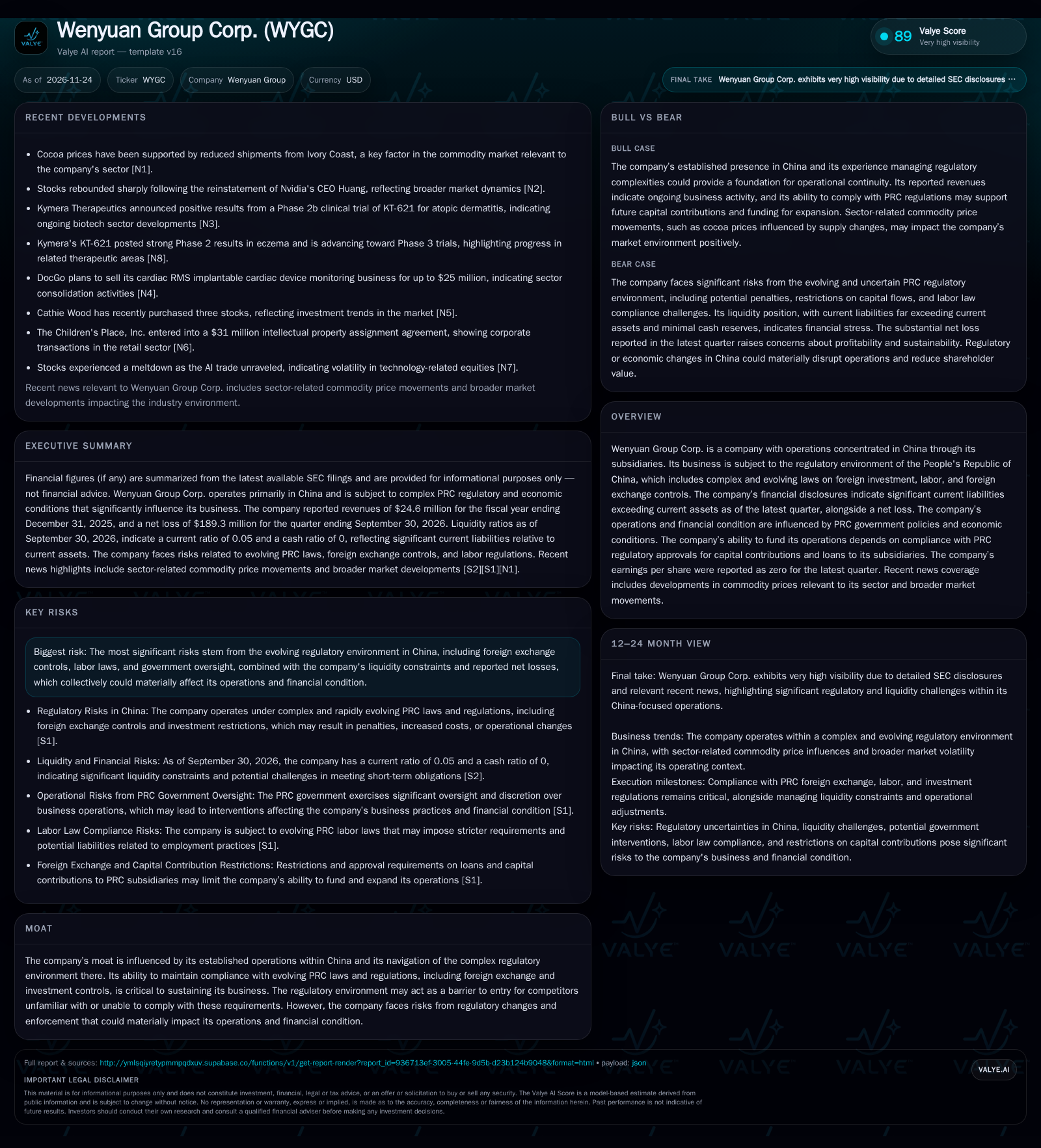
Wenyuan Group Corp. stands at a critical inflection point: despite ongoing operations in China and reported 2025 revenues of $24.6 million, its latest filings reveal a business under immense financial and regulatory strain. The company’s fate is now tightly bound to its ability to navigate PRC regulatory hurdles—especially those governing capital flows and operational compliance—while seeking new funding or restructuring options. For investors and stakeholders, Wenyuan exemplifies the acute risks facing foreign-listed firms operating in China’s volatile and tightly controlled business environment.
Liquidity Crisis and Regulatory Crossroads Define Wenyuan’s Present Reality
The most material current facts for Wenyuan Group Corp. are its near-total exhaustion of liquid resources, an overwhelming imbalance between current assets and liabilities, and a deeply negative bottom line. As of September 30, 2026, the company reported just $200,000 in cash and cash equivalents, with current assets totaling $19.999 million against $365.568 million in current liabilities—implying a current ratio of 0.05 and a cash ratio of 0 [S2]. This signals that Wenyuan has virtually no ability to meet short-term obligations without immediate new funding or creditor forbearance. For the same quarter, the company posted a net loss of $189.3 million, and reported zero earnings per share [S2].
These acute financial stresses are compounded by Wenyuan’s exposure to complex and evolving PRC regulations, including foreign exchange controls and labor law compliance requirements [S1]. The company’s ability to fund and expand operations is directly dependent on regulatory approvals for capital contributions and loans to PRC subsidiaries—a process subject to government discretion and potential delay. The criticality of these facts is that Wenyuan’s operational continuity now depends less on incremental business performance and more on external regulatory and financial interventions.
Economic Model Under Strain: Revenue Generation, Cost Structure, and Capital Needs
Wenyuan Group’s core business economics are presently defined by negative operating leverage and acute capital constraints. The company reported $24.6 million in revenues for the fiscal year ending December 31, 2025 [S2], but the sheer magnitude of its quarterly net losses implies that fixed costs, interest expense, or one-time charges far exceed gross profit. Without detail on product mix, pricing, or variable cost structure, the implication is that either margins are compressed by competitive or regulatory pressures, or that high overheads—possibly related to PRC compliance, legal, or restructuring costs—are overwhelming the income statement.
The company’s capital needs are immediate and existential. The company reported cash and liquidity metrics for the period; these figures do not by themselves establish operating runway, investment capacity, financial flexibility, or financing capacity. This makes the economics of continued operations contingent on access to new capital—either from external investors, parent entities, or creditor concessions. If PRC regulations restrict or delay capital injections (as suggested by the need for government approvals), the company’s financial model becomes unsustainable in the short term.
In normal circumstances, Chinese regulatory complexity can act as a barrier to entry, potentially supporting margins for established operators. However, in Wenyuan’s case, the cost of compliance and uncertainty over capital flows appear to have tipped the economics decisively toward distress.
Regulatory Navigation as a Double-Edged Sword in China’s Business Arena
Wenyuan’s competitive position is less a function of market share or product differentiation, and more about its ability to operate within China’s regulatory framework. The company’s established presence and history of navigating PRC compliance could, in theory, serve as a barrier to entry against less experienced foreign or domestic rivals. However, this advantage is currently offset by the risk that regulatory changes or enforcement actions could disproportionately harm incumbents with legacy structures or unresolved compliance issues.
Competitors in the same sector—especially those with stronger balance sheets or more direct political connections—may be better positioned to weather regulatory shocks or capitalize on market volatility. Substitutes could emerge if market participants with more flexible capital structures are able to gain regulatory clearance more quickly, or if state-linked enterprises are favored in government policy shifts.
In this environment, Wenyuan’s competitive edge depends not on traditional economic moats like technology or customer loyalty, but on its agility in adapting to new rules, securing timely capital approvals, and possibly restructuring its operations to align with shifting government priorities.
Rescue Pathways: Regulatory Relief and Capital Infusion as Catalysts for Recovery
The most plausible favorable scenario for Wenyuan involves a rapid regulatory approval for new capital contributions or loans, coupled with either an external investment, asset sale, or government-mediated restructuring. If Wenyuan is able to secure the necessary permissions from PRC authorities to inject fresh capital into its subsidiaries, it could address immediate liquidity needs, stabilize operations, and potentially restructure its liabilities.
Confirmation of this scenario would come from disclosure of a material capital raise, successful debt renegotiation, or explicit regulatory clearance for expanded funding. Improvement in the current ratio and restoration of positive cash balances would also serve as leading indicators. Additionally, evidence of cost-cutting measures, divestitures, or operational pivots could signal management’s ability to adapt and restore at least a neutral cash flow trajectory.
Falsification would occur if regulatory approvals are denied or delayed, if no new capital is raised, or if current liabilities continue to rise without offsetting asset growth—making insolvency or forced liquidation the likely outcome.
Treading Water: Extended Distress, Incremental Compliance, and Uncertain Survival
The most plausible near-term scenario is one of ongoing financial distress, with Wenyuan remaining operational but under severe constraint. In this middle path, the company may secure minor regulatory permissions or short-term credit extensions that allow for partial payment of obligations, but without a transformative capital event.
Evidence for this outcome would include continued reporting of negative earnings, persistent low liquidity ratios, and a lack of material improvement in the balance sheet quarter-over-quarter. Incremental regulatory compliance—such as small-scale approvals or minor fines—could keep the company afloat while failing to address the underlying structural imbalance. Disclosures of negotiations with creditors, government agencies, or potential investors would reinforce the picture of a company seeking but not yet securing a decisive turnaround.
If, conversely, Wenyuan posts a sharp improvement in liquidity or announces a major capital transaction, the scenario would shift toward the upside. A rapid acceleration in liabilities, new regulatory penalties, or loss of key licenses would move the outcome toward downside.
Accelerated Deterioration: Regulatory Intervention or Insolvency as Imminent Risks
The most adverse scenario is one in which Wenyuan fails to obtain timely regulatory approvals for capital infusions, creditors demand immediate repayment, or PRC authorities impose penalties or operational restrictions. In this case, the company would be unable to meet its obligations, leading to insolvency proceedings, forced asset sales, or government-mandated restructuring.
This scenario would be confirmed by new disclosures of default, creditor litigation, regulatory sanctions, or a formal announcement of bankruptcy or liquidation. If the company’s filings reveal loss of major licenses or operational permits, or if PRC policy shifts make the business model untenable, the downside would be realized.
A partial offset could occur if government agencies intervene to preserve employment or social stability, but such interventions are unpredictable and may not prioritize shareholder value.
Operational Lifelines and Regulatory Milestones That Will Determine Wenyuan’s Fate
Disclosure of any new capital raises, debt restructuring agreements, or major asset sales would directly impact the company’s ability to remain solvent.
Regulatory filings or announcements regarding PRC approvals for loans, capital contributions, or changes in ownership structure will signal management’s ability to navigate compliance bottlenecks.
If disclosed, updates on negotiations with major creditors or suppliers could test the company’s ability to extend its operational runway.
Any material regulatory penalties, fines, or forced operational changes imposed by PRC authorities would serve as red flags for downside acceleration.
A useful metric would be the company’s gross margin and SG&A expense trends, if disclosed, to assess operating leverage and cost control.
Sector-wide policy changes or macroeconomic interventions by the PRC government could alter the competitive landscape, either easing or tightening conditions for foreign-listed entities like Wenyuan.
Disclaimer: This is research-only, informational analysis and not investment advice. It may include AI-generated interpretation and general industry context. Always verify important details using primary sources.

Comments