
Interactive Strength’s Liquidity Strain Collides with Ambitious Connected Fitness Platform Expansion
Interactive Strength, Inc.
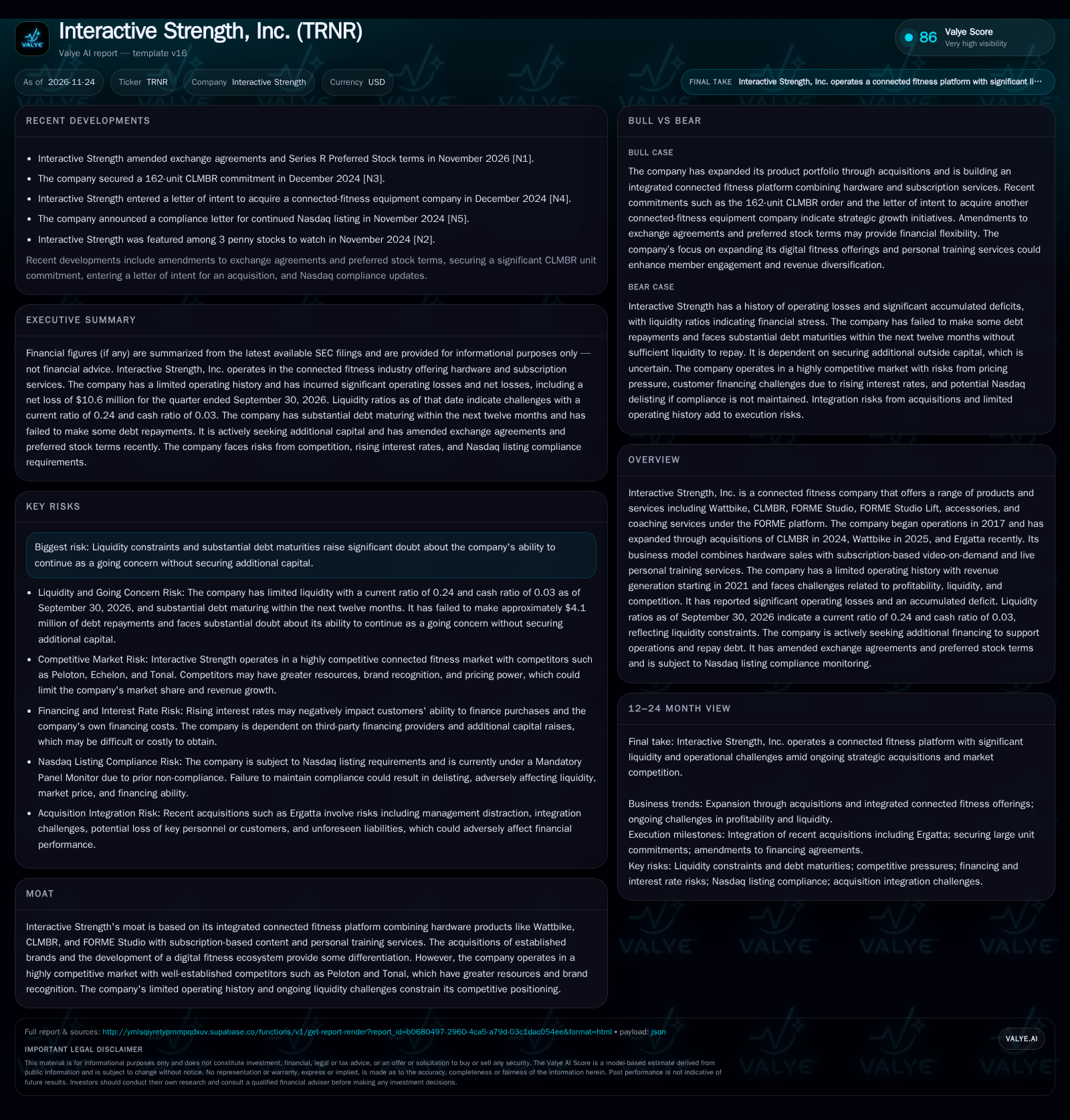
Interactive Strength, Inc. is expanding its connected fitness platform via acquisitions (including Wattbike, CLMBR, and Ergatta), combining hardware sales with digital memberships and coaching. However, as of September 30, 2026, the company reported a current ratio of 0.24, a cash ratio of 0.03, and ongoing operating losses, raising substantial doubt about its ability to continue as a going concern. Debt defaults, looming maturities, and reliance on new financing compound competitive and execution risk in a sector dominated by better-capitalized peers. These factors put the company’s multi-product strategy and Nasdaq listing at risk if capital is not secured soon. [S2] [N1]
Interactive Strength, Inc. has positioned itself as a next-generation connected fitness platform, rapidly expanding its portfolio through strategic acquisitions of brands like CLMBR, Wattbike, and Ergatta. Its ambition is to combine differentiated hardware, video-on-demand content, and live coaching into a unified member experience. The outcome now hinges on whether Interactive Strength can secure new capital quickly enough to sustain operations and integrate its disparate assets—while fending off deeply entrenched competitors and the threat of Nasdaq delisting.
Liquidity Crisis and Debt Defaults Define the Immediate Outlook
As of September 30, 2026, Interactive Strength reported $1.609 million in cash and equivalents, with current assets of $11.839 million against current liabilities of $48.334 million—yielding a current ratio of just 0.24 and a cash ratio of 0.03. The company has failed to make approximately $4.1 million in debt repayments as they became due and faces substantial debt maturities within the next twelve months. Management has explicitly disclosed substantial doubt about the company’s ability to continue as a going concern unless additional capital is secured. These facts place the company in a position where operational continuity is at risk, and strategic flexibility is severely limited. [S2]
Economics of a Multi-Modal Fitness Platform: Hardware, Subscriptions, and Unproven Leverage
Interactive Strength’s business model combines the sale of connected fitness hardware (e.g., Wattbike, CLMBR, FORME Studio) with recurring revenue from video-on-demand content and live personal training memberships. Theoretically, this should enable a blend of upfront hardware margin and ongoing subscription gross profit, with increased member engagement driving higher lifetime value.
However, the current reality is less robust. Reported revenue was $8.011 million for the quarter ended September 30, 2026, but the company posted a net loss of $10.639 million, suggesting negative operating leverage and high fixed costs relative to scale. The company’s history of operating losses and an accumulated deficit of $227.5 million as of December 31, 2025, signal that neither hardware sales nor subscriptions have reached critical mass or sustainable unit economics. Many memberships are on month-to-month terms, with limited historical data on renewal rates, making revenue predictability and customer lifetime value uncertain. The heavy capital requirements of hardware inventory, R&D, and ongoing content production amplify the need for external funding, particularly as integration costs from recent acquisitions linger. [S2]
Competitive Landscape Intensifies as Scale and Brand Dominate
The connected fitness market is intensely competitive, with established players like Peloton, Echelon, and Tonal offering similar hardware and digital content ecosystems. These competitors typically enjoy stronger brand recognition, deeper financial resources, and larger installed user bases, enabling them to weather market volatility, fund R&D, and offer aggressive promotions or financing.
Interactive Strength’s attempt to differentiate through a portfolio of brands and a broad hardware lineup could offer some cross-selling and ecosystem advantages. However, the company’s limited operating track record, unproven retention, and constrained marketing spend make it difficult to establish brand loyalty or pricing power. Customer switching costs in this sector are modest, as hardware is a one-time purchase and content subscriptions are easily canceled—especially with many customers on month-to-month terms. In this environment, scale, data-driven personalization, and deep content libraries are critical, and these are areas where rivals may maintain a structural advantage. [S2]
If Capital Arrives: Integration, Recurring Revenue, and Ecosystem Synergies
A favorable outcome for Interactive Strength would require the company to secure sufficient outside capital to resolve its immediate liquidity crisis, refinance or repay upcoming debt, and continue integrating its recent acquisitions. If management is able to stabilize operations, the combined portfolio of Wattbike, CLMBR, FORME Studio, and Ergatta could deliver operational synergies and cross-marketing opportunities, potentially increasing customer lifetime value and reducing churn.
A successful integration could also enable the company to leverage its digital platform to upsell coaching and premium content, moving a greater share of customers to recurring revenue models. Confirmation of this scenario would include evidence of new financing transactions or equity infusions, improved renewal rates and customer retention data, and a narrowing of operating losses as fixed costs are spread over a larger revenue base. A large-scale commercial contract or additional enterprise commitments beyond the 162-unit CLMBR order would further validate the scaling potential. [N3] [S2]
Survival Hinges on Bridge Financing and Execution under Pressure
The most plausible near-term path is that Interactive Strength secures some form of short-term bridge financing—likely at a high cost or with significant dilution—to avoid a near-term liquidity event. This would buy time to continue integrating acquired brands and seek operational efficiencies, but would not immediately resolve underlying scale and profitability challenges.
In this scenario, operating losses are likely to persist, and the company remains highly sensitive to execution risk, adverse market shifts, and any further delays in capital raising. Evidence confirming this scenario would include the announcement of new (but potentially expensive) financing rounds, continued Nasdaq compliance but with ongoing warnings, and further amendments to debt or preferred equity terms. Progress on integration and customer engagement would be incremental, with KPIs such as churn, average revenue per user (ARPU), and gross margin remaining volatile or undisclosed. [N1] [N5] [S2]
Failure to Bridge the Gap: Insolvency, Forced Asset Sales, or Delisting
If Interactive Strength is unable to raise new capital soon, the most likely outcome is a liquidity event—ranging from formal insolvency proceedings to forced asset sales or a distressed merger. Missed debt repayments and imminent maturities could trigger creditor actions, while Nasdaq delisting would further restrict access to capital and erode stakeholder confidence.
In this scenario, the company’s ability to operate as a going concern collapses, and the value of its recently acquired assets is realized only through liquidation or fire-sale transactions, likely at a significant discount. Confirmation would come from bankruptcy filings, creditor notices, or public announcements of asset sales, as well as a formal notice of Nasdaq delisting. [S2] [N5]
Milestones That Will Determine Whether Interactive Strength Can Stabilize and Scale
Securing and publicly announcing new capital raises, bridge loans, or equity infusions—preferably with terms that do not excessively dilute existing shareholders or encumber assets further.
Disclosure of improved customer retention and renewal rates for subscription memberships, as these would indicate whether the platform can build a recurring revenue base to offset hardware cyclicality—if disclosed.
Evidence of successful integration and cross-selling between acquired brands (CLMBR, Wattbike, Ergatta, FORME Studio), such as bundled offerings or unified digital experiences.
Progress on debt restructuring, refinancing, or repayment, especially related to the $4.1 million in missed payments and upcoming maturities.
Nasdaq compliance updates, including any further warnings, panel decisions, or potential delisting notices.
Gross margin and operating expense trends, as improvement here would signal progress toward sustainable unit economics—if disclosed.
Additional large-scale commercial contracts, enterprise sales, or institutional commitments beyond the previously announced 162-unit CLMBR order.
Management turnover, acquisition integration milestones, or changes in strategic direction, particularly in response to ongoing financial stress.
Disclaimer: This is research-only, informational analysis and not investment advice. It may include AI-generated interpretation and general industry context. Always verify important details using primary sources.

Comments