
Aptorum Group: Strategic Merger, Dual-Horizon Model, and the Reality of Early-Stage Healthcare Economics
Following its merger with DiamiR and a leadership refresh, Aptorum Group is repositioning around specialized biomarker diagnostics and proprietary neurodegeneration platforms. Yet, near-zero revenue, persistent net losses, and a material weakness in internal controls underscore the steep operational and financing challenges that must be addressed for the company’s new strategy to gain commercial traction.
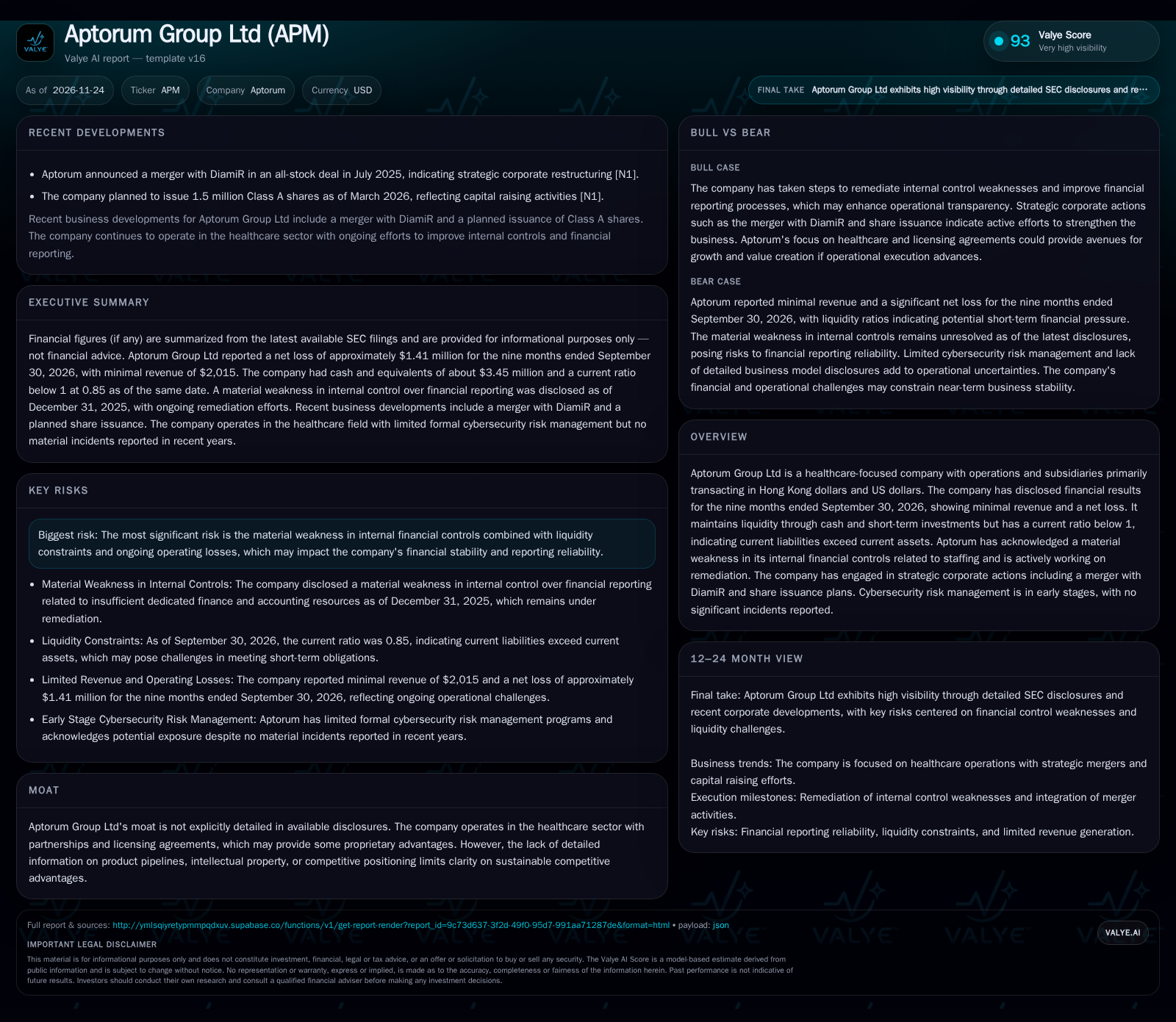
Aptorum Group, now merged with DiamiR, is pivoting toward precision brain health diagnostics and specialized assay services. Despite this strategic shift and new executive appointments, the company’s recent financials reflect minimal revenue and continued losses, with a current ratio below 1 and ongoing remediation of material internal control weaknesses. The dual-horizon commercialization model may offer long-term promise, but sustaining operations will likely require successful capital raising and demonstrable progress in clinical validation and commercial adoption of proprietary diagnostics. [S2]
Aptorum Group’s recent merger with DiamiR marks a strategic inflection point, positioning the company at the intersection of near-term laboratory services and the longer-term promise of proprietary brain health diagnostics. [S2]
Merger Integration and Financial Realities Define Aptorum’s Present
The company reported cash and liquidity metrics for the period; these figures do not by themselves establish operating runway, investment capacity, financial flexibility, or financing capacity. These figures spotlight the company’s limited operating scale and short-term financial pressure. The July 2026 all-stock merger with DiamiR brought changes in executive leadership, including the appointments of a new CEO, President/COO, and a CFO tasked with strengthening financial oversight. The company also disclosed a material weakness in internal controls related to finance and accounting resources, which it is actively remediating. Concurrently, Aptorum filed a $1.4 million ATM equity program and has sold $16,023 under it as of the latest report, reflecting ongoing efforts to raise working capital. [S2]
Unpacking the Economics of Dual-Horizon Healthcare Commercialization
Aptorum is attempting to bridge the gap between immediate cash needs and the long-term value of proprietary diagnostics through a dual-horizon model. In the near term, revenue is targeted from specialized biomarker testing, custom assay development, and clinical trial enrollment screening for biopharma sponsors and research foundations—services that, in theory, offer faster sales cycles and lower regulatory barriers than novel diagnostic products. However, the company’s actual revenue remains negligible, suggesting either slow market adoption, limited commercial reach, or both. The longer-term strategy hinges on clinical validation and commercialization of proprietary microRNA diagnostics (notably CogniMIR®), requiring substantial investment in R&D, regulatory submissions, and clinical trials. These activities are capital-intensive and carry long lead times before revenue realization. Fixed costs related to scientific and regulatory personnel, R&D, and laboratory infrastructure are likely to outpace variable costs at Aptorum’s current scale, leading to negative operating leverage until commercial traction is achieved. The company’s near-term capital needs are being addressed via equity offerings, but persistent losses and reported cash balance suggest a high dependency on external financing until the business model matures. [S2]
The dual-horizon model inherently requires a delicate balance between resource allocation for immediate revenue-generating activities and long-term R&D investments. Aptorum’s near-term laboratory services must achieve sufficient scale to provide a steady cash flow that can subsidize the extended timelines and high capital intensity of diagnostic development. However, if the near-term services remain underpenetrated or fail to build a scalable client base, the company’s burn rate could accelerate without offsetting income. Conversely, overcommitting to early-stage proprietary diagnostic projects without validated clinical endpoints or regulatory clarity risks capital misallocation. A disciplined stage-gate approach to investment, tied to clear scientific and commercial milestones, would help mitigate these risks and optimize capital efficiency within the dual-horizon framework.
How Aptorum’s Platform Might (or Might Not) Stand Out in Diagnostics
The diagnostic and life sciences service sector is highly fragmented, with competition ranging from large, established reference labs to nimble specialty diagnostics startups. Aptorum’s focus on microRNA-based diagnostics for neurodegeneration (e.g., CogniMIR®) targets a technically complex and clinically significant unmet need, potentially creating differentiation if the platform proves sensitive, specific, and clinically actionable. However, barriers to entry for new diagnostics are high; clinical validation, regulatory approval, and payer acceptance are all required before significant adoption. Larger incumbents may also have scale advantages in commercial reach, regulatory affairs, and payer negotiations. In laboratory services, price competition is fierce and customer switching costs are low unless proprietary tests or integrated service relationships are established. Aptorum’s ability to leverage academic and biopharma partnerships, coupled with any proprietary intellectual property, could provide some insulation if execution is strong. However, without proof of clinical utility or a robust commercial pipeline, the company’s current position is more promise than moat.
Aptorum’s ability to differentiate may also hinge on its intellectual property portfolio and the defensibility of its microRNA diagnostic technology. Proprietary biomarkers that demonstrate reproducibility and clinical relevance can create barriers to entry, but only if supported by robust patent protection and freedom to operate within a crowded molecular diagnostics landscape. Additionally, the company’s partnerships with academic institutions or biopharma sponsors could provide access to unique datasets and validation cohorts, accelerating clinical adoption. However, if competitors develop alternative biomarkers or multiplex panels with superior diagnostic accuracy or cost-effectiveness, Aptorum’s platform could face significant substitution risk. Therefore, continuous innovation and validation are critical to maintaining a competitive edge in this rapidly evolving sector.
What It Would Take for Aptorum’s Scientific Assets to Deliver Step-Change Value
Aptorum’s upside depends on successfully validating and commercializing its proprietary diagnostics, especially CogniMIR®, and scaling laboratory service revenue. If clinical studies establish CogniMIR® as a sensitive and specific early-detection tool for neurodegeneration, and regulatory clearance is secured, the company could see accelerated adoption among research institutions and biopharma partners. Near-term increases in laboratory service contracts or custom assay development for high-value clients would also provide tangible evidence of commercial traction. Confirmation of the upside scenario would include: (1) clinical trial results demonstrating strong diagnostic performance, (2) regulatory submissions and clearances, (3) signed commercial agreements with research or biopharma organizations, and (4) sequential revenue growth exceeding operating expense increases. A successful capital raise that extends runway and supports scaling would further support this case.
Navigating the Reality of Early-Stage Healthcare: Incremental Progress, Persistent Risks
The most plausible outcome is that Aptorum will make incremental progress—advancing clinical validation of its diagnostics and expanding laboratory services—while continuing to face operational and financial headwinds. Modest revenue growth from biomarker testing and contract services may occur, but is unlikely to offset operating losses in the near term. Remediation of internal controls and further capital raises may stabilize the business, but the path to significant commercial adoption of proprietary diagnostics is likely to be slow, given regulatory and clinical hurdles. Evidence confirming this scenario would include continued reporting of operating losses, limited but growing laboratory revenue, updates on internal control remediation, and cautious capital deployment. Falsification would come from either a sudden acceleration in commercial contracts or, conversely, a failure to progress in clinical or regulatory milestones coupled with worsening liquidity.
Liquidity Stress and Execution Failures: How the Thesis Could Break
In the adverse scenario, Aptorum’s capital-raising efforts fail to generate sufficient runway, and minimal revenue persists as clinical and commercial milestones are delayed. Unresolved material weaknesses in internal controls could result in unreliable financial reporting, further eroding investor confidence. If laboratory services do not scale and proprietary diagnostics face setbacks in validation or regulatory review, operating losses could accelerate, pushing the company toward restructuring or strategic alternatives. Confirmation of this scenario would include: (1) inability to execute planned equity offerings, (2) further deterioration in the current ratio or working capital position, (3) negative updates on internal controls, and (4) lack of meaningful progress in clinical or commercial milestones.
Milestones and Metrics That Will Define Aptorum’s Strategic Viability
Quarterly laboratory and assay service revenue growth, if disclosed, to assess adoption rates of commercial offerings.
Progress updates on CogniMIR® clinical validation, regulatory submissions, and any published peer-reviewed data.
Resolution status and auditor commentary on remediation of the material weakness in internal controls.
ATM equity offering activity and net proceeds raised, as well as additional capital-raising plans or outcomes.
Signed commercial agreements or partnerships with research institutions or biopharma companies, as announced.
Updates on executive leadership stability and any further changes in the finance or operations team.
Any adverse regulatory, clinical, or cybersecurity incidents that could disrupt operations or erode trust.
Disclaimer: This is research-only, informational analysis and not investment advice. It may include AI-generated interpretation and general industry context. Always verify important details using primary sources.

Comments