
Atlantic International Corp.: AI Ambitions Collide with Debt Defaults and Liquidity Strain
Despite strategic acquisitions and a push into AI-enabled workforce solutions, Atlantic International Corp. faces acute financial distress, with debt defaults and a going concern qualification raising existential questions about its ability to capitalize on operational progress.
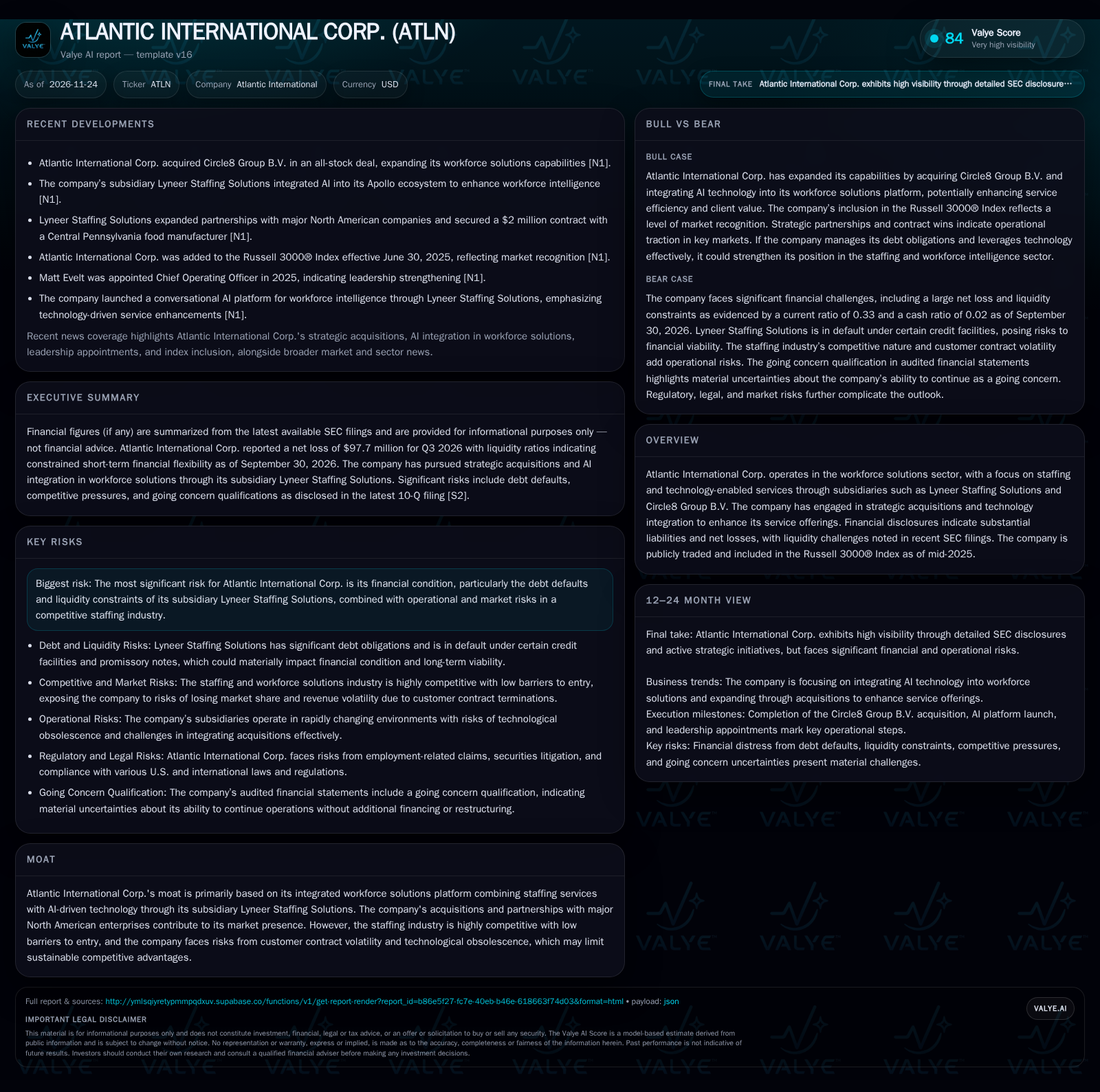
Atlantic International Corp. has made notable strategic moves, including acquiring Circle8 Group B.V. and integrating AI into its staffing subsidiary Lyneer. The challenge is whether technological advances and expanded partnerships can offset severe financial and market risks before restructuring or external intervention becomes necessary. [S2]
Atlantic International Corp. stands at a precarious intersection of operational innovation and financial fragility. While the company has moved aggressively to integrate AI technology into its workforce solutions and expanded its reach through acquisitions like Circle8 Group B.V., its balance sheet tells a starkly different story. With its primary staffing subsidiary, Lyneer, in default under credit facilities and the parent company carrying a going concern warning, Atlantic’s ability to translate strategic vision into sustainable value is in question. The company’s future now hinges not only on market traction and technology adoption but also on urgent financial stabilization and restructuring efforts. [S2]
Liquidity Pressures and Debt Defaults Define the Immediate Outlook
As of September 30, 2026, Atlantic International Corp. reported cash and cash equivalents of $20,464,755 against current liabilities of $948,118,869, resulting in a current ratio of 0.33 and a cash ratio of 0.02. These figures reflect severe liquidity constraints, placing the company at heightened risk of operational disruption. The situation is compounded by net losses of $97,744,346 for the quarter and a going concern qualification in its audited financial statements, signaling material uncertainty regarding its ability to continue operations without urgent intervention. Most critically, its key subsidiary, Lyneer Staffing Solutions, is in default under certain credit facilities and promissory notes, underscoring the acute stress on the company’s financial structure. [S2]
Staffing Economics: High Volume, Low Margins, and the Role of Technology
Atlantic International operates in the workforce solutions sector—an industry characterized by high transaction volumes, low gross margins, and intense working capital demands. Staffing firms typically earn revenue through placement fees or markups on temporary labor, but face high payroll obligations and short payment cycles. This creates a structural need for reported liquidity position and disciplined receivables management, particularly when scaling through acquisitions.
The company’s push to integrate AI into Lyneer’s Apollo ecosystem is aimed at driving operational efficiency, automating candidate matching, and providing workforce intelligence. If successful, these innovations could reduce costs and improve gross margins by cutting manual processes and differentiating service offerings. However, without clear evidence of recurring, high-margin technology revenue, the business remains exposed to industry-standard pricing pressures and contract churn. The all-stock acquisition of Circle8 Group B.V. suggests a strategy of inorganic growth, but such moves can introduce integration risks and further strain limited capital resources if synergies or cross-selling do not materialize rapidly.
Given the company’s current liquidity position, any positive impact from technology adoption or scale economies may be delayed or muted unless accompanied by a fundamental improvement in cash flow and debt servicing capacity.
Can AI Integration Offset Structural Weakness in a Hyper-Competitive Market?
The staffing and workforce solutions market is intensely competitive, with low barriers to entry and little product differentiation beyond service quality, pricing, and, increasingly, technology. Atlantic’s strategy to combine traditional staffing with AI-driven platforms through Lyneer aims to create a defensible niche, potentially offering faster placements, better talent analytics, and predictive workforce management.
However, this technological edge is not guaranteed to confer long-term pricing power or customer stickiness unless it produces meaningful, quantifiable outcomes for clients—such as lower turnover or improved workforce productivity. Larger staffing firms and technology-first entrants are simultaneously racing to deploy similar solutions, while established relationships and switching costs in the sector remain relatively low. The company’s ability to secure multi-year, recurring contracts or embed its platform deeply within client workflows would be necessary to build a moat, but current evidence points to ongoing contract volatility and customer churn risk.
Furthermore, the integration of Circle8 Group B.V. introduces international complexity and exposure to new regulatory and competitive dynamics, which could amplify operational risks if not managed proactively.
Pathway to Resilience: If Technology Adoption and Turnaround Outpace Financial Decay
A favorable outcome would require Atlantic International to rapidly stabilize its liquidity profile—potentially through asset sales, refinancing, or external capital infusion—buying time to realize the benefits of its technology investments. If Lyneer’s AI-driven Apollo ecosystem demonstrably improves placement speed, reduces cost per hire, and secures larger or more stable contracts, the company could achieve incremental margin expansion and higher client retention.
Successful integration of Circle8 Group B.V. could also unlock cross-selling opportunities in new geographies and customer segments, leveraging the combined client base and workforce intelligence tools. In this scenario, evidence would include a reversal of net losses, improved operating cash flow, new multi-year or recurring revenue contracts, and a reduction in credit defaults or debt service pressures.
This pathway is contingent on not only operational execution but also the company’s ability to restore market and lender confidence, as indicated by debt restructuring progress or new financing announcements.
Operational Progress Stalled by Persistent Financial Headwinds
The most plausible trajectory for Atlantic International in the near term is one where operational gains from technology integration and new partnerships are largely offset by persistent liquidity strain and debt overhang.
Absent an immediate and substantial improvement in working capital or external funding, the company is likely to remain in a state of heightened vulnerability, with ongoing risks of further contract loss, service disruptions, or forced asset sales. Evidence supporting this scenario would include continued going concern language in filings, lack of material debt restructuring or capital raises, and a stagnant or declining revenue base despite operational initiatives.
Debt Spiral and Customer Attrition Trigger Restructuring or Insolvency
In a negative scenario, liquidity constraints and debt defaults worsen, leading to an acceleration of lender demands, further credit downgrades, or court-driven restructuring. As working capital dries up, the company could face payroll interruptions, loss of key contracts, and impaired ability to deliver on client commitments. In the competitive staffing market, such operational instability often results in rapid customer attrition and reputational damage, which can be difficult to reverse even if financing is secured later.
If the integration of acquired entities falters or if AI initiatives fail to deliver tangible cost savings and retention improvements, the company could be forced to pursue asset sales at distressed valuations or file for bankruptcy protection. Confirming evidence would be additional covenant breaches, missed payrolls, abrupt leadership changes, or regulatory filings indicating restructuring or liquidation plans.
Testing Atlantic International’s Survival and Strategic Execution
Resolution of Lyneer’s credit facility defaults, through restructuring, refinancing, or forbearance agreements, would be a critical early indicator of stabilization.
Operating cash flow trends in upcoming quarters—if disclosed—would help assess whether the business is moving toward self-sufficiency or deeper distress.
New capital raises, equity infusions, or asset sales would signal management’s ability to shore up liquidity and address the going concern risk.
Disclosure of multi-year, recurring, or renewal contracts—especially with major clients—would demonstrate improved revenue visibility and customer retention.
Evidence of margin expansion, lower cost per hire, or quantifiable client outcomes from AI platform adoption would help test the thesis that technology can offset industry headwinds.
Integration milestones and realized synergies from the Circle8 Group B.V. acquisition—if reported—would clarify whether the company is capturing intended scale and cross-selling benefits.
Any change in the going concern qualification or auditor commentary in future filings would directly reflect progress (or setbacks) in financial health.
Updates on legal proceedings or regulatory actions, particularly related to debt, employment claims, or securities litigation, could materially affect both operations and investor confidence.
Disclaimer: This is research-only, informational analysis and not investment advice. It may include AI-generated interpretation and general industry context. Always verify important details using primary sources.

Comments