
Exicure’s Strategic Pivot: Can Acquisitions and Partnerships Replace Lost Biotech Momentum?
After divesting its core R&D assets, Exicure seeks to reinvent itself through acquisitions, clinical-stage partnerships, and expansion into neurotechnology.
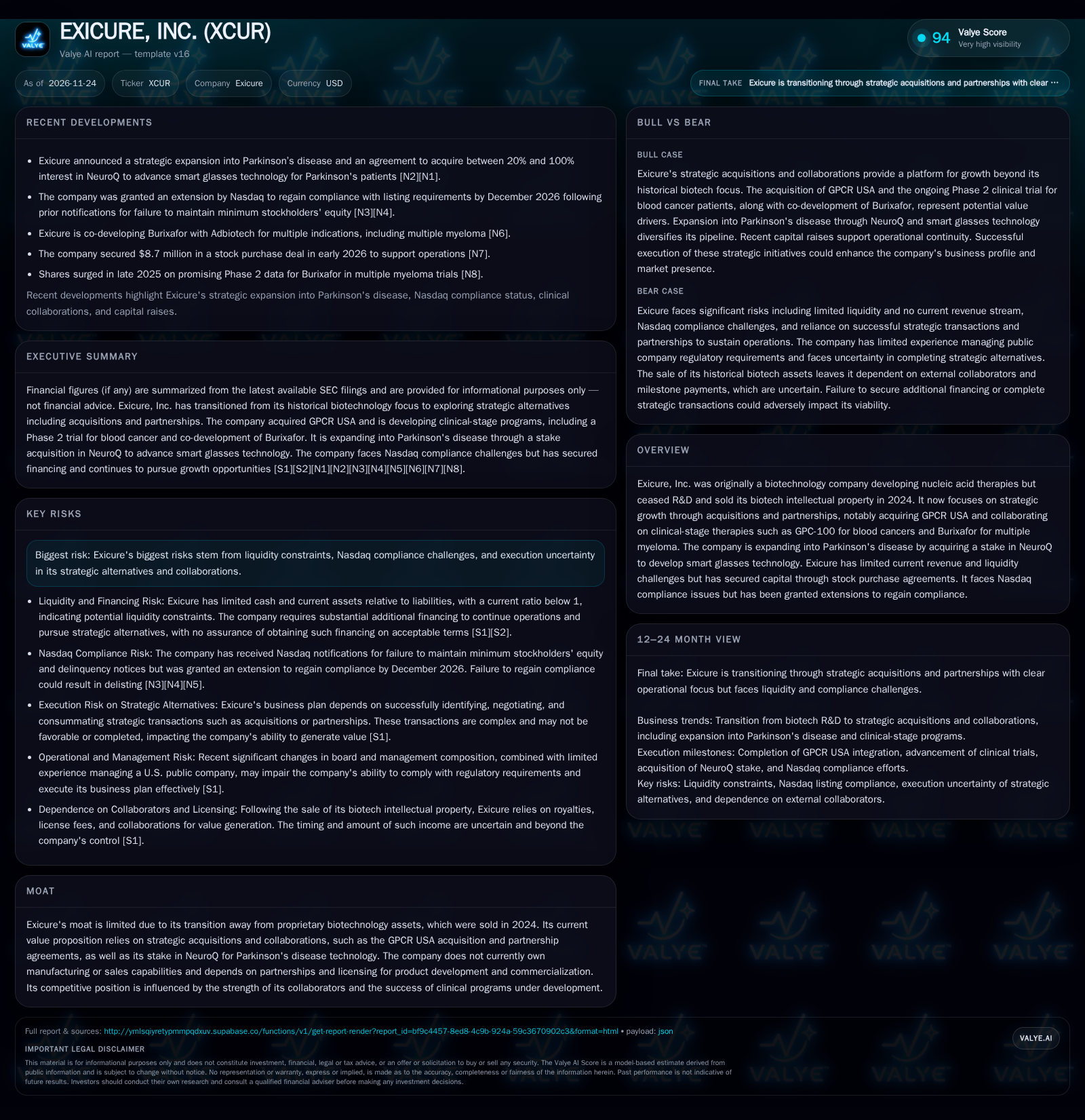
Exicure has moved from biotech R&D to a deal-driven model, acquiring clinical-stage assets and targeting Parkinson’s disease technology amid severe liquidity and compliance pressures. The company’s outlook now depends on delivering results from clinical programs and successfully closing strategic acquisitions, but execution and financing risks remain acute. [S1] [S2] [N1] [N2] [N3] [N4] [N6] [N7] [N8]
Exicure, Inc. stands at a crossroads after abandoning its original nucleic acid therapy platform and selling its biotech IP. The company is now pursuing a high-variance strategy built on acquiring clinical-stage assets, forging development partnerships, and venturing into neurotechnology for Parkinson’s disease. The next 12–24 months will be defined by whether these bets can deliver real value before resources run out.
Strategic Acquisitions, Clinical Bets, and Financial Pressures Shape the Current Landscape
Exicure’s most material recent developments include the 2025 acquisition of GPCR Therapeutics USA and the initiation of collaborations to advance GPC-100 for blood cancers and Burixafor for multiple myeloma. Notably, promising Phase 2 data for Burixafor drove investor interest in late 2025, even as the company reported no revenue and modest net income for Q3 2026. [S2] [N8] Simultaneously, Exicure is expanding into neurotechnology, announcing plans to acquire between 20% and 100% of NeuroQ, which is developing smart glasses for Parkinson’s disease. The company reported a current ratio of 0.58 for the period. [N1] [N2] [S2] [N3] [N4] [N5] The company’s future now hinges on extracting value from new clinical assets and executing strategic transactions before liquidity constraints become existential.
Deal-Driven Economics: From Asset Sales to Clinical Milestones and Royalties
Exicure’s business model has shifted from R&D-driven value creation to a portfolio approach reliant on licensing, milestone payments, and potential royalties from out-licensed or co-developed clinical assets. Having sold its core IP, the company’s economic upside now depends on the success of externally advanced programs (like GPC-100 and Burixafor) and the ability to close and integrate new technology acquisitions, such as NeuroQ.
This model is inherently high-variance: revenue is unpredictable, largely contingent on clinical milestones, regulatory approvals, and the success of commercial partners. Upfront payments or equity stakes from collaborations could provide near-term inflows, but most economics will be back-end weighted. Exicure’s fixed costs are likely reduced post-R&D exit, but the need to fund deal diligence, integration, and potential clinical development (if it assumes active roles) could create episodic capital requirements.
The company reported cash and liquidity metrics for the period; these figures do not by themselves establish operating runway, investment capacity, financial flexibility, or financing capacity. The company’s ability to capture upside depends on structuring transactions that both preserve optionality and generate tangible economics before funding runs out. [S2] [N7]
Rebuilding Relevance: Exicure’s Place in a Crowded Clinical and Neurotechnology Landscape
Exicure’s competitive position is fundamentally transitional. Having exited its proprietary platform, it now competes as a clinical-stage aggregator and dealmaker, rather than a differentiated science-based innovator. In oncology, it must contend with a crowded field of clinical-stage biotechs, many with deeper pipelines, established teams, and stronger financing. Its co-development of Burixafor with Adbiotech and GPC-100 with GPCR Therapeutics provides access to mid-stage assets, but Exicure’s lack of internal R&D or commercial infrastructure means it is heavily dependent on partners’ execution and capital.
The planned expansion into neurotechnology via NeuroQ introduces a new set of competitors: established medtech firms, digital health startups, and traditional device companies all targeting Parkinson’s disease and related neurological disorders. Success here will depend on the uniqueness and clinical efficacy of NeuroQ’s smart glasses, as well as Exicure’s ability to drive adoption and reimbursement—neither of which is assured without significant investment and clinical validation.
Exicure’s moat is weak: it lacks proprietary technology, recurring revenue, or entrenched customer relationships. Future defensibility rests on its ability to secure exclusive rights to promising assets and structure deals that give it meaningful participation in future upside.
If Clinical and Neurotech Bets Deliver: A Path to Strategic Value Creation
The bull case for Exicure is that at least one of its new clinical-stage programs—such as Burixafor or GPC-100—achieves a major positive inflection, either through strong Phase 3 data, a lucrative licensing deal, or outright acquisition by a larger pharmaceutical partner. This could generate milestone payments, royalties, or an exit event that dramatically improves Exicure’s financial profile.
Separately, the NeuroQ smart glasses initiative could gain traction if early clinical results show meaningful improvement for Parkinson’s patients, leading to regulatory clearance and commercial partnerships. Success in this segment may open doors to additional digital health collaborations or product extensions.
Confirmation of this scenario would require: (1) public disclosure of significant milestone payments or licensing deals, (2) positive late-stage clinical results for lead assets, (3) closing of the NeuroQ acquisition at favorable terms, and (4) evidence of non-dilutive funding or new recurring revenue sources. Failure to achieve these would falsify the upside.
Most Likely: Episodic Progress, Ongoing Funding Needs, and Uncertain Value Realization
The most plausible path is that Exicure continues to pursue opportunistic deals and advances existing collaborations, but with slow, uncertain progress toward monetization. Clinical programs may yield incremental data, but substantial revenues—if any—remain several years away. The NeuroQ acquisition could close, but product development and market adoption for smart glasses in Parkinson’s will likely take time and require further capital.
In this scenario, Exicure’s liquidity remains tight, necessitating periodic dilutive financings or asset sales. Nasdaq compliance is maintained, but only through balance sheet management and interim infusions. The company’s valuation remains highly sensitive to clinical milestones and deal announcements, with volatility tied to external catalysts.
Evidence supporting this scenario would be continued deal activity without transformative economics, ongoing cash raises, and limited revenue growth. A material deviation—such as a major clinical failure, delisting, or a breakthrough licensing deal—would falsify this middle path.
Failure to Monetize or Secure Funding Could Force Restructuring or Delisting
The bear case is that Exicure fails to close or monetize its pending acquisitions, clinical programs stall or disappoint, and the company cannot secure further capital on acceptable terms. With a current ratio below 1 and no revenue, even modest cash burn could exhaust resources before strategic alternatives materialize.
If Exicure cannot regain Nasdaq compliance by the end of 2026, it risks delisting, further restricting access to capital and eroding investor confidence. In this scenario, Exicure could be forced to sell remaining assets at distressed prices, pursue a reverse merger, or enter restructuring.
Confirmation of this scenario would be the absence of new financings or milestone payments, missed compliance deadlines, or public disclosure of going concern warnings or asset liquidations. Any successful deal or capital raise would weaken this downside thesis.
Milestones That Will Determine Whether Exicure’s Reinvention Succeeds or Falters
Progress on the NeuroQ acquisition: Announcement of definitive deal terms, closure, and integration steps will help clarify Exicure’s neurotechnology ambitions.
Clinical results for Burixafor and GPC-100: Publication of trial data, advancement to next phases, or new licensing deals would be critical validation points.
Nasdaq compliance status: Updates on meeting minimum equity, filing, and governance requirements by the December 2026 deadline.
Revenue recognition or milestone payments: Any reported inflows from licensing, royalties, or collaborations would test the success of the new business model.
Deal pipeline and strategic alternatives: Public information on new acquisition targets, partnership negotiations, or asset sales would inform future optionality.
Operational execution: Changes in management, board composition, or regulatory filings related to execution risk would provide color on Exicure’s ability to manage complexity.
If disclosed, progress on commercial partnerships or customer adoption for NeuroQ’s smart glasses would help assess the addressable market and competitive traction.
Disclaimer: This is research-only, informational analysis and not investment advice. It may include AI-generated interpretation and general industry context. Always verify important details using primary sources.

Comments