
Sentinel Holdings: Acquisition Ambitions and Technology Integration Collide with Persistent Losses and Liquidity Strain
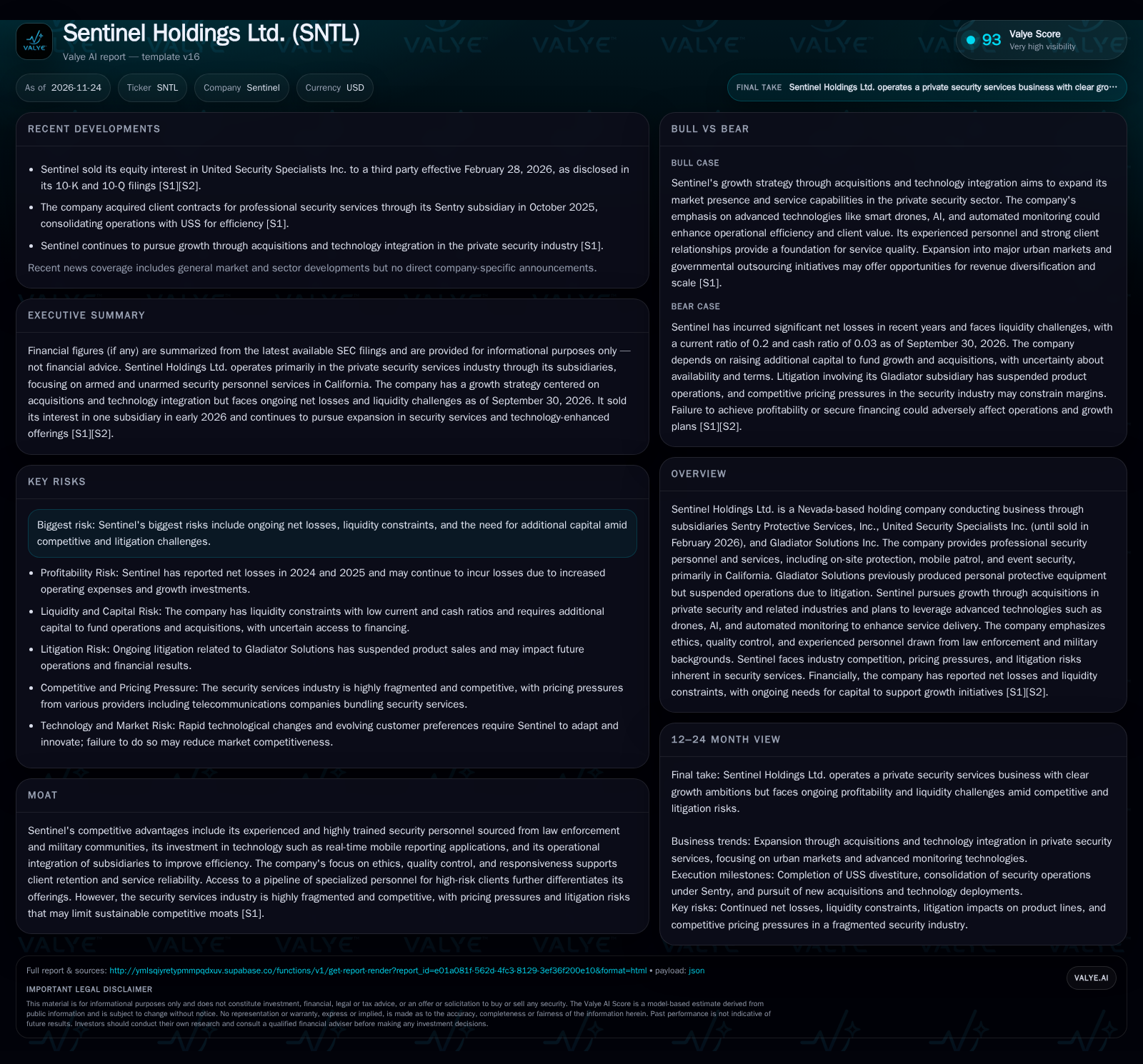
Sentinel Holdings is betting on scale and advanced security technology to carve out a niche in a fragmented market, but ongoing net losses, litigation headwinds, and reported liquidity position raise existential questions about its acquisition-fueled strategy.
Sentinel Holdings Ltd. has repositioned itself as a consolidator in the private security sector, acquiring contracts and integrating technology to boost operational effectiveness. However, recent divestitures, ongoing litigation, and persistent net losses—combined with a reported liquidity position—underscore the urgency of achieving both capital access and margin improvement if the company’s growth thesis is to hold.
Sentinel Holdings Ltd. is at a strategic crossroads: after consolidating its core security guard operations and exiting a non-core subsidiary, the company is doubling down on growth via acquisition and technology integration. Yet, despite ambitions to modernize and scale within the $250 billion security services market, Sentinel’s ongoing net losses, suspended product lines due to litigation, and acute liquidity pressures highlight the fragility of its current position. The company’s ability to secure capital and execute on its tech-driven vision will determine whether it can move beyond survival mode to sustainable growth.
Recent Divestitures and Acquisitions Reshape Sentinel’s Core
The operational landscape for Sentinel Holdings has shifted notably in the past year. The company’s main business is now the provision of armed and unarmed security services through Sentry Protective Services, especially after selling its equity interest in United Security Specialists (USS) in February 2026 [S1] [S2]. This sale followed an October 2025 acquisition of client contracts for Sentry, suggesting a focus on consolidating and scaling core operations. Meanwhile, Gladiator Solutions, previously Sentinel’s vehicle for personal protective equipment, remains inactive due to litigation, removing a potential growth lever [S1]. The company reported cash and liquidity metrics for the period; these figures do not by themselves establish operating runway, investment capacity, financial flexibility, or financing capacity. [S2] These facts together set the stage: Sentinel is consolidating around its core security services, but faces mounting financial and operational pressure.
How Sentinel’s Operating Model Confronts Margin and Capital Realities
Sentinel’s economics are shaped by the labor-intensive nature of traditional security services: the majority of costs are variable and scale with headcount, while pricing power is often constrained by competitive bidding and commoditization. The company’s approach—emphasizing highly trained personnel from military and law enforcement backgrounds—may justify premium pricing for high-risk or specialized contracts, but also raises wage expenses.
Operating leverage is limited in a pure guard services model, as each contract typically requires incremental personnel and direct supervision. Sentinel’s stated intent to integrate advanced technologies (e.g., drones, AI-driven monitoring, mobile reporting apps) could, if successfully implemented, shift the economics by enabling higher-margin remote monitoring or hybrid contracts that reduce the need for on-site staff. However, such a transition requires upfront investment in hardware, software, and training, as well as client willingness to adopt new service models.
The company’s acquisition strategy—recently evidenced by the purchase of client contracts—aims to achieve scale and cross-subsidiary efficiency. Unless the company can secure additional capital on reasonable terms, growth ambitions may be checked by balance sheet realities [S1] [S2].
Fragmented Industry, Price Wars, and the Technology Adoption Race
Sentinel operates in a $250 billion global security services market that is highly fragmented, with national brands, regional players, and emerging technology-driven entrants all competing for share [S1]. The company’s competitive strengths—such as in-field support, quality control, and a pipeline of military-trained personnel—offer differentiation, particularly for high-risk or premium clients. However, the prevalence of price-driven contracts and the entry of new players bundling security with telecom or facilities management services create persistent margin pressure.
The industry is also at an inflection point: traditional guard services are increasingly being supplemented or replaced by technology-enabled solutions (e.g., remote video monitoring, smart drones, AI analytics). Sentinel’s stated focus on technology integration may help defend share and improve margins, but execution risk is high—especially for smaller players with limited capital. Litigation, especially the suspension of Gladiator Solutions’ product line, further limits Sentinel’s diversification options and exposes it to single-segment risk.
Ultimately, Sentinel’s ability to carve out a defensible niche will depend on whether it can deliver superior service quality, adopt technology at pace, and maintain enough scale to negotiate with clients and suppliers.
What Could Unlock a Turnaround: Capital Infusion, Tech Differentiation, and Margin Recovery
A favorable trajectory for Sentinel would require three reinforcing developments. First, the company secures new capital—whether through debt, equity, or strategic partners—enabling it to fund both acquisitions and advanced technology rollouts. Second, Sentinel successfully integrates AI, drones, and automated monitoring into its service portfolio, allowing it to win contracts that demand a blend of physical and technological security. Third, operational efficiencies from consolidated subsidiaries and process automation drive margin improvement, narrowing or reversing net losses.
Evidence that would confirm this scenario includes: timely capital raises at non-punitive terms, visible deployment of technology-enhanced services, new contract wins that cite technology differentiation, and a sequential reduction in operating losses. Conversely, if Sentinel fails to close a meaningful financing round, or if technology pilots stall with no commercial uptake, the upside case would be undermined.
Survival Mode: Managing Losses While Pursuing Selective Growth
The most plausible near-term outcome is a period of constrained, selective growth as Sentinel juggles operational continuity with its capital limitations. The company may continue to pursue small, tuck-in acquisitions and incremental technology pilots, but the scale and speed of transformation will be dictated by its ability to manage cash outflows and refinance or restructure liabilities. Traditional guard services will remain the revenue backbone, with technology integration progressing slowly as resources allow.
Confirmation would come from stable or slightly improving revenues, persistent but narrowing net losses, and the gradual addition of technology-enabled contract features (if disclosed). Falsification would be signaled by accelerating losses, further divestitures of core operations, or a complete halt in acquisition and technology activity due to lack of funds.
Liquidity Crunch and Litigation: The Path to Forced Asset Sales or Restructuring
The risk scenario is defined by a deepening liquidity crisis: Sentinel, unable to secure timely capital, is forced to curtail operations, sell off additional assets, or pursue a distressed restructuring. Litigation related to Gladiator Solutions could result in material settlements or ongoing legal costs, further draining limited resources. Under this scenario, Sentinel may lose key personnel or clients to better-funded competitors, and the company’s ability to invest in technology or acquisitions evaporates.
Evidence supporting this trajectory would be missed payroll or vendor payments, fire-sale asset disposals, bankruptcy warnings, or legal judgments that materially impact the balance sheet. The absence of new client wins, technology deployments, or acquisition activity would also suggest Sentinel is in retrenchment rather than recovery mode.
Milestones That Will Determine Sentinel’s Ability to Execute Its Growth Thesis
Progress and terms of any new capital raises—timing, amount, and dilution—will be critical to supporting both operations and growth.
Adoption and commercialization of technology-driven services (drones, AI-enabled monitoring) as evidenced by new contract wins or client testimonials would help validate the transformation thesis.
Operating margin and net loss trends over sequential quarters: narrowing losses or a move toward break-even would indicate improved economics.
Resolution or escalation of litigation involving Gladiator Solutions, as this could free up—or further constrain—resources and management attention.
Employee headcount stability and retention, especially among experienced personnel from law enforcement or military backgrounds, would reflect operational resilience.
Visible progress on the acquisition pipeline—announcements of closed deals or new client contract acquisitions (if disclosed)—would support the growth-by-acquisition narrative.
Client concentration or churn (if disclosed): a shift in major client relationships could signal either risk or momentum, depending on direction.
Any regulatory or industry developments that materially alter the competitive landscape for private security services in California and other target markets.
Disclaimer: This is research-only, informational analysis and not investment advice. It may include AI-generated interpretation and general industry context. Always verify important details using primary sources.

Comments