
Edible Garden AG: Product Expansion and Governance Reforms Confront Liquidity and Listing Headwinds
Edible Garden AG Inc is pursuing growth through new produce supply agreements, branded product launches, and retail partnerships while strengthening its governance and financial leadership.
Edible Garden AG’s recent supply agreement, branded product expansions, and Iowa facility signal a drive for scale in sustainable agriculture. The appointment of a new CFO and an experienced board add governance depth.
Edible Garden AG Inc is at a strategic crossroads: it is actively expanding its sustainable agriculture platform through new supply agreements, innovative product lines, and broader retail distribution, while simultaneously reinforcing its leadership and governance structures. The company’s next phase will test whether recent commercial and organizational initiatives can translate into sustainable growth and market confidence, or whether structural financial pressures will force a reset.
Recent Supply Agreements and Liquidity Metrics Define the Immediate Landscape
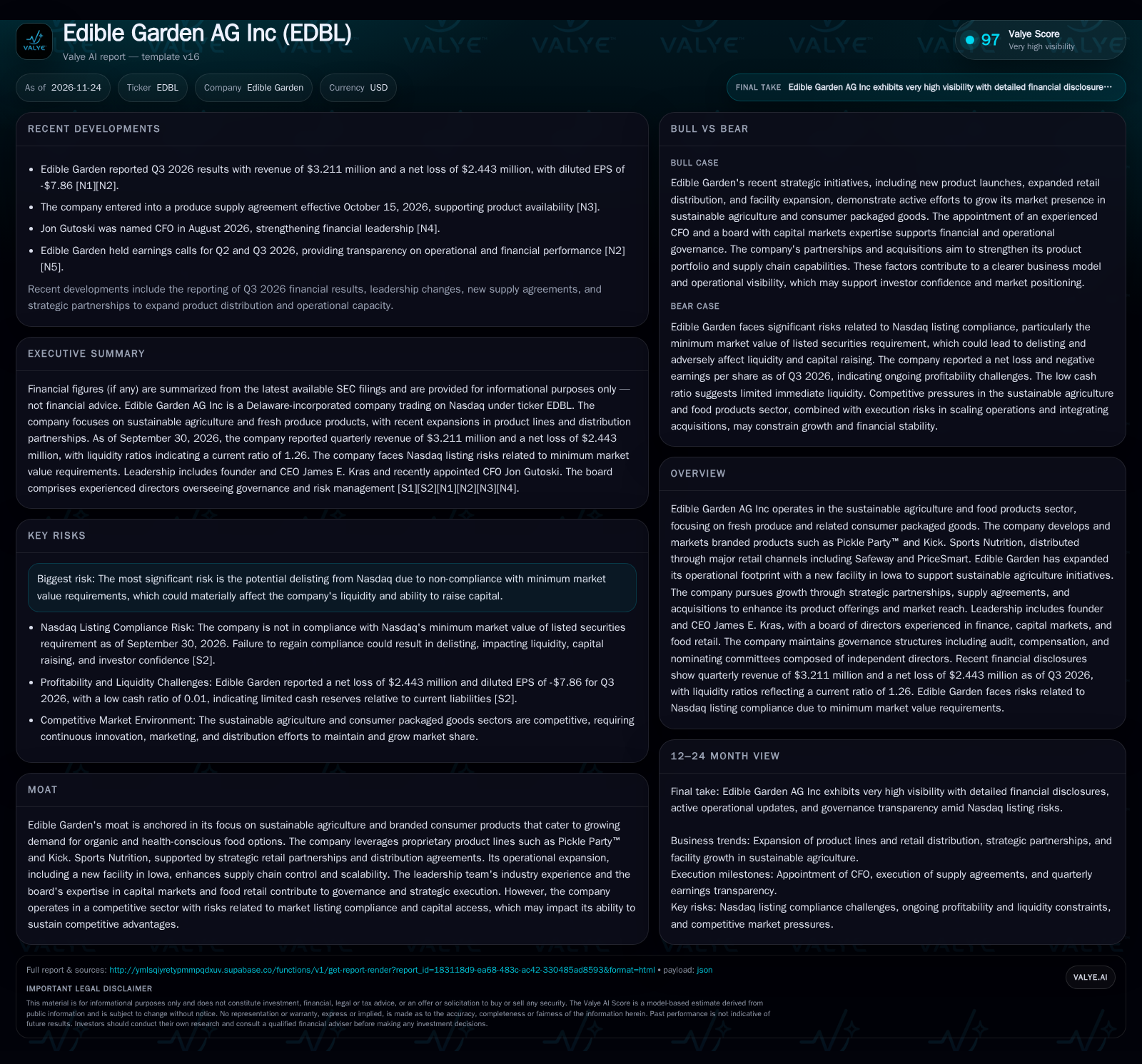
Edible Garden AG Inc’s operational landscape has shifted with several material developments. On October 15, 2026, the company entered a new produce supply agreement designed to stabilize and potentially grow its product availability across retail channels [N3]. The launch of proprietary product lines like Pickle Party™ and Kick. Sports Nutrition, now distributed in major outlets such as Safeway and PriceSmart, reflects an effort to broaden revenue streams and capture consumer trends towards health-conscious foods [S1]. On the governance front, the appointment of Jon Gutoski as CFO in August 2026 signals a commitment to financial discipline and leadership depth [N4]. [S2] These facts frame a business simultaneously seeking scale and fighting for financial stability.
How Edible Garden’s Growth Model Meets the Realities of Cash Flow and Fixed Costs
Edible Garden generates revenue by producing and selling branded fresh produce and consumer packaged goods, distributed through both direct retail relationships and supply agreements. The economics are characterized by a mix of relatively low-margin, high-volume produce sales and potentially higher-margin branded products, such as Pickle Party™ and Kick. Sports Nutrition, though the precise margin mix is not disclosed. The expansion of distribution into large retailers can drive volume growth, but it can also compress margins due to retailer bargaining power and promotional requirements.
Fixed costs are material in this sector—operating a new facility in Iowa increases both potential capacity and overhead. Variable costs include labor, raw materials, and logistics, all sensitive to seasonal fluctuations and supply chain volatility. [S2] The business model’s success thus hinges on scaling branded product sales, maintaining efficient operations, and securing sufficient working capital to support growth and inventory cycles.
The interplay between fixed and variable costs in Edible Garden’s model also underscores the importance of operational leverage. As volume scales, fixed costs such as facility overhead and salaried personnel are spread over a larger revenue base, potentially improving profitability if incremental sales are achieved at positive contribution margins. However, if growth stalls or sales mix shifts unfavorably toward lower-margin produce, the fixed cost burden can exacerbate losses. Additionally, working capital management is critical, given the perishability of fresh produce and inventory carrying risks. Efficient inventory turnover and supply chain synchronization can reduce cash tied up in stock, but disruptions or demand forecasting errors could lead to write-downs or stockouts, impacting both margins and customer relationships.
Sustainable Branding and Retail Access: Strengths and Structural Vulnerabilities
Edible Garden’s competitive profile rests on its focus on sustainable, health-oriented branded products and its ability to secure shelf space in major retail chains. This positions the company to capture demand from consumers increasingly seeking organic and eco-friendly options. Strategic supply agreements and the opening of a new Iowa facility may enhance supply chain resilience and support regional expansion.
However, the sustainable agriculture and consumer packaged goods sectors are crowded with both established multinationals and nimble regional players. Larger competitors can leverage scale for cost advantages and have entrenched retail relationships, while smaller brands may compete aggressively on innovation and niche marketing. Without exclusive supply contracts or proprietary technology, Edible Garden’s differentiation depends on brand equity, execution, and the ability to adapt to rapidly shifting consumer preferences. Its financial constraints may also limit its ability to invest in marketing, product development, or capacity at the pace of better-capitalized rivals.
Edible Garden’s positioning within the sustainable agriculture sector also requires navigating complex supply chain dynamics. Sourcing organic or sustainably farmed inputs often involves higher costs and greater variability compared to conventional agriculture, which can compress margins or require premium pricing strategies. The company’s ability to secure reliable supplier relationships and implement quality control measures will influence product consistency and brand reputation. Moreover, consumer preferences in the health and sustainability segment are evolving rapidly, necessitating agile product development and marketing to maintain relevance. Without scale advantages, Edible Garden must leverage data-driven insights and customer engagement to differentiate effectively against both large incumbents and innovative startups.
If Branded Product Expansion Sparks Margin Gains and Distribution Leverage
A bullish trajectory for Edible Garden would see its expanded branded product lines—like Pickle Party™ and Kick. Sports Nutrition—achieve meaningful velocity and shelf share at major retailers, driving higher-margin revenue growth. Successful execution of the October 2026 produce supply agreement could improve supply consistency and inventory turnover, reducing cost of goods sold and unlocking operating leverage.
Confirmation of this scenario would come from sequential increases in branded product sales, improved gross margin rates, and evidence of positive operating cash flow in subsequent earnings reports. Additional large-scale retail partnerships or exclusive distribution deals would further support this view. The scenario could be falsified if branded products fail to gain traction, gross margins stagnate, or if liquidity constraints force the company to curtail marketing or production investment.
Expansion Efforts Offset by Tight Liquidity and Listing Uncertainty
The most plausible outcome is that Edible Garden continues to grow its presence in sustainable produce and branded consumer goods, but at a pace constrained by working capital limitations and market listing pressures. The company’s Iowa facility and new supply agreements may help stabilize operations and underpin modest revenue growth, while the strengthened board and recent CFO appointment provide greater governance and oversight.
Evidence supporting this middle path would include steady but moderate revenue growth, incremental margin improvement, and ongoing efforts to resolve listing compliance. If liquidity deteriorates further or the company loses its Nasdaq listing, this scenario would tilt toward the downside.
Liquidity Squeeze and Delisting Threat Trigger Strategic Retrenchment
Loss of exchange listing could significantly restrict access to equity capital and weaken supplier and customer confidence.
This scenario would be confirmed by further deterioration in liquidity metrics, missed supplier payments, or the announcement of workforce reductions and asset sales. A delisting notice from Nasdaq would be a clear negative inflection point. The downside could be mitigated if the company rapidly secures additional capital or executes a turnaround in cash flow, but absent such developments, the risk of strategic retrenchment or even insolvency rises.
What Will Define Edible Garden’s Trajectory in the Coming Year?
Monthly or quarterly updates on cash balance and cash ratio—if disclosed—would indicate whether liquidity is stabilizing or worsening.
Gross margin trends, especially for branded product lines, would help test whether product mix is shifting toward higher-margin offerings.
Updates on Nasdaq compliance status and any remediation plans will be essential for assessing listing and capital access risk.
Evidence of new or expanded retail partnerships, or shelf space wins at existing partners, would support the growth thesis.
Operating cash flow figures in future earnings releases would clarify whether the business model is becoming self-sustaining.
Progress on integrating the Iowa facility and any related impact on capacity utilization or cost structure would be material.
Announcements of additional supply agreements, product launches, or geographic expansion efforts would signal commercial momentum.
Disclosure of any new financing arrangements, equity raises, or strategic investments would directly affect the risk/reward profile.
Disclaimer: This is research-only, informational analysis and not investment advice. It may include AI-generated interpretation and general industry context. Always verify important details using primary sources.

Comments