
Momentus Inc.: Capitalizing on Space Infrastructure Demand Amid Launch Provider Constraints
Momentus blends proprietary satellite and propulsion technologies with an expanding service portfolio, but its reliance on a concentrated launch provider base and the capital-intensive pace of innovation create a delicate balance between opportunity and vulnerability.
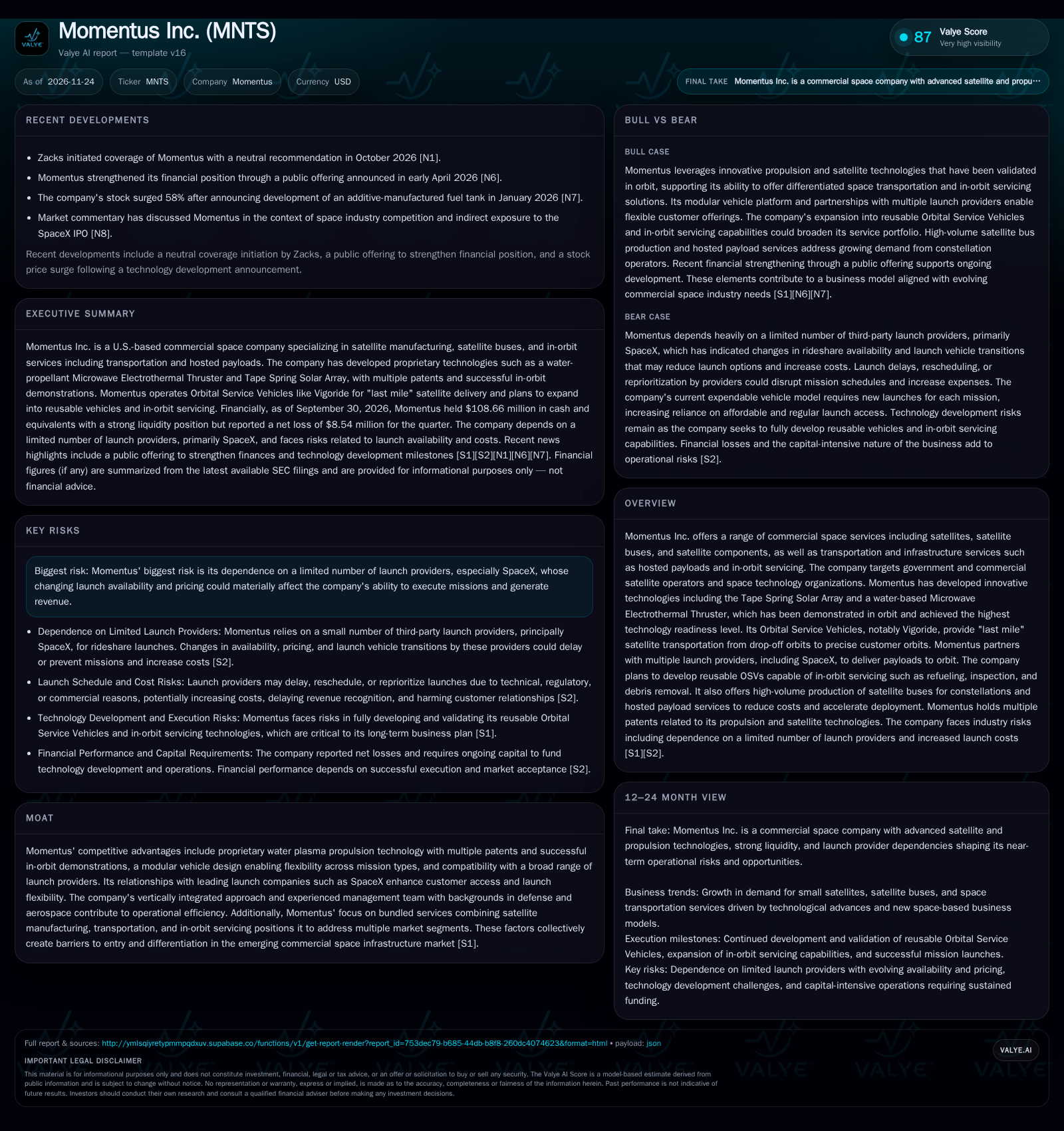
Momentus Inc. is advancing proprietary satellite and propulsion technologies, underpinned by a reported liquidity position following a public offering. However, its business trajectory is shaped by heavy dependence on a limited number of launch providers, especially SpaceX, and ongoing financial losses as it seeks to scale reusable vehicles and in-orbit servicing. The company's ability to capture rising demand for commercial space infrastructure will hinge on execution, cost control, and launch ecosystem stability. [S1] [S2] [N6]
Momentus Inc. stands at a pivotal intersection in the commercial space sector, offering modular satellite transportation and infrastructure services underpinned by patented propulsion technology. While recent financial moves have bolstered its liquidity, the company remains in a capital-intensive race to deliver operational breakthroughs—such as reusable service vehicles—against the backdrop of mounting industry demand and acute reliance on a narrow set of launch partners. The path forward will be defined by the interplay between Momentus’s pace of innovation, its ability to negotiate launch bottlenecks, and the economics of scaling space infrastructure services.
Recent Financial Moves and Operational Progress Reshape the Risk-Reward Profile
The company reported cash and liquidity metrics for the period; these figures do not by themselves establish operating runway, investment capacity, financial flexibility, or financing capacity. However, the company continues to operate at a net loss, posting negative $8.54 million in net income for the most recent quarter. Commercially, Momentus has secured launch manifests for three of its next four Vigoride missions, but remains exposed to risks from limited launch provider availability and potential increases in launch costs. The recent development and announcement of an additive-manufactured fuel tank triggered a 58% stock surge, suggesting that market sentiment is tightly coupled to technical milestones and perceived innovation leadership. [S2] [N6] [N7]
How Momentus’s Business Model Leverages Technology and Scale—But Faces Cost and Timing Pressures
Momentus’s primary revenue streams are derived from the delivery of satellites and payloads to custom orbits ('last mile' transportation), manufacturing of satellite buses, and in-orbit services such as hosted payloads and, prospectively, vehicle servicing. The company’s modular approach, anchored by the Vigoride Orbital Service Vehicle and proprietary water-based propulsion, is designed to reduce per-mission costs and provide flexibility for diverse customer requirements. However, the current expendable vehicle model means each mission requires a new launch, limiting the capture of operating leverage until reusable vehicles reach commercial maturity.
The economics of space transportation are highly sensitive to launch costs, vehicle utilization rates, and the cadence of customer missions. Fixed costs are significant—driven by R&D, manufacturing, and infrastructure investments—while variable costs are tied to the number of missions and payloads delivered. As the company transitions toward high-volume satellite bus production and in-orbit servicing, the potential for improved margins exists if demand scales and reusable vehicles are successfully deployed. Capital needs remain elevated, both to fund ongoing development and to manage the timing gap between upfront investment and revenue realization.
A critical factor influencing Momentus’s cost structure is the balance between fixed and variable expenses as the company scales. Fixed costs, encompassing research and development, manufacturing facilities, and engineering talent, create a substantial baseline expenditure that must be amortized over increasing mission volumes to achieve profitability. Conversely, variable costs such as launch fees, fuel, and mission-specific integration scale directly with the number of deployments. Achieving a higher utilization rate of vehicles and manufacturing throughput is therefore essential to dilute fixed costs and improve margins. However, this scaling is contingent on consistent demand and reliable launch schedules, which remain uncertain in the current market environment.
Timing mismatches between capital deployment and revenue recognition pose an additional challenge. The development and certification of reusable vehicles and in-orbit servicing platforms require upfront investment with a multi-year horizon before commercial returns materialize. This creates a cash flow gap that must be managed through capital reserves or financing. If market adoption of new services lags or technical hurdles delay deployment, the company faces increased pressure on liquidity and may need to adjust investment pacing. Conversely, accelerated customer commitments or partnerships could shorten this gap and improve the capital efficiency of growth.
Differentiation Through Propulsion IP and Service Integration—But Launch Provider Risk Dominates Competitive Dynamics
Momentus’s competitive positioning is anchored in its proprietary water plasma propulsion technology—protected by patents expiring through 2041—and its modular, flexible platform that can support a range of missions from satellite delivery to in-orbit servicing. The company’s ability to bundle manufacturing, transportation, and infrastructure services may appeal to constellation operators and space tech companies seeking to simplify supply chains and accelerate deployment.
However, the most acute counterforce is the company’s reliance on a small number of launch providers, especially SpaceX, whose own strategic priorities and pricing power shape the economics and availability of rideshare launches. In addition, Momentus faces competition from both established aerospace contractors and emerging commercial space infrastructure firms, many of whom are also racing to develop reusable vehicles and in-orbit servicing capabilities. Technology substitution risk is moderate in the near term due to the high barriers to entry in propulsion and integration, but could intensify as the market matures and alternative propulsion or service models gain traction.
What If Reusable Vehicles and In-Orbit Servicing Unlock Step-Change Economics?
The most favorable outcome for Momentus would be the successful commercial deployment of reusable Orbital Service Vehicles, enabling the company to amortize development and manufacturing costs over multiple missions, significantly lowering per-mission economics. If in-orbit servicing capabilities—such as refueling, inspection, and debris removal—are validated and adopted by satellite operators, Momentus could unlock recurring revenue streams and address a broader market, spanning both new satellite deployments and the maintenance of existing space assets.
Evidence that would confirm this scenario includes: demonstration of multiple successful reusable vehicle missions, signed multi-mission contracts for in-orbit servicing, and a positive inflection in gross margin as vehicle reusability reduces cost of goods sold. Additionally, stable or declining launch costs and expanded partnerships with launch providers would further validate the upside case.
Execution and Launch Ecosystem Frictions Define the Most Likely Trajectory
The most plausible path forward is a gradual ramp in mission cadence and service breadth, constrained by ongoing dependence on a few launch providers and the technical complexity of developing reusable vehicles. Momentus likely continues to serve a mix of government and commercial customers, with revenue growth paced by the availability of affordable launches and the company's ability to deliver on satellite bus and hosted payload demand.
Validation of this scenario would come from steady mission execution, incremental improvement in net losses (but not necessarily profitability), and continued technical milestones—such as successful demonstration flights and incremental enhancements to vehicle capabilities. Any material disruption in launch schedules, cost overruns in vehicle development, or customer attrition due to delays would challenge this middle path.
Launch Provider Disruptions and Technology Delays Amplify Financial Strain
The most adverse scenario for Momentus would be a combination of reduced rideshare launch availability (for example, due to SpaceX reprioritizing its own missions or increasing prices), technical setbacks in reusable vehicle development, and customer hesitancy to commit to new service offerings. In this case, the company could face a shrinking pipeline, cost escalations, and a widening gap between cash burn and revenue generation.
Downside evidence would include repeated launch delays, cancellations, or cost increases; missed technical milestones (such as failed demonstration flights); and a marked deterioration in customer bookings or backlog. Persistent operating losses without a clear path to commercialized reusability or diversified launch access would increase the risk of further dilutive capital raises or operational contraction.
Signals That Will Shape Whether Momentus Can Capture Space Infrastructure Growth
Frequency and success rate of Vigoride and other Orbital Service Vehicle launches, including any demonstration of vehicle reusability.
Progress and technical milestones in in-orbit servicing capabilities, such as on-orbit refueling, inspection, or debris removal, if disclosed.
Customer contract pipeline and backlog, particularly for multi-mission or recurring in-orbit services—would help test the durability of demand.
Trends in launch provider availability, pricing, and partnership diversification beyond SpaceX.
Gross margin evolution as a function of vehicle utilization and manufacturing scale—an indicator of economic inflection.
R&D and capital expenditure levels relative to revenue growth, to gauge burn rate and capital efficiency.
Any regulatory, insurance, or geopolitical developments affecting launch access or customer adoption.
Disclaimer: This is research-only, informational analysis and not investment advice. It may include AI-generated interpretation and general industry context. Always verify important details using primary sources.

Comments