
Aibotics, Inc.: Strategic Pivot from Psychedelic Research to AI-Driven Wellness Robotics Faces Execution and Liquidity Hurdles
Aibotics, Inc. is navigating a high-risk, high-reward transition from supporting psychedelic mental health research to developing AI-powered consumer wellness devices.
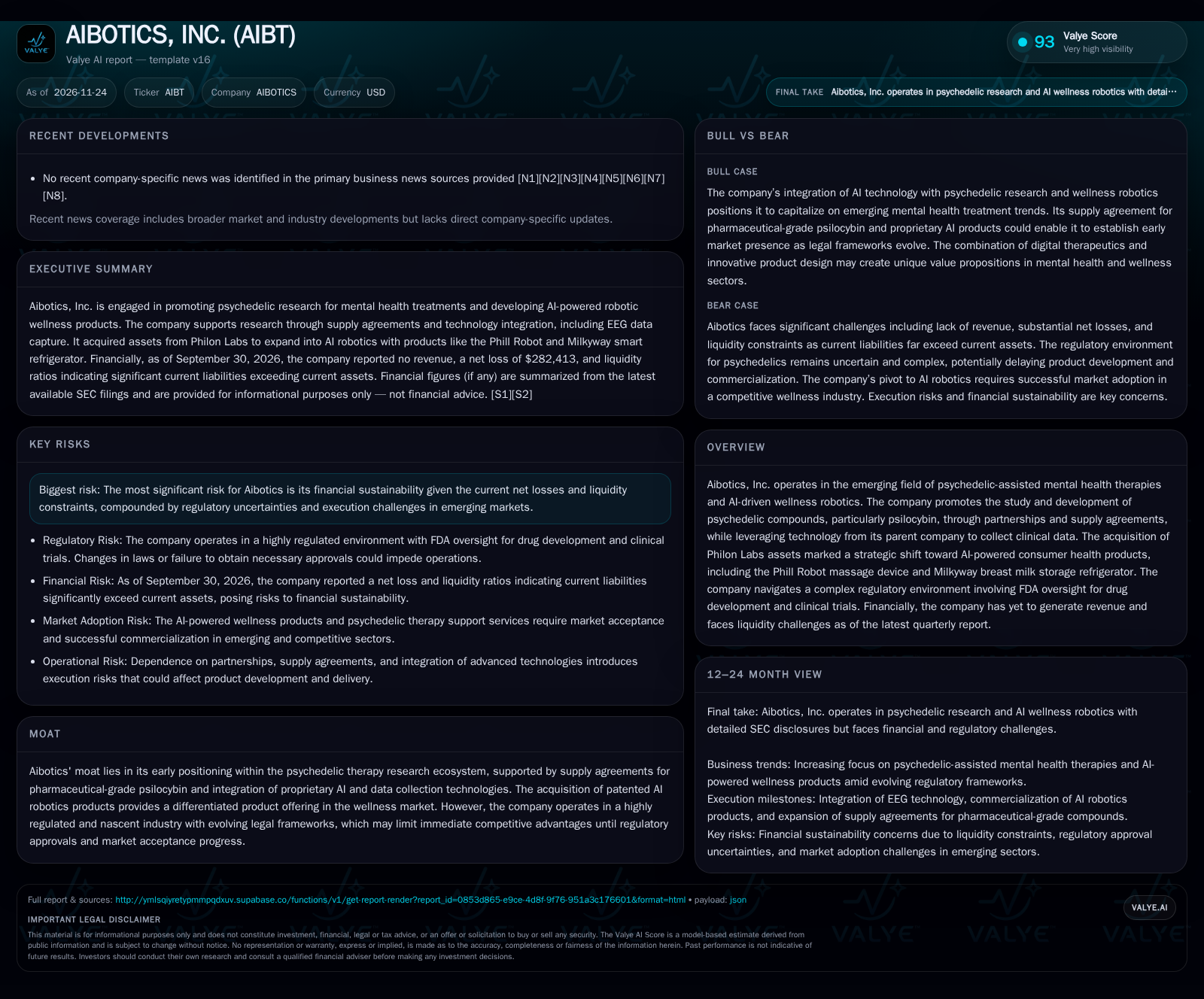
Aibotics, Inc. has shifted its strategy from facilitating psychedelic research to commercializing AI-driven wellness robotics products. The company has no revenue and a significant liquidity deficit as of September 30, 2026, raising questions about financial sustainability. Its success will depend on gaining market traction for its new AI products and navigating complex regulatory hurdles in both the mental health and consumer wellness spaces. [S1] [S2]
Aibotics, Inc. stands at an inflection point, shifting from its roots in psychedelic-assisted mental health research to an ambitious foray into AI-powered consumer wellness robotics. Despite acquiring patented technology and forging supply agreements in the psychedelic space, the company faces significant financial headwinds—reporting zero revenue and a deep liquidity shortfall as of September 2026. Its ability to commercialize newly acquired robotics products and navigate complex regulatory environments in both digital health and psychedelics will determine whether Aibotics can transform its bold vision into a sustainable business.
Liquidity Crunch and Strategic Reorientation Define Aibotics’ Present State
Aibotics, Inc. reported no revenue and a net loss of $282,413 for the period ending September 30, 2026. The company’s balance sheet highlights acute liquidity challenges, with current assets of $265,266 against current liabilities of $5,171,551—resulting in a current ratio of just 0.05 and a cash ratio of 0.08. [S2]
Strategically, Aibotics has transitioned from an exclusive focus on psychedelic research support toward the development and commercialization of AI-powered wellness robotics. The acquisition of Philon Labs’ assets—namely the Phill Robot massage device and the Milkyway smart refrigerator—signals an intent to participate in the broader consumer health technology market. At the same time, the company maintains a supply agreement with HAVN Life Sciences for pharmaceutical-grade psilocybin, underscoring its continued engagement with psychedelic-assisted therapy research. [S1]
Examining Business Model Viability: Capital Intensity, Revenue Pathways, and Margin Structure
Aibotics’ business model is currently pre-revenue, with the potential for future monetization hinging on two distinct verticals: AI-powered consumer wellness robotics and support services for psychedelic-assisted therapy research. The company’s acquisition of patented robotic products suggests a move toward direct-to-consumer or business-to-business hardware sales, potentially supplemented by app-based subscriptions or service contracts if the devices are integrated into broader digital health ecosystems. However, absent disclosed unit economics, it is unclear whether these products will be priced at a premium, subsidized to gain market share, or bundled with recurring services.
The company’s capital requirements remain significant—further product development, regulatory compliance, and go-to-market activities for both wellness robotics and psychedelic research tools demand ongoing investment. The issuance of Series B Preferred Stock valued at $2 million for the Philon Labs assets, coupled with employee incentives tied to revenue milestones, highlights an expectation of future top-line growth, but there is currently no evidence of cash inflows to support these ambitions. [S1]
Operating leverage could materialize if Aibotics achieves scale in device sales or builds a recurring revenue base from software or data services. Conversely, the fixed costs of R&D, regulatory navigation, and sales infrastructure could weigh heavily if adoption lags or regulatory barriers persist.
Assessing Competitive Dynamics: Nascent Differentiation Versus Market and Regulatory Barriers
Aibotics seeks to differentiate through early entry into two emerging markets: psychedelic-assisted mental health research and AI-driven consumer wellness robotics. In the psychedelic space, its supply agreement for pharmaceutical-grade psilocybin and plans for EEG data collection position it as a potential enabler of next-generation clinical studies. However, the field is crowded with academic institutions, established pharmaceutical companies, and digital therapeutics startups, all vying for regulatory breakthroughs and clinical validation.
On the robotics front, Aibotics’ patented Phill Robot and Milkyway products target wellness and maternal health niches. The company faces competition from established consumer electronics brands, health-tech startups, and global appliance manufacturers—many with deeper pockets, established distribution, and brand recognition. The degree of product differentiation, user experience, and integration with broader health platforms will likely determine whether Aibotics can capture meaningful share.
Both verticals are subject to stringent regulatory oversight. In psychedelics, FDA and local laws dictate research and commercialization timelines. In consumer health devices, safety, efficacy, and data privacy standards may pose additional barriers to rapid scaling.
Unlocking Value Through Regulatory Progress and Successful Product Launches
The most favorable scenario for Aibotics involves two reinforcing developments: (1) regulatory tailwinds enabling broader psychedelic research and eventual clinical adoption, and (2) rapid market acceptance of its AI-powered wellness devices. If FDA or equivalent authorities accelerate approvals for psychedelic compounds or related digital therapeutics, Aibotics’ existing supply agreements and technology stack could become valuable assets—potentially attracting partnerships or licensing deals.
On the consumer side, if the Phill Robot and Milkyway devices achieve traction through superior functionality or integration with popular health apps, Aibotics could generate revenue quickly, establish a recurring customer base, and leverage early-mover advantages. Confirmation of this scenario would require evidence of initial product sales, positive user feedback, new commercial partnerships, and regulatory clearances for research tools or devices.
Falsification would occur if, despite regulatory progress, Aibotics fails to secure adoption or if competitors outpace it in product launches and distribution.
Plausible Trajectory: Extended Pre-Revenue Phase and Incremental Progress Under Financial Duress
The most likely near-term outcome is a prolonged period of limited revenue as Aibotics works to commercialize its newly acquired robotics products and deepen its engagement in psychedelic research support. Under this scenario, the company may achieve modest product development milestones, such as pilot studies, prototype launches, or initial regulatory filings, but will struggle to convert these into meaningful sales or cash flow due to resource constraints.
Incremental external funding—via equity, convertible notes, or partnerships—may provide temporary runway extensions, but dilution and unfavorable terms are likely given the current balance sheet. Confirmation of this scenario would include announcements of pilot deployments, additional financing rounds, or incremental regulatory progress, but continued reporting of net losses and reported liquidity position.
A falsifying development would be a major commercial contract, licensing deal, or a breakthrough in regulatory status that materially accelerates revenue generation or improves the company’s capital position.
Liquidity Crisis and Execution Risk Could Precipitate Strategic Retreat or Restructuring
The adverse scenario features a combination of persistent liquidity shortfalls, failed product launches, and regulatory or market setbacks. If Aibotics is unable to secure new funding or generate revenue within the next several quarters, it may be forced to delay development, divest assets, or pursue restructuring options. Execution risks are high: integration of acquired technologies, development of compliant products, and market entry all require capital and operational expertise that may be out of reach for a company in financial distress.
This scenario would be confirmed by ongoing net losses, further deterioration of liquidity ratios, missed product milestones, or the announcement of cost-cutting measures, asset sales, or insolvency proceedings. A falsifying event would be the rapid closing of a substantial funding round or the unexpected achievement of commercial scale.
Milestones and External Factors That Will Shape Aibotics’ Trajectory
Evidence of initial sales, distribution agreements, or early adoption for the Phill Robot or Milkyway products—if disclosed—would help validate the commercial potential of Aibotics’ AI-driven wellness strategy.
Announcements or filings regarding regulatory submissions, clearances, or approvals for either wellness devices or psychedelic research tools will be critical to de-risking the business model.
Updates on the integration and practical deployment of EEG brain cap technology in psychedelic research studies would signal progress toward Aibotics’ data-driven mental health ambitions.
Details on new financing rounds, terms of capital raises, or strategic partnerships will determine whether the company can address its acute liquidity constraints.
Any expansion or renewal of the psilocybin supply agreement, or new collaborations in the psychedelic research ecosystem, would clarify Aibotics’ standing in that vertical.
Disclosure of unit economics, pricing structures, or recurring revenue models for wellness robotics would help test the sustainability and scalability of the business.
Market feedback, user reviews, or clinical validation reports for Aibotics’ products—if available—would provide evidence of competitive differentiation or highlight shortcomings.
Disclaimer: This is research-only, informational analysis and not investment advice. It may include AI-generated interpretation and general industry context. Always verify important details using primary sources.

Comments