
Dogecoin Cash, Inc.: Asset-Light Telemedicine for Medical Cannabis Faces Regulatory Crosswinds
Dogecoin Cash, Inc., operating primarily through the PrestoDoctor telemedicine platform, has achieved notable revenue scale in medical cannabis evaluations while maintaining an asset-light model. However, its growth prospects and margins are tightly linked to evolving state and federal regulations, the actions of larger telemedicine rivals, and the challenge of capital efficiency in a crowded digital health landscape.
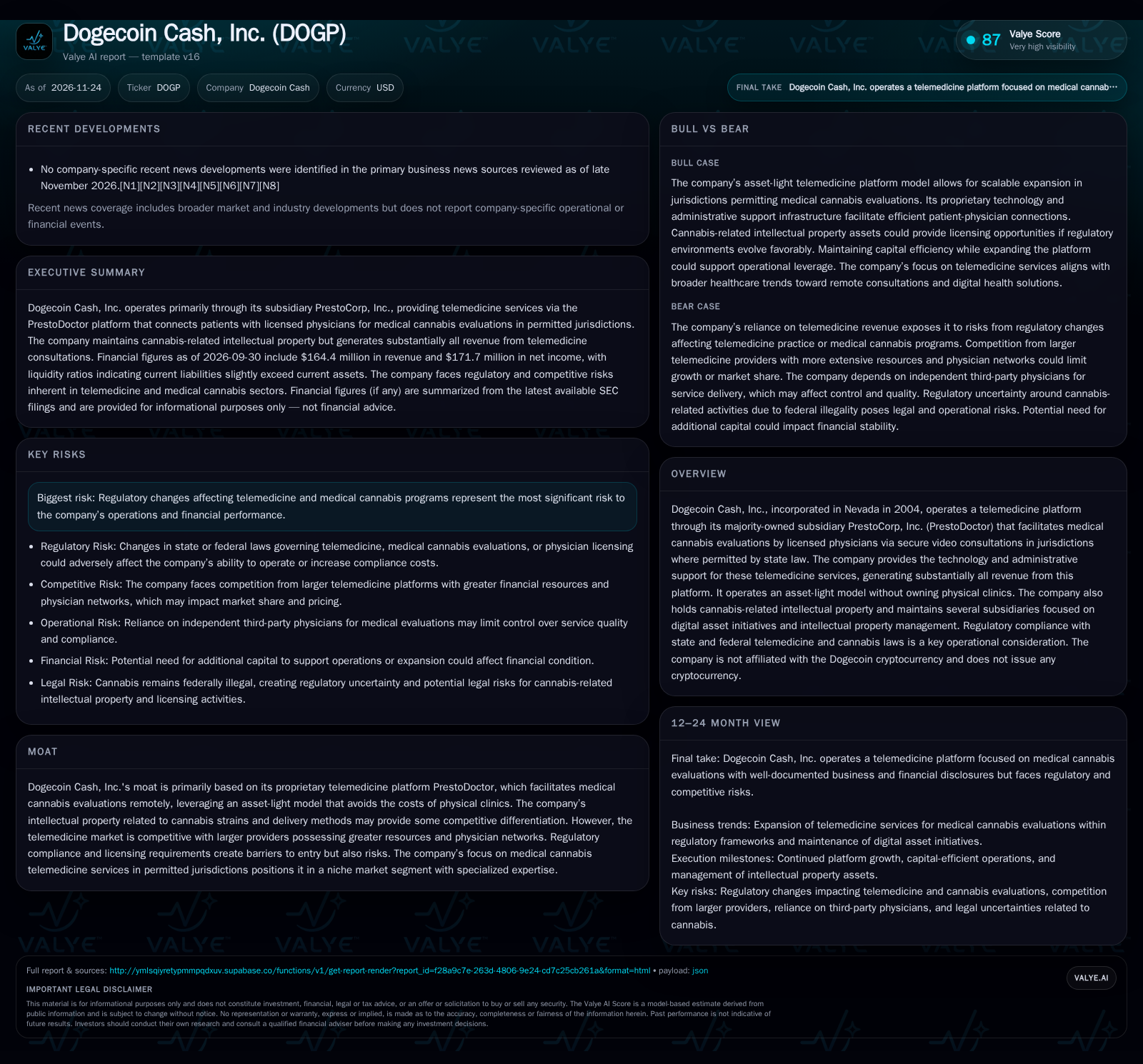
Dogecoin Cash, Inc. reported $164.4M in revenue and $171.7M in net income for the period ending 2026-09-30, driven almost entirely by its PrestoDoctor telemedicine platform for medical cannabis evaluations. The business is exposed to regulatory changes in telemedicine and cannabis, faces competition from larger platforms, and depends on third-party physicians for service delivery. Intellectual property holdings in cannabis strains and delivery systems may offer future optionality but are not current revenue drivers. The principal risk is regulatory: shifts in telemedicine or cannabis law could rapidly alter the company’s addressable market or compliance costs. [S2]
Dogecoin Cash, Inc. stands at the intersection of telemedicine and medical cannabis, leveraging its PrestoDoctor platform to deliver remote evaluations in jurisdictions where permitted. Its asset-light structure—eschewing clinic ownership for a pure technology and service model—has enabled rapid expansion and revenue growth, even as regulatory and competitive risks loom large. The company’s recent financial results show meaningful scale, but its future trajectory will depend on how it navigates regulatory volatility, capital efficiency, and the evolving competitive landscape.
Recent Performance and Financial Position Define Immediate Strategic Leverage
As of September 30, 2026, Dogecoin Cash, Inc. reported $164.4 million in revenue and $171.7 million in net income, with operations almost entirely anchored in telemedicine consultations for medical cannabis via the PrestoDoctor platform. Cash and equivalents were $9.5 million, but the cash ratio of 0.02 suggests most assets are non-cash or tied up elsewhere. [S2]
How the Asset-Light Telemedicine Model Drives Revenue and Cost Structure
Dogecoin Cash’s business model is fundamentally asset-light: it provides a digital platform and administrative support for independent physicians to deliver medical cannabis evaluations remotely. The company does not own clinics or employ physicians directly, which minimizes fixed costs and allows for rapid market entry in compliant jurisdictions. Revenue is generated primarily from consultation fees, which may be structured as either transaction-based or through platform facilitation, though exact commercial terms are not disclosed in the current report. This model enables high operating leverage—incremental consultations generate revenue with limited increase in overhead—provided regulatory compliance is sustained.
Variable costs are largely tied to technology upkeep, customer support, and platform compliance rather than physical expansion. However, the reliance on independent physicians means the company must compete for provider participation, potentially pressuring margins if physician compensation demands rise. Capital needs are relatively modest compared to traditional healthcare providers, but ongoing investment in technology and compliance infrastructure is essential. If the company seeks to expand into new states or launch ancillary digital health services, additional capital or strategic partnerships may be required.
Specialization Versus Scale: Competitive Pressures in Telemedicine and Cannabis
Dogecoin Cash occupies a specialized niche at the overlap of telemedicine and medical cannabis, which offers some differentiation but also exposes the company to intense competition from generalist telemedicine platforms and healthcare technology providers. Larger competitors can leverage broader physician networks, more robust compliance resources, and deeper marketing budgets, potentially outcompeting smaller, niche-focused operators on price, service breadth, and patient acquisition.
The company’s proprietary PrestoDoctor platform and cannabis-related intellectual property (such as patents on cannabis strains and delivery methods) may provide some defensible differentiation. However, these assets are not currently major revenue drivers. Barriers to entry exist due to regulatory complexity and the need for specialized compliance, but these also raise the cost of ongoing operations and heighten vulnerability to sudden legal changes. Substitution risk is high if broader telemedicine platforms or in-person providers move aggressively into cannabis evaluations, especially if regulatory or reimbursement environments shift.
If Regulatory Clarity and Platform Scale Align, Margin Expansion and Licensing Optionality Could Follow
The most favorable outcome would involve stable or improving regulatory environments for both telemedicine and medical cannabis, enabling Dogecoin Cash to expand PrestoDoctor into new states or increase patient throughput in existing markets. Under this scenario, the company could leverage its asset-light platform to drive operating leverage, as incremental consultations would disproportionately boost margins. Further, if intellectual property—such as cannabis strain or lozenge patents—becomes monetizable through licensing or partnerships, ancillary revenue streams could develop.
Confirmation of this scenario would require evidence of regulatory reform at the state or federal level (such as broader telemedicine acceptance or cannabis rescheduling), expansion announcements into new jurisdictions, rising consultation volumes, or disclosed IP licensing deals. Sustained improvements in net income and margin expansion relative to revenue would further validate the upside case.
Sustaining Niche Leadership Amid Regulatory Ambiguity and Incremental Growth
The most plausible trajectory is that Dogecoin Cash continues to operate as a specialized telemedicine platform for medical cannabis evaluations, growing incrementally within the constraints of current state regulations. Revenue may track modest market growth or fluctuations in state-level cannabis program participation, with margins remaining stable absent major regulatory disruption. The company is likely to preserve its asset-light model, reinvesting in technology and compliance rather than physical expansion.
This scenario would be confirmed by steady or slightly rising quarterly revenues, consistent gross margins, and the absence of major legal or regulatory headwinds. Evidence of ongoing physician participation and stable patient demand would support this path, as would continued, but not transformative, investment in digital asset or IP initiatives.
Regulatory Shifts or Competitive Encroachment Could Erode Core Revenue Stream
A negative turn could occur if state or federal regulations become more restrictive—such as tighter telemedicine practice standards or reduced eligibility for medical cannabis evaluations—forcing contraction in the company’s addressable market. Alternatively, if larger telemedicine platforms aggressively enter the cannabis evaluation space, Dogecoin Cash could see competitive pricing pressure, higher physician acquisition costs, or loss of market share.
This scenario would be confirmed by declining consultation volumes, revenue contraction, margin compression, or disclosures of regulatory enforcement actions.
Factors That Could Shift the Thesis for Dogecoin Cash, Inc.
Quarterly revenue growth or contraction, particularly as a function of changes in patient or consultation volumes, would help test the sustainability of the current business model.
Disclosure of new state or federal regulatory developments affecting telemedicine or medical cannabis eligibility would materially impact future addressable market size.
Physician participation rates on the PrestoDoctor platform—if disclosed—would provide insight into the company’s ability to maintain and scale service delivery.
Gross margin trends, especially if reported for the telemedicine platform specifically, would indicate whether operating leverage or pricing pressure is affecting profitability.
Any announced licensing agreements or revenue derived from cannabis-related intellectual property would help assess the value of the company’s IP portfolio.
Competitive developments—such as new product launches or acquisitions by larger telemedicine providers targeting the cannabis evaluation market—could shift the competitive balance.
Material changes in legal proceedings, compliance disclosures, or regulatory enforcement actions would directly affect operational risk.
Disclaimer: This is research-only, informational analysis and not investment advice. It may include AI-generated interpretation and general industry context. Always verify important details using primary sources.

Comments