
National Fuel Gas Co: Strategic Realignment and Segment Synergies Shape the Next Chapter
National Fuel Gas is preparing for a 2027 spin-off that will divide its regulated utility and Appalachian gas production businesses, aiming to sharpen its operational focus. Recent revenue and earnings growth amid segment complexity, regulatory rate relief, and commodity market volatility frame a pivotal period for the integrated energy company.
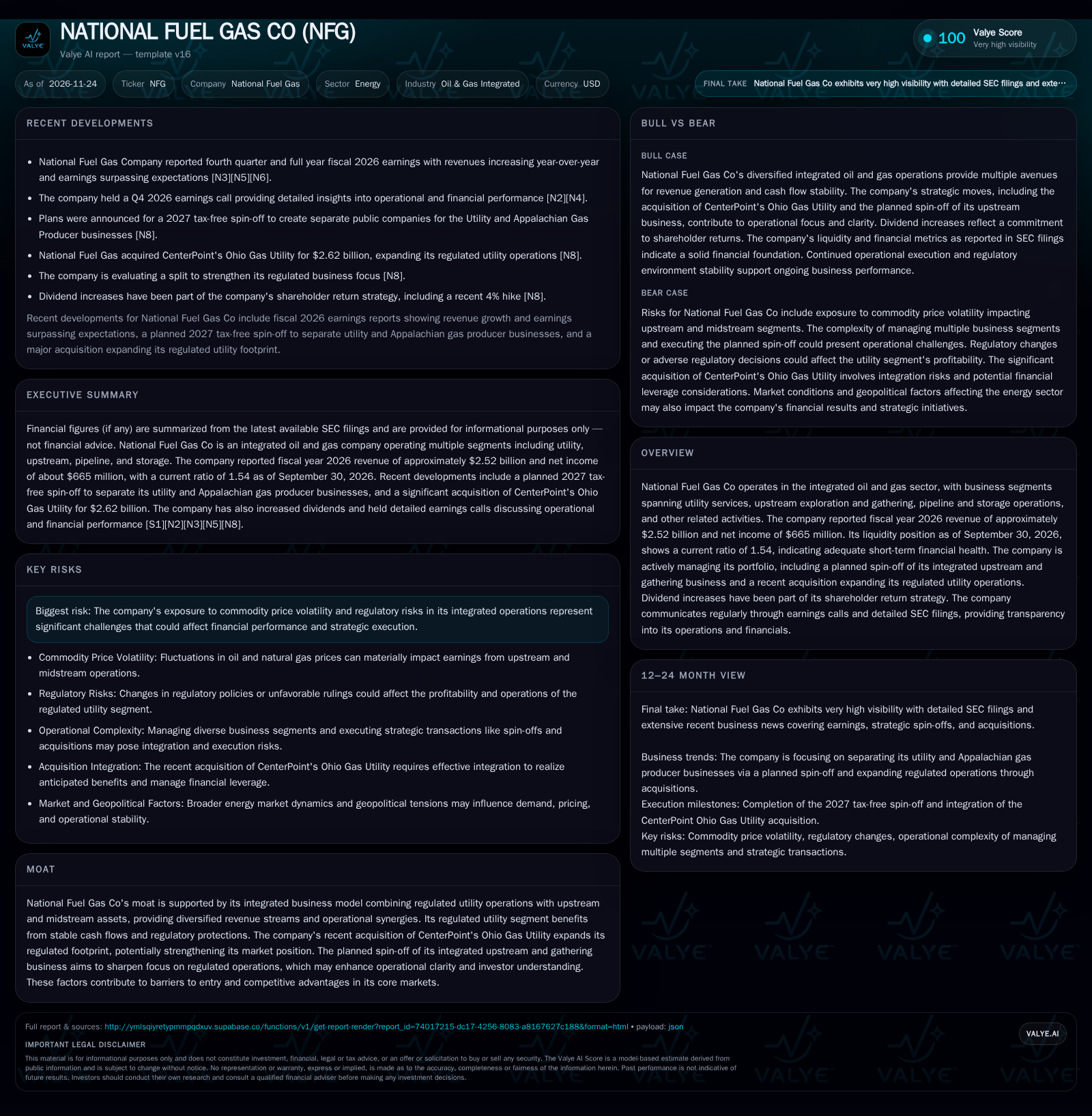
National Fuel Gas reported $2.52 billion in fiscal 2026 revenue and $665 million in net income, with a current ratio of 1.54 as of September 30, 2026. The company is planning a 2027 spin-off to separate its utility and Appalachian gas producer businesses, seeking to enhance focus on regulated operations. Regulatory rate increases are set to bolster the utility segment, while upstream and midstream results remain sensitive to commodity price swings. Execution of the spin-off and adaptation to regulatory and market conditions will determine future value creation. [S1] [N8]
National Fuel Gas stands at a strategic inflection point as it prepares for a 2027 spin-off to decouple its regulated utility business from its Appalachian gas production operations. The company is coming off a year of solid financial results, reporting $2.52 billion in revenue and $665 million in net income for fiscal 2026. With a favorable regulatory rate outcome in New York and plans to sharpen its focus on regulated growth, National Fuel Gas is navigating the inherent volatility of commodity markets and the operational complexity of a multi-segment portfolio. The effectiveness of its restructuring and its ability to manage regulatory and market risks will be central to its next phase of value creation. [S1] [S2] [N8]
2026 Financials and 2027 Spin-Off Set the Stage for Strategic Repositioning
National Fuel Gas reported $2.52 billion in revenue and $665 million in net income for the fiscal year ended September 30, 2026, with diluted EPS of $7.02. As of the same date, the company held $1.89 billion in current assets and $1.23 billion in current liabilities, resulting in a current ratio of 1.54. While these figures reflect solid financial standing, the company’s liquidity is not unusually high for the sector, with cash and cash equivalents of $39.35 million. [S1]
A pivotal development is the announced plan for a tax-free spin-off in 2027, which will separate the regulated utility business from the Appalachian gas producer segment. This transaction aims to enhance strategic clarity, operational focus, and potentially unlock value for shareholders. The New York utility segment also secured a multi-year rate hike, providing a clearer earnings runway for its regulated operations. [N8] [S2]
Recent quarterly results show year-over-year revenue growth and earnings that outpaced expectations, though the company continues to face the complexities and risks associated with integrated oil and gas operations, including commodity price volatility and regulatory oversight. [N3] [N5] [N6]
Integrated Model Drives Multi-Segment Revenue, But Margin Dynamics Diverge
National Fuel Gas’s earnings profile is shaped by its mix of regulated utility, upstream exploration and production, gathering, pipeline, and storage operations. The utility segment benefits from regulated rates and cost recovery mechanisms, providing a base of predictable cash flows and relatively stable margins. Recent regulatory approval in New York for a three-year rate plan—including increases of $57.3 million in fiscal 2025, $15.8 million in fiscal 2026, and $12.7 million in fiscal 2027—enhances forward visibility and supports capital recovery. [S2]
In contrast, upstream and gathering operations are highly sensitive to natural gas and oil price fluctuations. These segments can generate outsized profits during favorable commodity cycles, but are exposed to significant downside risk when prices fall. The capital intensity of exploration and production, coupled with the need for ongoing investment in gathering and midstream infrastructure, means that cash flow volatility is inherent in this part of the portfolio.
Pipeline and storage segments typically offer steadier, fee-based revenue, but require sustained capex for maintenance and regulatory compliance. The spin-off plan suggests a future where the utility business, with its regulated returns, may be valued more like a pure-play utility, while the upstream business will be exposed to market-driven volatility and may pursue a more opportunistic capital allocation strategy.
Segment-Level Advantages and Vulnerabilities in a Shifting Energy Landscape
The company’s integrated structure has historically provided diversification benefits: regulated utility cash flows offsetting the cyclicality of upstream and midstream earnings. The utility segment enjoys local market share, regulatory barriers to entry, and a captive customer base in New York and Pennsylvania. Rate cases and cost recovery mechanisms anchor its earnings stability, but also subject it to periodic regulatory scrutiny and political risk. [S2]
Upstream and gathering operations compete with other Appalachian basin producers, where scale, access to infrastructure, and drilling efficiency are key. While the company’s midstream assets offer some competitive insulation via vertical integration, they are not immune to regional competition, market access constraints, and evolving environmental regulations.
The planned spin-off could strengthen each segment’s competitive positioning by allowing management teams to focus on distinct capital allocation priorities and risk profiles. However, the loss of internal synergies—such as captive gas supply or shared infrastructure—could marginally increase costs or reduce flexibility in each separate entity.
Spin-Off Execution and Regulatory Tailwinds Unlock Value
If National Fuel Gas successfully executes its 2027 spin-off, the market could begin to ascribe higher multiples to the now-pure-play utility business, reflecting its regulated, predictable earnings and lower risk profile. The separated Appalachian gas producer may attract investors seeking commodity leverage and growth potential, especially if natural gas prices strengthen and production costs remain competitive.
Regulatory tailwinds—such as the multi-year rate increases just secured in New York—could further bolster earnings stability and support higher returns on invested capital for the utility segment. Evidence that would confirm this scenario includes sustained post-spin-off outperformance of utility segment margins, positive market re-rating, and disciplined capital allocation by both new entities.
Falsification would come from delayed or poorly executed spin-off logistics, regulatory pushback, or deterioration in commodity prices undermining upstream cash flows post-separation.
Segment Realignment Delivers Clarity, but Earnings Remain Sensitive to External Factors
The most plausible outcome is that National Fuel Gas completes its spin-off as planned in 2027, resulting in two focused, publicly traded companies. The utility segment continues to deliver stable, regulated returns, supported by the recently approved rate plan, but faces ongoing regulatory review and periodic capital investment needs.
The Appalachian gas production business operates in a volatile price environment, with earnings oscillating in response to commodity cycles and regional supply-demand dynamics. Both entities are likely to see some near-term costs from restructuring and separation, but operational clarity and more targeted capital allocation could offset these over time.
Confirmation of this scenario would be smooth spin-off execution, maintenance of current operating margins, and steady regulatory relations. Evidence against it would include unforeseen separation costs, regulatory or legal challenges, or significant commodity price shocks impacting upstream results.
Commodity Slump or Regulatory Setbacks Expose Segment Weaknesses
A less favorable trajectory would involve a sharp decline in natural gas or oil prices coinciding with or following the spin-off, significantly impairing the cash generation and valuation of the newly independent Appalachian gas producer. Meanwhile, the utility segment could face adverse regulatory outcomes, such as delayed or denied rate increases, or new policy mandates elevating costs.
Operational complexity during the separation process could lead to execution missteps, cost overruns, or disruption of service continuity, further eroding investor confidence. Evidence confirming this downside would include profit warnings, missed financial targets, or regulatory/legal disputes related to the spin-off.
If disclosed, rising debt levels or significant capital outlays without corresponding revenue growth would also suggest increasing financial strain in either entity post-separation.
Milestones and Metrics That Will Shape the Value of National Fuel Gas’s Strategic Shift
Progress on the 2027 spin-off timeline and any regulatory or legal milestones associated with the separation process.
Earnings and margin performance of the utility segment following implementation of the New York rate plan increases.
Natural gas and oil price trends and their impact on upstream segment revenue and profitability.
Capital expenditure levels and return on invested capital in both the utility and Appalachian gas producer entities, if disclosed.
Post-spin-off cost structure, including any dis-synergies or unexpected separation-related expenses.
Regulatory developments in New York and Pennsylvania that could affect rate setting, allowed returns, or compliance costs.
Management commentary on potential asset sales, acquisitions, or further restructuring initiatives.
Disclaimer: This is research-only, informational analysis and not investment advice. It may include AI-generated interpretation and general industry context. Always verify important details using primary sources.

Comments