
SOAR AI’s Expansion Ambitions: Can Capital-Intensive Growth Outpace Liquidity and Industry Headwinds?
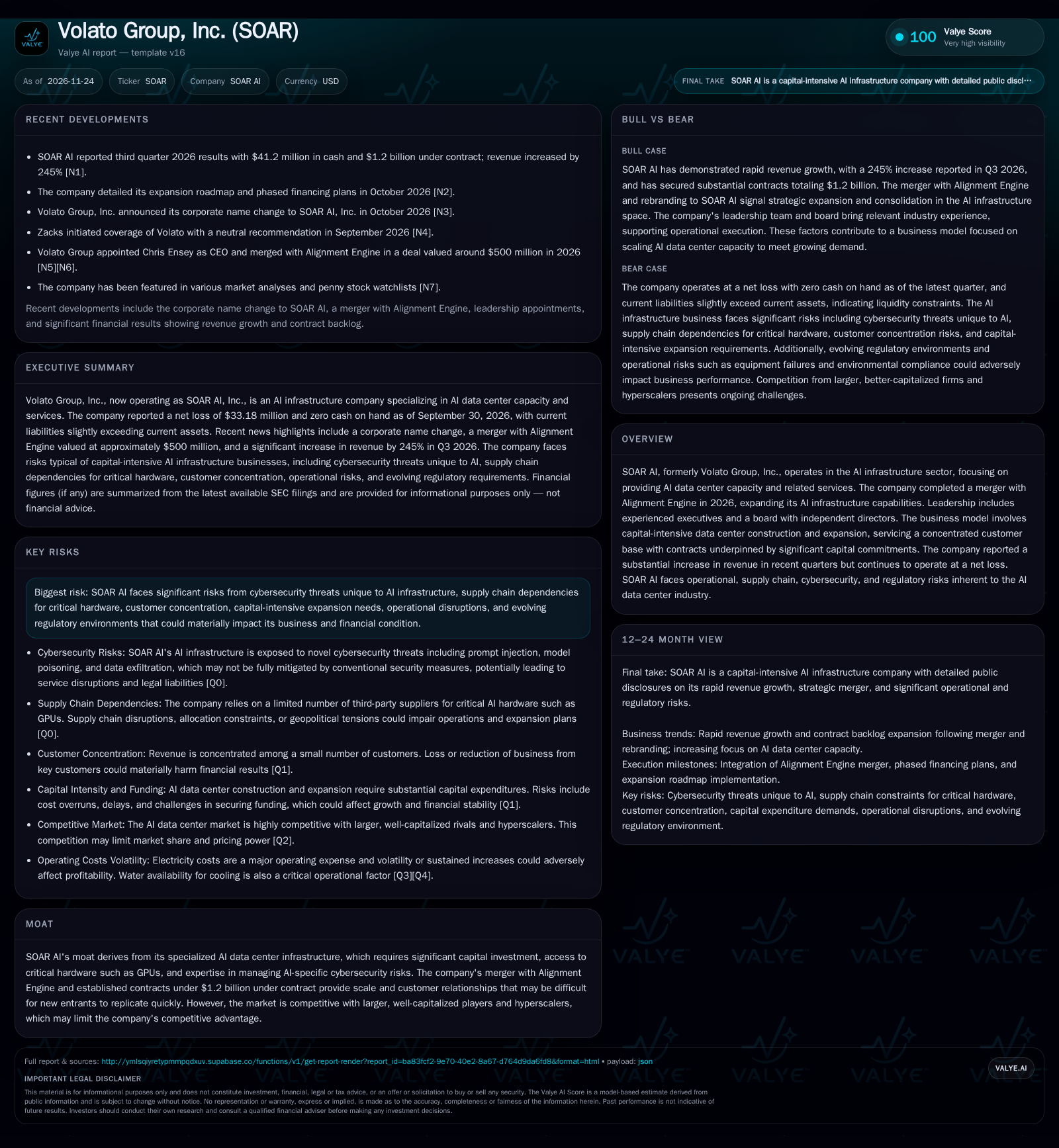
SOAR AI (formerly Volato Group) is riding a surge in AI infrastructure demand, posting 245% revenue growth and a $1.2 billion contract backlog. Yet, persistent net losses, a near-zero cash position, and heavy capital requirements heighten the stakes as the company scales its data center business in a fiercely competitive, risk-laden sector.
SOAR AI has rapidly grown revenue and secured a sizable contract base, but its latest financials show zero cash on hand, net losses, and liabilities exceeding current assets. The company's ability to deliver on its expansion roadmap hinges on managing customer concentration, supply chain risks for critical AI hardware, capital needs, and evolving regulatory and operational risks in the AI data center market. Execution, funding, and risk mitigation will determine whether SOAR AI can transform early momentum into durable market position.
SOAR AI, rebranded from Volato Group in October 2026, is aggressively scaling to meet surging demand for AI data center infrastructure. The company’s reported 245% revenue jump and $1.2 billion in contracts paint a picture of high growth potential. However, this momentum is tempered by a stark liquidity snapshot—zero cash on hand and current liabilities exceeding assets—as well as ongoing net losses. With expansion hinging on heavy capital outlays and execution in a market dominated by hyperscalers, SOAR AI’s next phase will test whether its contract pipeline and operational discipline can outpace sector risks and resource constraints.
Liquidity Squeeze Amid Record Growth and Contract Wins
SOAR AI’s Q3 2026 results show a company at a critical inflection point. Revenue grew by 245% year-over-year, fueled by a $1.2 billion contract backlog that highlights strong demand for AI data center capacity [N1]. Yet, this growth comes alongside a net loss of $33.18 million and a balance sheet showing zero cash and a current ratio of 0.96, with liabilities slightly exceeding current assets as of September 30, 2026 [S2]. The company reported cash and liquidity metrics for the period; these figures do not by themselves establish operating runway, investment capacity, financial flexibility, or financing capacity.
Capital Intensity and the Economics of Scaling AI Data Centers
SOAR AI’s business model is inherently capital intensive. The company delivers AI infrastructure services by building, expanding, and operating data centers optimized for AI workloads—a segment that demands high upfront investment in real estate, critical hardware (notably GPUs), power, and cooling infrastructure. Revenue growth is likely driven by multi-million dollar contracts with a small set of enterprise or hyperscale customers, as suggested by the reported $1.2 billion under contract and explicit customer concentration risk disclosures.
Gross margins in AI data centers can be attractive if scale and utilization are high, but fixed costs—facility construction, hardware procurement, and utility infrastructure—create significant operating leverage, amplifying both upside and downside. Variable costs, particularly electricity and water for cooling, are substantial and volatile. Capital expenditure discipline and efficient asset utilization will be crucial for margin improvement and cash flow stabilization.
Navigating a Crowded Field: Hyperscalers and Specialized Rivals
SOAR AI operates in a market dominated by hyperscalers (such as AWS, Microsoft Azure, and Google Cloud) and well-capitalized AI data center specialists. The company’s moat is built on specialized AI infrastructure and technical expertise, but these advantages are limited by industry realities: hyperscalers benefit from massive purchasing power, integrated ecosystems, and deep customer relationships, while private and public data center operators compete aggressively on price, reliability, and speed to deploy.
SOAR AI’s customer concentration—reliance on a few large contracts—both reflects and exacerbates its competitive vulnerability. If a key customer reduces spend or fails to renew, revenue and capacity utilization could drop precipitously. Meanwhile, supply chain dependencies for GPUs and other critical hardware expose the company to delays and cost inflation that larger competitors may more easily absorb. To carve out durable share, SOAR AI would need to demonstrate superior execution, reliability, and possibly differentiated offerings (for example, specialized AI security or regulatory compliance features), but the evidence for sustained differentiation is limited in the current disclosures.
If Contract Conversion and Capital Flows Align, Scale Could Drive Margin Expansion
The path to outsized upside for SOAR AI runs through successful execution on its $1.2 billion contract backlog and the ability to rapidly convert these contracts into recurring, high-margin revenue. If the company can secure sufficient funding—whether through equity, debt, or project-level financing—to complete its expansion roadmap without excessive dilution or cost overruns, operating leverage could kick in as new data center capacity comes online and utilization rises.
Upside would be confirmed by a sustained increase in cash flow from operations, improving gross and operating margins, and evidence of successful customer renewal or expansion. Additional signs would include new contract wins with diversified customers, hardware supply chain stability, and better current ratio trends as expansion is funded and monetized. Conversely, failure to convert backlog, persistent negative cash flow, or customer churn would falsify this scenario.
Managing Growth Pains: Balancing Expansion With Funding and Risk Mitigation
The most plausible near-term trajectory is that SOAR AI continues to grow revenue on the back of its existing contract base but faces ongoing margin pressure, liquidity constraints, and execution risk. The company may secure additional funding, but at higher cost or with dilutive terms, as investors price in the risks of negative cash flow and capital intensity. Customer concentration and supply chain friction remain persistent watchpoints, with any delays or disruptions impacting the pace of recognized revenue.
Confirmation of this scenario would come from moderate revenue growth, continued net losses, and periodic capital raises or financing announcements. Margins may improve incrementally as new capacity is utilized, but volatility in electricity and hardware costs, as well as regulatory or operational setbacks, could offset some gains. Failure to demonstrate positive operating cash flow or diversify the customer base would reinforce this as the likely path.
Liquidity Crunch or Execution Missteps Could Trigger a Strategic Reset
The bear case materializes if SOAR AI’s liquidity position deteriorates further, forcing the company to delay or scale back expansion, breach contract obligations, or accept punitive financing. A single customer loss or a major supply chain disruption—particularly for GPUs—could leave expensive new capacity underutilized, compounding losses and undermining credibility with customers and financiers. Regulatory setbacks, environmental compliance costs, or operational failures (such as outages or equipment failures) could amplify downside risk.
Downside confirmation would include negative working capital trends, missed contract milestones, forced asset sales, layoffs, or abrupt management changes. Evidence of customer attrition, inability to secure hardware, or regulatory enforcement actions would further validate this scenario.
Thesis-Testers for SOAR AI’s Capital, Execution, and Customer Traction
Quarterly cash flow from operations: Sustained improvement or deterioration would signal whether growth is translating into real cash generation.
Contract conversion rate: A useful metric would be the pace at which backlog is recognized as revenue—delays here could signal execution or supply chain issues.
Customer concentration ratio: If disclosed, tracking the share of revenue from top customers would clarify dependence and diversification progress.
Capacity utilization: Higher utilization of new and existing data center infrastructure would suggest effective scaling and margin leverage.
Gross margin trends: Improvements would indicate cost control and pricing power, while compression could signal rising input or utility costs.
Hardware supply chain stability: Any disclosure on GPU or critical hardware lead times, allocation, or pricing would help test resilience to shortages.
New contract wins and customer diversification: Securing additional large customers would reduce single-customer risk and support sustainable growth.
Regulatory or environmental compliance incidents: Any fines, delays, or operational constraints disclosed would test the company’s ability to manage non-market risks.
Disclaimer: This is research-only, informational analysis and not investment advice. It may include AI-generated interpretation and general industry context. Always verify important details using primary sources.

Comments