
IES Holdings: Data Center Momentum Offsets Housing Headwinds as Segment Diversification Deepens
IES Holdings’ record Communications backlog and recent acquisitions drive expansion into high-growth infrastructure markets, but cyclical pressures in residential construction and integration execution will determine whether margin gains can be sustained.
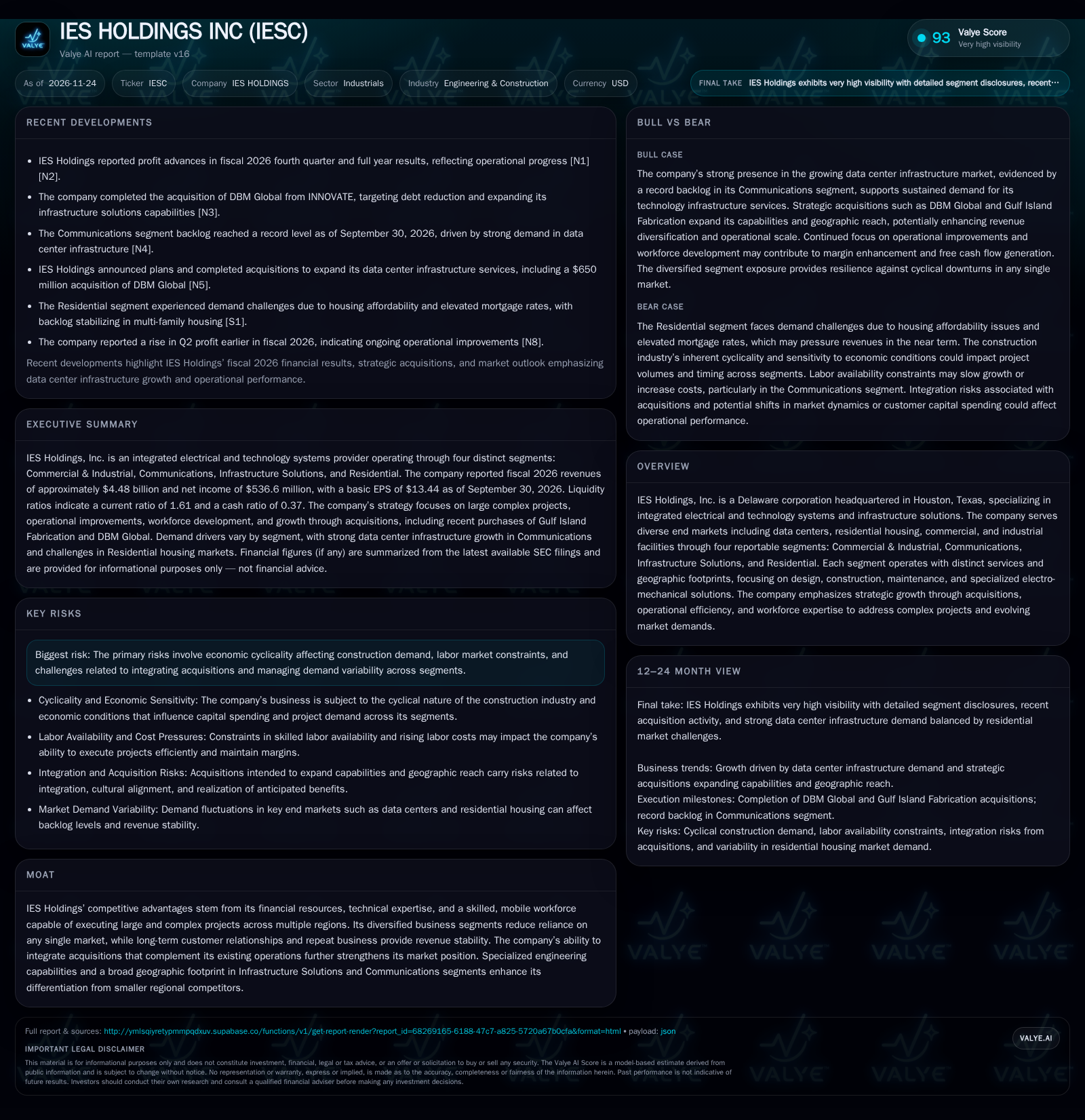
IES Holdings reported $4.48B in revenue and $536.6M net income for FY2026, with a record Communications segment backlog driven by data center demand. Recent acquisitions (DBM Global, Gulf Island Fabrication) expand capabilities and reach. However, the Residential segment faces demand pressure from housing affordability and mortgage rates. Segment diversification and operational focus may support resilience, but cyclical and integration risks remain prominent. [S1]
IES Holdings enters late 2026 with sharply contrasting signals across its business lines: surging demand in data center infrastructure underpins a record Communications backlog, while housing market pressure weighs on Residential segment volumes. The company’s strategic acquisitions and broadening capabilities position it to capture more complex, higher-value projects, but the cyclical nature of construction and the challenges of integrating new businesses remain significant variables. As IES Holdings works to balance operational improvements and market share expansion, the interplay of secular tech infrastructure growth and residential market softness will shape its next phase.
Contrasting Demand Across Segments Sets the 2026 Backdrop
IES Holdings reported approximately $4.48 billion in revenue and $536.6 million in net income for the fiscal year ended September 30, 2026, with basic EPS of $13.44. These figures reflect strong overall performance, but the composition of demand is uneven across segments. The Communications segment posted a record backlog, attributed to sustained demand for data center infrastructure solutions, while the Residential segment struggled with demand headwinds linked to housing affordability and high mortgage rates. Recent acquisitions of Gulf Island Fabrication and DBM Global have expanded IES Holdings’ capabilities and geographic reach, supporting its strategy of targeting larger and more complex projects. The company reported cash and liquidity metrics for the period; these figures do not by themselves establish operating runway, investment capacity, financial flexibility, or financing capacity. [S1]
How Segment Mix and Project Complexity Shape Earnings Power
The core of IES Holdings’ business economics lies in its ability to capture value from large, technically demanding projects across four segments: Commercial & Industrial, Communications, Infrastructure Solutions, and Residential. The Communications segment, buoyed by data center and network infrastructure demand, likely benefits from higher project values and potentially better margins due to complexity and customer stickiness. These projects typically require specialized technical expertise and strong project management, which can create opportunities for operating leverage as scale increases.
The Commercial & Industrial and Infrastructure Solutions segments serve mission-critical and industrial end markets, where custom solutions and recurring maintenance can drive repeat business and margin resilience. The Residential segment, by contrast, is more exposed to volume swings and margin pressure linked to the housing cycle; fixed costs in this segment may amplify volatility when demand falls. The company’s acquisition strategy—most recently with Gulf Island Fabrication and DBM Global—suggests a focus on expanding service breadth and moving up the value chain, which could further improve margin mix if integration is successful.
Pricing power across segments may be limited by the competitive, project-based nature of the construction industry, but technical differentiation and long-term relationships can support premium pricing in specialized niches. Capital intensity is moderate, with working capital needs tied to project timing and backlog conversion; large projects may require upfront investment and careful cash management, especially as the company scales into bigger, more complex contracts.
Technical Depth and Scale as Differentiators in a Fragmented Market
IES Holdings competes in a highly fragmented industry landscape, facing regional and local firms as well as national players in each segment. Its competitive edge is rooted in a combination of financial resources, specialized technical expertise, and a skilled workforce capable of executing large-scale, complex projects. The recent acquisitions of Gulf Island Fabrication and DBM Global further broaden its engineering capabilities and geographic reach, differentiating IES Holdings from smaller competitors that may lack the scale or technical depth to bid on similar projects. [S1]
Long-term customer relationships and repeat business are a strategic focus, particularly in Commercial & Industrial and Communications, where project complexity and mission-critical requirements can increase switching costs. However, the broader construction market remains price-competitive, and barriers to entry for basic installation and maintenance services are relatively low. The company’s diversification across segments—especially its exposure to high-growth infrastructure markets such as data centers—offers some insulation from cyclical downturns in any single end market, but does not eliminate overall economic sensitivity.
If Data Center Demand Remains Relentless, Margin Expansion Could Follow
The most favorable scenario for IES Holdings is one where secular growth in data center infrastructure continues to drive record backlogs and high-margin opportunities in the Communications segment. Sustained investment from hyperscale cloud providers and enterprises in digital infrastructure could support robust project pipelines and allow IES Holdings to command premium pricing for its integrated solutions. Successful integration of Gulf Island Fabrication and DBM Global would further enhance service offerings and cross-segment synergies, supporting both revenue diversification and operational efficiency.
Confirmation of this scenario would come from continued growth in Communications backlog, rising segment margins, and further expansion into other high-value infrastructure verticals. Additional evidence would include new large project wins, successful cross-selling between acquired and legacy businesses, and a mix shift toward higher-margin segments over time.
Segment Diversification Balances Cyclical Swings and Integration Hurdles
The most plausible near-term outcome is one where IES Holdings’ diversified segment exposure provides partial resilience against economic and industry-specific cycles, but does not fully offset them. Communications and Infrastructure Solutions continue to benefit from data center and industrial demand, while the Residential segment faces ongoing volume pressure from housing affordability and mortgage rates—though multi-family backlog stabilizes as rental demand persists.
Integration of recent acquisitions proceeds with some friction but no major setbacks, resulting in incremental capability gains and modest margin improvement. Operating leverage is realized primarily in the Communications and Commercial & Industrial segments, while overall earnings growth reflects a mix of secular tailwinds and cyclical headwinds. Confirmation would come from steady or growing backlog across most segments, stable or gradually improving segment margins, and evidence that integration costs remain manageable relative to anticipated synergies. A sharp contraction in Residential or labor/cost overruns in acquired businesses would challenge this view.
Cyclical Reversal and Integration Missteps Could Undermine Gains
A less favorable outcome would see a pronounced cyclical downturn in construction demand, with the Residential segment experiencing sustained weakness and spillover effects into Commercial & Industrial and Infrastructure Solutions as broader economic conditions deteriorate. If data center buildouts slow or hyperscale investment is delayed, the Communications segment’s backlog could erode, exposing the company to margin compression and underutilized capacity.
Integration risks from Gulf Island Fabrication and DBM Global could materialize as cost overruns, cultural clashes, or failure to capture anticipated synergies, leading to operational disruptions and diluted earnings. Confirmation would come from a shrinking total backlog, declining segment margins, and higher-than-expected integration expenses or write-downs. Prolonged labor shortages or inflationary pressures could further exacerbate cost structures, eroding competitive advantages and financial performance.
How to Test IES Holdings’ Resilience and Growth Ambitions in 2027
Communications segment backlog and new project wins—continued record levels would support the secular growth thesis; a decline would test the durability of data center demand.
Segment margin trends, especially in Communications and Infrastructure Solutions—rising margins would indicate operating leverage and successful integration; flat or declining margins could signal cost pressures or integration issues.
Residential segment backlog and order flow—improvement or stabilization would suggest resilience to housing market headwinds; further deterioration would increase risk.
Pace and cost of integration for Gulf Island Fabrication and DBM Global—a useful metric would be realized synergies versus planned, and any unexpected integration expenses.
Labor availability and wage inflation—if disclosed, tracking workforce utilization rates and labor cost escalation could reveal emerging constraints or margin risks.
Working capital requirements and cash conversion cycle—monitoring changes, especially as project mix shifts toward larger, more complex contracts, would help assess financial discipline.
Customer concentration and exposure to major data center clients—if disclosed, rising dependence on a few large customers could increase revenue volatility.
Disclaimer: This is research-only, informational analysis and not investment advice. It may include AI-generated interpretation and general industry context. Always verify important details using primary sources.

Comments