
Moog Inc.’s Aerospace and Defense Momentum: Can Backlog and Margin Gains Withstand Sector Volatility?
A surge in sales, margin improvement, and a record backlog highlight Moog’s operating leverage in aerospace and defense.
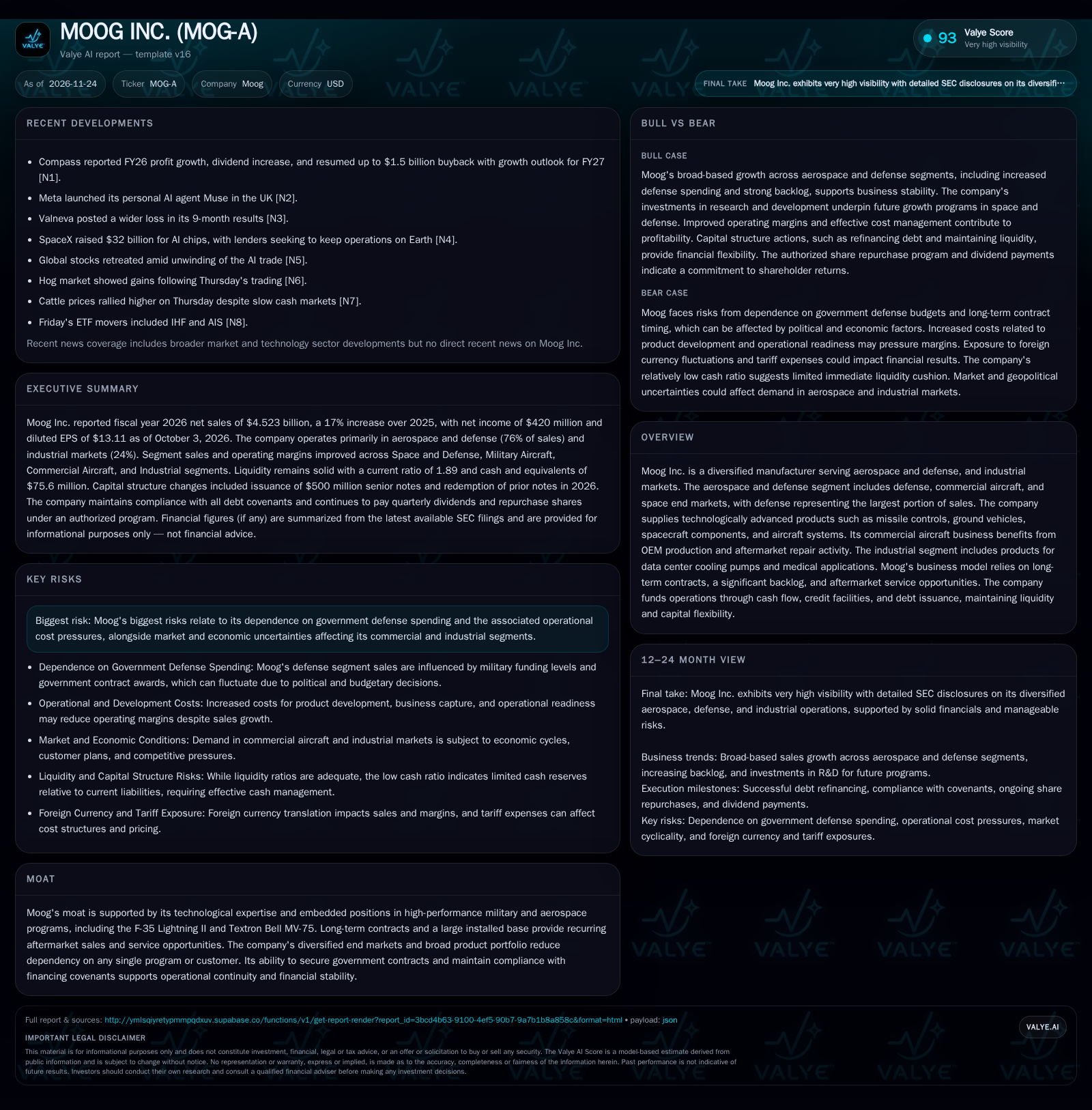
Moog Inc. reported a 17% revenue jump and margin gains in 2026, driven by robust aerospace and defense demand. Monitoring contract flow, cost discipline, and aftermarket activity will be critical for the next phase.
Moog Inc. enters 2027 with strong momentum: double-digit sales growth, improved operating margins, and a record backlog underscore the company’s entrenched role in aerospace and defense supply chains. However, the very factors that fueled recent outperformance—government contract wins, ambitious R&D investment, and reliance on long-cycle programs—also expose Moog to volatility if funding or execution stumbles. The challenge is whether Moog’s operational discipline and diversified end-market reach can offset the sector’s inherent cyclicality and rising cost base.
2026 Surge: Backlog and Margins Set the Stage
Moog’s 2026 net sales reached $4.523 billion, a 17% increase over the prior year, with defense-related sales making up 53% and the overall aerospace and defense segment accounting for 76% of the total [S1]. Operating income and margins improved across all major segments—Space and Defense, Military Aircraft, Commercial Aircraft, and Industrial—reflecting both higher sales and operating leverage. Gross margin ticked up to 28.4% from 27.4%, benefitting from tariff refunds and scale effects [S1]. The company’s backlog expanded to $7.73 billion, up 29%, providing revenue visibility into future periods but also increasing exposure to the timing and health of government and OEM spending cycles [S1].
On the capital side, Moog issued $500 million in 5.50% senior notes due 2034 while redeeming a like amount of 4.25% notes due 2027, and extended its revolving loan commitments to 2031 [S1]. [S1]
How Moog Turns Contracts into Margin: Volume, Mix, and Operating Leverage
Moog’s economics are shaped by the interplay of high-value, long-cycle contracts in aerospace and defense with a diversified but smaller industrial business. Revenue is generated primarily through the sale of advanced components and systems for military aircraft, commercial aviation, and space, as well as industrial applications. Pricing power is typically strongest in defense and space, where technical complexity and program longevity create switching frictions and recurring aftermarket opportunities. Commercial aircraft revenue is more exposed to OEM build rates and airline maintenance cycles, while industrial sales are influenced by broader economic conditions.
Operating leverage is notable: the 2026 margin improvement was driven by both higher volumes (aided by backlog conversion) and business-mix shifts, alongside one-time tariff refunds [S1]. As fixed costs are amortized over rising sales, incremental margin expansion is plausible if volumes continue to rise. However, R&D investment grew 28% in 2026, reflecting Moog’s need to stay competitive on next-generation platforms—raising the bar for future sales growth to offset higher development costs [S1]. The company’s capital needs are largely tied to R&D, working capital for long-cycle programs, and periodic debt refinancing, rather than asset-heavy expansion.
Cash flow is supported by aftermarket service and maintenance contracts, especially in defense and commercial aviation, which can provide recurring revenue streams beyond initial equipment sales. However, the extent of recurring versus one-off revenue is not fully disclosed; aftermarket dynamics and contract structure (e.g., cost-plus vs. fixed-price) will materially affect margin sustainability and risk.
Defensible Niche or Crowded Field? Moog’s Position in Aerospace Supply Chains
Moog’s competitive strength lies in its technological expertise, embedded roles on high-profile military and aerospace programs (such as the F-35 Lightning II and Textron Bell MV-75), and a diversified end-market footprint [S1]. Long-term contracts and a broad installed base in both defense and commercial sectors provide recurring aftermarket opportunities and switching costs for customers. These factors create some insulation from pure price competition, particularly in military and space platforms where qualification and certification hurdles are high.
However, the company operates in a competitive environment alongside other aerospace suppliers, including large diversified manufacturers and specialized subsystem providers. The industrial segment faces even more commoditized competition, with lower switching barriers and more price-sensitive customers. Technology substitution—such as the shift toward advanced electronics, electrification, or new propulsion systems—could threaten legacy product lines if Moog fails to keep pace with R&D and integration.
While Moog’s backlog and installed base offer short- to medium-term stability, the question is whether new program wins and technology upgrades can outpace the natural attrition of aging platforms and offset competitive encroachment from both established peers and emerging entrants.
Sustained Defense Tailwinds and Aftermarket Expansion Drive Earnings Surprise
In a favorable scenario, continued increases in government defense budgets and robust demand for next-generation military and space programs could drive further sales growth and margin expansion for Moog. The company’s $7.73 billion backlog would convert efficiently to revenue, with new contract wins supplementing existing programs. Aftermarket and service revenues may rise as the installed base of equipment grows, creating a higher mix of recurring, higher-margin sales.
Operating leverage would amplify earnings as fixed costs are spread over larger sales volumes, and R&D investments begin to yield new program awards. Confirmation of this scenario would come from: (1) sustained or rising defense and space segment sales; (2) visible program wins or extensions for key platforms; (3) continued gross and operating margin improvement; and (4) aftermarket revenue growth outpacing original equipment sales. Falsification would occur if defense spending stagnates or contracts are delayed/cancelled, eroding the backlog and margin trajectory.
Backlog Conversion Supports Stable Growth, But Cost Pressures and Cyclicality Remain
The most plausible scenario is that Moog’s current backlog and diversified segment performance support moderate top-line growth and steady, if incremental, margin improvement over the next 12-24 months. Defense and space remain the primary growth drivers, but growth rates may normalize from the 2026 surge. R&D spending continues at an elevated pace, supporting future program wins but tempering near-term margin expansion.
Industrial and commercial aircraft sales are likely to remain sensitive to broader economic and airline industry cycles, introducing some volatility. Cost inflation, wage pressures, or supply chain disruptions could erode recent margin gains if not offset by pricing or productivity improvements. Confirmation of the base case would include (1) stable backlog levels and conversion rates; (2) modest, sustained margin progression; and (3) R&D intensity remaining high but manageable as a percentage of sales. The scenario would be challenged if backlog declines, cost overruns rise, or industrial/commercial demand weakens materially.
Defense Budget Cuts or Execution Missteps Erode Backlog and Margins
Adverse outcomes could stem from a contraction in government defense spending, program delays, or cancellations that reduce backlog and impair visibility. Rising R&D or operational costs—without commensurate sales growth—could compress margins, especially if fixed-price contracts expose Moog to cost overruns. [S1]
Industrial and commercial aerospace markets could also weaken in a global economic slowdown, further pressuring top-line growth. Early warning signs would include (1) a sharp drop in new contract awards or backlog; (2) margin contraction despite stable sales; (3) increased drawdowns on credit facilities or delayed dividend/buyback activity; and (4) evidence of program losses to competitors or technological obsolescence.
What Will Determine Moog’s Resilience in the Next Cycle?
Backlog trajectory: Track quarterly changes in total and segment backlog to assess sales visibility and program health.
Segment margin trends: Monitor gross and operating margins by segment, especially in Space and Defense, for signs of cost pressure or scale benefits.
Aftermarket vs. OEM mix: If disclosed, shifts in aftermarket/service revenue versus original equipment sales would indicate margin and revenue durability.
R&D as a percentage of sales: Sustained high R&D investment may be justified by pipeline wins but could signal margin risk if not matched by new business.
Contract award flow: Watch for new defense, space, and commercial aircraft program awards or renewals as forward indicators.
Industrial segment demand: Changes in industrial sales and margins could flag broader macroeconomic or execution issues.
Disclaimer: This is research-only, informational analysis and not investment advice. It may include AI-generated interpretation and general industry context. Always verify important details using primary sources.

Comments