
LCNB CORP: Earnings Fluctuations and Acquisition Strategy Shape Competitive Banking Outlook
LCNB CORP has demonstrated resilience with recent earnings beats and shareholder returns, but faces ongoing volatility tied to acquisition-driven growth and the management of intangible assets. The company's ability to sustain positive momentum amid sector competition and potential asset impairments will shape its future trajectory.
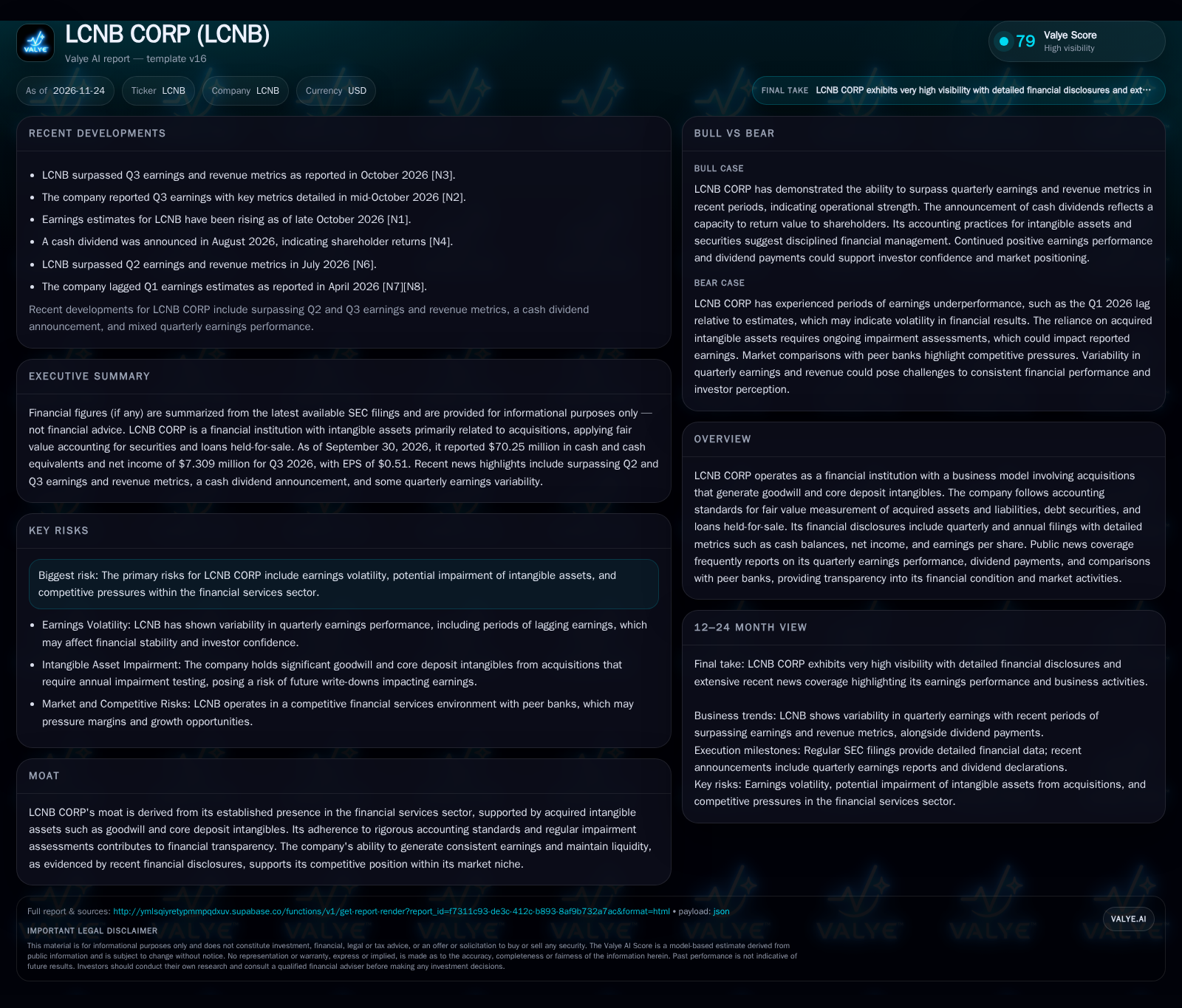
LCNB CORP reported $7.3 million in net income and $70.25 million in cash for Q3 2026, surpassing earnings expectations for both Q2 and Q3 but underperforming in Q1. The company’s results reflect both operational strength and underlying volatility, largely due to its acquisition-driven model and associated intangible assets. Dividends remain a feature, but the risk of impairment and competitive pressure from peer banks remain critical variables for future performance. [S2] [N3] [N6] [N7] [N8]
LCNB CORP stands at a crossroads between demonstrated operational momentum and persistent structural risks. However, the underlying business model—anchored in acquisitions and the management of significant intangible assets—introduces volatility and exposure to impairment charges. As LCNB competes in a crowded community banking sector, its ability to maintain earnings consistency and manage balance sheet risks will be central to its future value proposition.
Recent Earnings Beats and Dividend Stability Define 2026 Operating Snapshot
As of September 30, 2026, LCNB reported $7.309 million in net income for Q3 and held $70.25 million in cash and cash equivalents, with basic and diluted EPS at $0.51 per share [S2]. The company exceeded earnings and revenue expectations in both Q2 and Q3 2026, reversing a Q1 performance shortfall earlier in the year [N3] [N6] [N7] [N8]. The cited source reports dividend-related activity; that disclosure alone does not establish dividend-policy continuity, management confidence, or a material constraint on capital flexibility. [N4] These developments collectively reflect a period of operational strength, but the quarterly variability highlights persistent earnings volatility.
Acquisition-Driven Model: Intangible Assets and Profitability Dynamics
LCNB’s core business model is predicated on traditional community banking—originating loans, managing deposits, and investing in securities—augmented by acquisitions that generate goodwill and core deposit intangibles [S1]. Revenue is primarily derived from net interest income (the spread between interest-earning assets and liabilities), with non-interest income contributed by fees and other banking services. The use of acquisitions can provide scale, new customer bases, and operational synergies, but also introduces amortization costs and the risk of periodic impairment charges if acquired assets underperform.
Operating leverage in this context depends on the ability to grow earning assets without proportionally increasing fixed costs. However, integration costs from acquisitions, as well as potential writedowns of goodwill or core deposit intangibles, can dampen margin expansion. The bank’s practice of fair value accounting for securities and lower-of-cost-or-market for loans held-for-sale further exposes reported results to market fluctuations. Capital needs are influenced by regulatory requirements and the necessity to maintain sufficient buffers for loan losses and potential asset impairments.
The interplay between acquisition-driven growth and organic expansion also influences capital allocation decisions. When acquisitions generate goodwill and core deposit intangibles, management must weigh the trade-offs between pursuing further deals and investing in internal growth initiatives such as technology upgrades or product innovation. If the pace of acquisitions accelerates without proportional improvements in integration efficiency, the risk of impairments may increase, potentially undermining profitability. Conversely, a disciplined acquisition strategy that targets assets with complementary customer bases and cost structures can enhance franchise value and create sustainable earnings growth over time.
Moreover, the amortization of intangible assets, while non-cash, affects reported earnings and can obscure underlying operating performance. Investors and analysts often adjust for these accounting impacts to assess core profitability. However, the timing and magnitude of impairment tests introduce earnings uncertainty, especially in volatile economic conditions or shifting interest rate environments. Therefore, the company’s ability to maintain credit quality and asset performance is critical not only for cash flow generation but also for preserving intangible asset values on the balance sheet. This dynamic underscores the importance of robust risk management and conservative underwriting standards within an acquisition-led growth model.
Peer Banks, Margin Pressure, and the Challenge of Differentiation
LCNB operates in a highly competitive regional and community banking sector, vying for deposits and lending opportunities against similarly sized institutions and larger regional players. While acquisitions have enabled LCNB to expand its footprint, the bank faces ongoing pressures from both traditional banks and non-bank financial service providers. Margin compression remains a structural risk, particularly as deposit costs fluctuate and loan growth becomes more competitive.
The presence of significant intangible assets on the balance sheet may offer some insulation through established customer relationships and brand goodwill, but these are not inherently durable moats. Competitors can replicate product offerings and, in a rising-rate or credit-tightening environment, customer churn could increase if LCNB’s pricing or service levels lag peers. Technology adoption and digital banking capabilities will also be factors in retaining and growing market share, especially as younger demographics demand more seamless financial experiences.
Sustained Outperformance Through Integration and Credit Quality Management
An optimistic scenario for LCNB hinges on the successful integration of acquired institutions, leading to expense synergies, deeper customer relationships, and improved operating efficiency.
Confirmation of this scenario would require continued positive earnings surprises, stable or improving net interest margins, and minimal impairment charges over subsequent quarters. Evidence such as rising EPS, consistent dividend increases, and manageable non-performing asset levels would further validate the case for durable outperformance.
Earnings Volatility Balances Out: Growth Offset by Integration and Impairment Risks
The most plausible trajectory for LCNB is one of moderate growth punctuated by periodic earnings variability. The company’s acquisition-driven strategy is likely to deliver incremental scale and revenue, but integration costs, potential goodwill impairments, and fluctuating net interest margins will intermittently weigh on profitability. Dividend payments are likely to remain a feature, but the pace of increases may slow if earnings growth becomes less predictable.
This scenario would be confirmed by a pattern of quarterly earnings that occasionally miss consensus estimates, offset by periods of outperformance, and a generally stable, but not rapidly growing, dividend. Watchpoints would include the frequency and size of impairment charges, changes in loan quality metrics, and the ability to maintain or grow net interest margin in a competitive rate environment.
Adverse Credit Cycles and Asset Impairments Erode Profitability
A negative scenario emerges if LCNB faces a deteriorating credit environment—manifesting in rising loan defaults or delinquencies—while also encountering impairment of its significant intangible assets. This could result in material writedowns, reduced earnings, and potential pressure on regulatory capital ratios. If acquisition integration falters or cost synergies fail to materialize, operating expenses could escalate, further eroding profitability.
This downside would be confirmed by a series of earnings misses, rising non-performing assets, large one-time impairment charges, and potential dividend cuts or suspensions. External signals might include sector-wide credit tightening, negative peer bank results, or regulatory scrutiny over asset quality and capital adequacy.
Testing LCNB’s Thesis: Performance, Integration, and Asset Quality Benchmarks
Quarterly net interest margin trends—sustained expansion would suggest pricing power, while compression could indicate intensifying competition or funding pressure.
Non-performing asset ratio—if disclosed, a rising ratio would signal credit deterioration and potential future loan losses.
Size and frequency of goodwill or core deposit intangible impairment charges—material writedowns would directly impact earnings stability.
Quarterly EPS and revenue beats/misses—continued outperformance or volatility will provide real-time feedback on execution and market standing.
Loan growth and deposit inflow rates—these metrics, if disclosed, would indicate underlying franchise health and competitive positioning.
Expense efficiency ratio—a useful metric to assess whether acquisition integration is delivering promised synergies or if costs are escalating.
Disclaimer: This is research-only, informational analysis and not investment advice. It may include AI-generated interpretation and general industry context. Always verify important details using primary sources.

Comments