
Energous Corp: Can Wireless Power and Battery-Free Tags Scale Beyond Niche Adoption?
Energous Corp’s push into wireless power and battery-free smart tag technology has delivered bursts of revenue growth and secured contracts with multinational retailers, yet persistent net losses and a competitive, fast-evolving landscape raise questions about long-term economic viability and adoption curves.
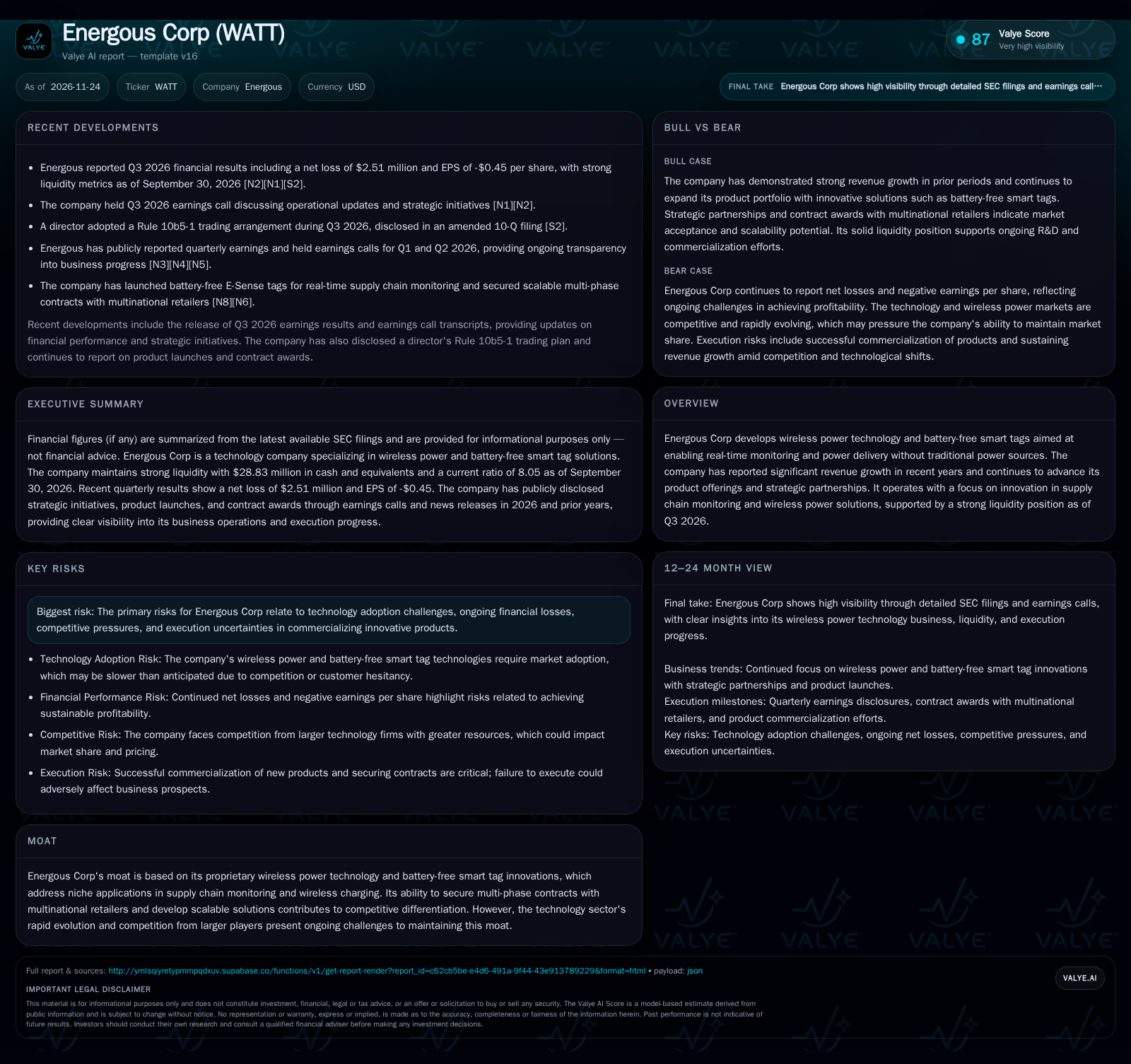
Energous Corp develops wireless power and battery-free smart tag solutions, recently reporting a net loss of $2.51 million for Q3 2026 despite reported liquidity position. The company’s product launches and multi-phase contracts with major retailers demonstrate commercial traction, but ongoing losses and the need for broader adoption in a competitive market remain critical hurdles. The next phase hinges on whether Energous can translate innovation and early contracts into durable, scalable profitability.
Energous Corp stands at a strategic crossroads in the wireless power and smart tag ecosystem.
Recent Financials and Commercial Wins Shape the Near-Term Outlook
As of September 30, 2026, Energous Corp reported $28.83 million in cash and cash equivalents, with current assets of $41.71 million and current liabilities of $5.18 million—yielding a current ratio of 8.05 and a cash ratio of 5.56 [S2] [N2]. This positions the company with substantial liquidity relative to its obligations. However, the company posted a net loss of $2.51 million for Q3 2026, equivalent to -$0.45 per share [S2] [N2].
On the commercial front, Energous has launched its battery-free E-Sense tag for real-time supply chain monitoring and secured scalable, multi-phase contracts with multinational retailers [N6] [N8]. These developments signal both product advancement and external validation, yet persistent net losses underscore that the current revenue base does not yet cover operating expenses.
The company’s publicly reported quarterly earnings and active disclosure of strategic initiatives—such as the adoption of a Rule 10b5-1 trading plan by a director—underscore a commitment to transparency but do not signal a shift in underlying profitability or adoption pace [S2].
How Energous’s Model Could Scale—and Where Profitability May Stall
Energous’s core business model centers on the commercialization of wireless power technology and battery-free smart tags for applications such as real-time supply chain monitoring. Revenue streams likely derive from a mix of hardware sales (e.g., E-Sense tags and transmitters), software or platform integrations, and potentially recurring service or data fees if the offering evolves into a full-stack monitoring solution.
The company’s recent contract wins and product launches suggest initial traction, but the economics of scaling remain unproven. Hardware-centric models are typically capital intensive, with gross margins pressured unless proprietary technology delivers clear cost or functional advantages. If Energous can shift toward a recurring-revenue model—either via SaaS-like platforms or managed service contracts—operating leverage could improve as fixed R&D and SG&A costs are spread over a growing user base.
Capital needs remain a relevant consideration: Energous filed an $80 million mixed securities shelf in December 2024, indicating openness to further capital raising [S1]. The company reported cash and liquidity metrics for the period; these figures do not by themselves establish operating runway, investment capacity, financial flexibility, or financing capacity.
Proprietary Tech vs. Industry Giants: Energous’s Differentiation and Its Limits
Energous asserts a moat based on proprietary wireless power transmission and battery-free smart tag innovations. These address pain points in supply chain monitoring—particularly in environments where battery maintenance is costly or infeasible. The ability to secure contracts with multinational retailers suggests real-world validation and potential for sticky deployments, especially if switching costs and integration complexity rise as customers scale usage.
However, the wireless power and IoT device space is highly competitive, with larger technology firms able to invest heavily in R&D and leverage existing customer relationships. Energous faces the risk that these incumbents could either replicate similar functionality or bundle competing solutions as part of broader enterprise platforms, eroding Energous’s pricing power or compressing margins.
Technology substitution remains a looming threat: advances in low-power Bluetooth, energy harvesting, or alternative wireless charging protocols could reduce the relative advantages of Energous’s approach, especially if standards shift or integration with legacy infrastructure proves challenging.
From Niche Wins to Platform Adoption: What a Durable Growth Story Would Require
The upside scenario for Energous hinges on converting initial contract wins and product launches into broad, recurring deployments across large enterprise customers. This would require not only successful execution on current multi-phase contracts but also demonstrable ROI for customers, leading to repeat orders and expansion into adjacent applications (e.g., asset tracking, inventory management, or environmental monitoring).
Confirmation would come from sequential increases in contract value, rising deployment volumes across multiple customer sites, and evidence of a shift toward recurring revenue—such as multi-year service contracts or platform subscriptions. Gross margin expansion would signal successful value capture, while reductions in net loss or movement toward profitability would validate the scalability of the model.
Falsification would be indicated by stagnation in contract size or scope, inability to secure add-on business, or customer churn in early deployments. If Energous remains dependent on one-off hardware sales with no clear path to recurring revenue, the upside case weakens considerably.
Incremental Growth, Persistent Losses: The Most Likely Trajectory Absent a Step-Change
The most plausible scenario is that Energous continues to secure incremental contract wins and expands its installed base in supply chain monitoring and adjacent markets. Revenue may grow in bursts as new deployments are booked, but operating losses persist due to the high fixed costs of R&D, sales, and support.
Evidence supporting this path would include continued reporting of net losses alongside periodic revenue spikes, modest gross margin improvements, and a slow but steady increase in deployment footprint.
Falsification would require either a clear inflection in recurring revenue or a sustained drop in contract wins, suggesting market resistance or technological obsolescence.
Commercialization Gaps, Adoption Hesitancy, and the Threat of Displacement
The bearish scenario centers on the risk that Energous’s technology remains confined to pilot deployments or niche use cases, with broader market adoption stalling due to integration challenges, customer hesitancy, or superior alternatives from larger competitors.
In this world, revenue growth tapers off, net losses widen as fixed costs persist, and the company is forced to either dilute shareholders through additional capital raises or scale back operations. Confirmation would include contract cancellations or non-renewals, a shrinking customer pipeline, or a marked increase in competitive pricing pressure.
Falsification of the downside would require clear evidence of successful scale-up—such as multi-year contract renewals, new vertical penetration, or a pivot to a software-centric, high-margin business model that reduces reliance on hardware sales.
Milestones That Will Reveal Whether Energous Can Break Out of the Niche
The size, renewal rate, and expansion of current multi-phase contracts with multinational retailers—if disclosed—would clarify whether early wins are translating into long-term, scalable customer relationships.
Gross margin trends by segment (hardware vs. potential services/software), if reported, would help test whether the business is moving toward higher-value, recurring revenue streams.
Sequential revenue growth and the visibility of backlog or contracted pipeline would indicate whether the adoption curve is steepening or plateauing.
Operating expense discipline and the ability to narrow net losses over successive quarters would signal progress toward sustainable economics.
Any disclosure of new verticals or geographies entered—beyond current supply chain monitoring use cases—would suggest market expansion potential.
Updates on competitive pricing dynamics or customer feedback regarding Energous’s solution vs. alternatives would provide insight into defensibility and price elasticity.
Capital raising activity or changes in cash burn rate would give clues about the urgency of profitability and the risk of shareholder dilution.
Disclaimer: This is research-only, informational analysis and not investment advice. It may include AI-generated interpretation and general industry context. Always verify important details using primary sources.

Comments