
Aspire Biopharma: Sublingual Platform Progresses from Cardio Emergency to Consumer Supplements
Aspire Biopharma leverages a patent-pending sublingual drug delivery system, targeting both acute cardiovascular care and high-velocity supplement markets. With positive clinical results for its lead aspirin candidate and early revenue from diversified formulations, the company’s dual-pronged strategy faces classic regulatory, manufacturing, and liquidity hurdles.
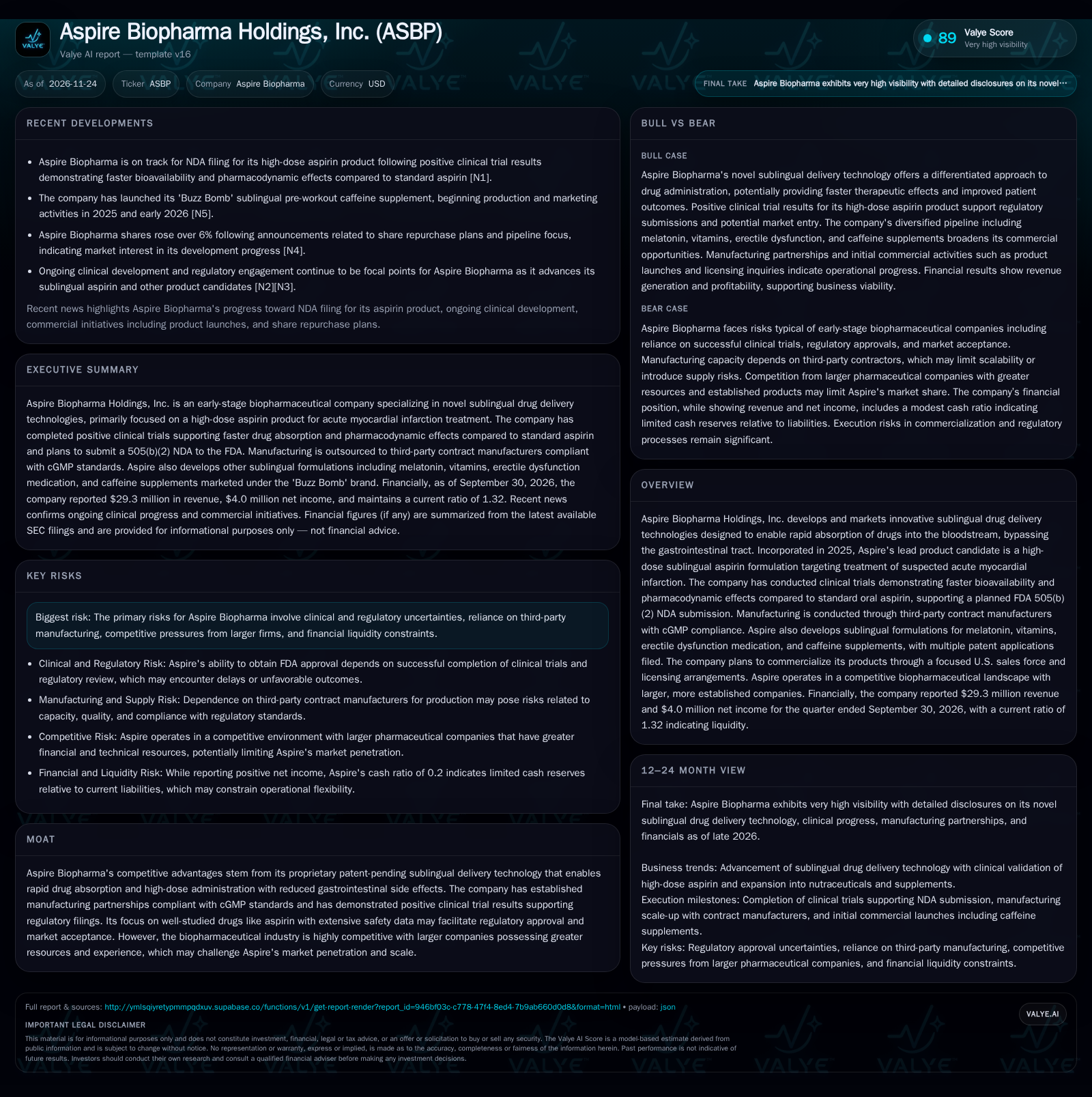
Aspire Biopharma has demonstrated faster drug absorption with its sublingual aspirin, aims for FDA approval via a 505(b)(2) pathway, and is generating initial revenue from both pharmaceutical and supplement products. Early revenue and clinical validation are promising, but execution in commercialization and cash management will determine the company’s trajectory. [S1] [S2]
Aspire Biopharma represents a rare blend in early-stage biotech: a proprietary drug delivery platform with both clinical and commercial traction. Its lead sublingual aspirin candidate—designed for rapid intervention in acute myocardial infarction—has completed clinical trials showing superior bioavailability versus standard oral formulations. The company is not waiting for regulatory approval to build momentum, as it has launched supplement products and generated meaningful revenue. Yet Aspire’s path forward is shaped by familiar industry hurdles: FDA review, manufacturing scale-up via third parties, and the need to defend its niche against established pharmaceutical giants. Liquidity is positive but not robust, underscoring the importance of execution in the next phase. [S1] [S2]
Recent Achievements Anchor Aspire’s Transition from Clinic to Market
Aspire Biopharma’s most material developments center on its patent-pending sublingual delivery technology, which has demonstrated faster absorption and pharmacodynamic effects for high-dose aspirin in clinical trials. This positions Aspire to submit a 505(b)(2) NDA to the FDA for acute myocardial infarction treatment, with pre-IND meetings and supportive FDA feedback already in hand. [S1]
Financially, Aspire reported $29.3 million in revenue and $4.0 million in net income for the quarter ended September 30, 2026—an unusual accomplishment for a company at this stage. [S2] The launch of the 'Buzz Bomb' sublingual caffeine supplement and other formulations shows Aspire’s intent to monetize its platform beyond prescription drugs. [N5]
The company reported cash and liquidity metrics for the period; these figures do not by themselves establish operating runway, investment capacity, financial flexibility, or financing capacity. [S2] The company’s reliance on third-party cGMP manufacturers, including Glatt and Microsize, is central to its ability to scale production and meet regulatory standards. [S1]
Sublingual Platform Economics: Fixed R&D, Outsourced Production, and Mixed-Margin Product Suite
Aspire’s economic model is shaped by the capital intensity of drug development, the variable costs of third-party manufacturing, and a product mix spanning regulated pharmaceuticals and consumer supplements. The up-front costs are dominated by R&D, clinical trials, and regulatory submissions, with fixed costs likely to be significant during the development phase. By outsourcing manufacturing to established cGMP partners, Aspire avoids heavy investment in plant and equipment, but may sacrifice some gross margin and control over quality or timelines.
Once approved, the high-dose sublingual aspirin could command premium pricing in the acute care setting, especially if it demonstrates meaningful clinical advantages (such as faster onset in heart attack intervention). However, pricing power will be constrained by reimbursement dynamics and payer acceptance, especially in a genericized drug category.
The supplement side (melatonin, vitamins, caffeine under 'Buzz Bomb') is likely to be lower-margin but higher-velocity, with revenue driven by volume and brand differentiation. Success in this segment depends on marketing efficiency, channel reach, and the ability to defend intellectual property in a crowded market. The reported net income ($4.0M) and positive EPS suggest early operating leverage, but sustainability will depend on cost discipline and the mix shift between high-margin pharma and lower-margin supplements. [S2]
Can Aspire’s Patent-Pending Delivery System Defend Its Niche Amid Pharma Heavyweights?
Aspire’s primary moat is its proprietary sublingual delivery technology, designed to enable faster absorption and potentially higher efficacy for both pharmaceuticals and supplements. The company has filed multiple patent applications, but in pharmaceuticals, intellectual property alone may not deter larger firms with the resources to innovate around patents, invest in similar delivery systems, or simply outspend Aspire in clinical development and marketing.
The acute care aspirin market is crowded with entrenched oral and intravenous formulations, many of which are generic and benefit from established clinical trust. Aspire competes on speed of action, convenience, and potentially reduced gastrointestinal side effects. However, larger pharmaceutical companies possess deeper sales networks, greater regulatory experience, and established payer relationships, making market penetration challenging.
In supplements, barriers to entry are weaker. The success of 'Buzz Bomb' and other products will hinge on brand-building, consumer loyalty, and the ability to demonstrate a tangible benefit from sublingual delivery. Competing against a fragmented field, Aspire must differentiate on both product efficacy and marketing.
What If Aspire’s Sublingual Aspirin Achieves Rapid Clinical Adoption?
The most favorable trajectory for Aspire involves swift FDA approval of its high-dose sublingual aspirin, followed by rapid uptake in emergency and acute care settings. This would require clear evidence—both clinical and real-world—of improved patient outcomes versus standard oral or IV aspirin, such as faster platelet inhibition translating into better survival or reduced complications.
If Aspire can leverage supportive clinical data and FDA feedback into favorable labeling and reimbursement, the product could be adopted as a new standard of care for suspected heart attacks. This would drive high-margin, recurring sales, especially if guidelines or protocols incorporate the sublingual formulation.
Further upside could come from successful cross-selling of the platform into other acute or chronic indications, or through licensing deals with larger pharmaceutical partners. Confirmation would include FDA approval, guideline inclusion, strong hospital ordering, and expansion of manufacturing capacity. Falsification would be signaled by regulatory setbacks, weak sales traction post-approval, or failure to secure payer support.
Platform Monetization Proceeds in Parallel: Incremental Drug Launches, Gradual Adoption, and Supplement Growth
The most plausible path is a steady, multi-segment rollout: Aspire’s aspirin NDA moves through FDA review, with an initial focus on niche adoption in select emergency departments and cardiology practices. Simultaneously, the company leverages its platform and cGMP partnerships to launch additional supplement and over-the-counter products, building brand awareness and cash flow while awaiting regulatory milestones.
Revenue growth is driven by a mix of pharmaceutical and supplement sales, but margins are pressured by third-party manufacturing costs and the relatively lower profitability of consumer products. The company’s current liquidity supports short-term operations, but further investment or licensing partnerships may be needed to fund large-scale commercialization and pipeline expansion.
Confirmation would come from incremental market share gains in both acute care and supplements, successful NDA progress, and visible growth in manufacturing and distribution agreements. Falsification would be signaled by regulatory or clinical trial delays, channel conflicts, or inability to scale production cost-effectively.
Execution Gaps: Regulatory Delays, Manufacturing Disruptions, and Liquidity Stress
Adverse outcomes could materialize if Aspire encounters regulatory setbacks—such as FDA requests for additional data, extended review timelines, or non-approval—which would stall the launch of its lead aspirin product and drain resources. Manufacturing disruptions, whether from quality lapses at third-party partners or supply chain bottlenecks, could delay product launches across both pharma and supplement lines.
If revenue growth stalls or margins compress, Aspire may face liquidity stress, forcing it to raise dilutive capital or cut investment in R&D and commercialization. Competitive responses from larger players—such as new sublingual or rapid-acting formulations—could erode Aspire’s differentiation before it achieves scale.
Downside confirmation would include regulatory setbacks, missed launch timelines, manufacturing quality issues, or deteriorating net income/cash flow. Falsification would require evidence of resilient revenue and margin performance despite operational headwinds.
Milestones and Metrics to Probe Aspire’s Platform Viability and Commercial Traction
FDA acceptance of the 505(b)(2) NDA for sublingual aspirin, and progress toward regulatory approval.
Incremental clinical data releases or real-world evidence showing superior outcomes for the sublingual aspirin versus standard of care, if disclosed.
Quarterly revenue and net income trends, particularly the mix between pharmaceutical and supplement sales.
Gross margin evolution as manufacturing scales and product mix shifts; a useful metric would be product-level margins, if disclosed.
Updates on manufacturing capacity, quality compliance, and supply chain reliability from third-party partners.
Market penetration metrics for the 'Buzz Bomb' caffeine supplement and other consumer products; a useful metric would be unit sales or market share, if disclosed.
Announcements of licensing, co-marketing, or distribution partnerships with larger pharmaceutical or supplement companies.
Disclaimer: This is research-only, informational analysis and not investment advice. It may include AI-generated interpretation and general industry context. Always verify important details using primary sources.

Comments