
Ashland Inc.: Specialty Ingredients Diversification Meets Margin Pressure and Strategic Uncertainty
Ashland Inc.'s broad specialty chemicals portfolio and global reach provide exposure to resilient end markets, but recent earnings volatility, environmental liabilities, and potential M&A talks highlight a business at a critical strategic juncture.
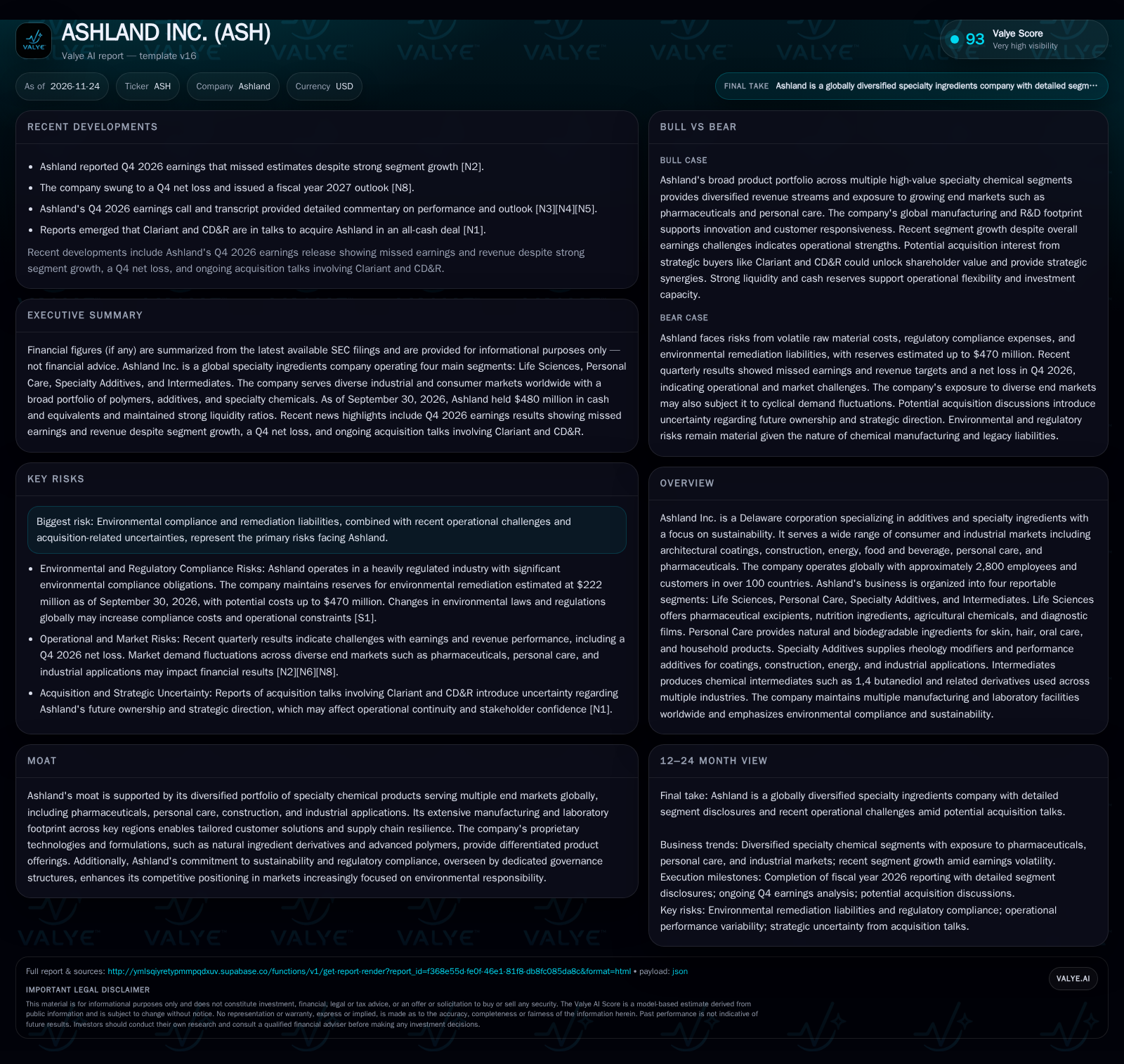
Ashland Inc. operates across four specialty chemicals segments with global scale, reported liquidity position, and a focus on sustainable ingredients. Despite robust segment growth in 2026, the company missed Q4 earnings and revenue estimates and reported a net loss, underscoring ongoing margin and cost challenges. Reports of acquisition interest from Clariant and CD&R add further uncertainty to Ashland's future direction. Environmental compliance costs remain a significant overhang, with reserves potentially rising to nearly $470 million.
Ashland Inc., a global specialty additives and ingredients provider, finds itself at a crossroads as it balances resilient segment growth with persistent margin and regulatory headwinds. While the company’s diversified portfolio spans high-value markets from pharmaceuticals to personal care, recent earnings disappointments and looming environmental costs have weighed on performance. Add to this the backdrop of reported acquisition discussions with Clariant and CD&R, and Ashland’s next chapter may hinge as much on external decisions as internal execution. For investors, the core question is whether Ashland’s broad specialty focus and financial resources can offset cyclical and regulatory pressures—or whether strategic change is imminent.
Earnings Misses, Segment Growth, and M&A Rumors Reshape the Narrative
Ashland’s Q4 2026 earnings release revealed a net loss and missed both earnings and revenue estimates, despite reporting strong growth within its operating segments [N2] [N6] [N8]. This disconnect suggests that while end-market demand for certain specialty ingredients remains healthy, cost pressures or mix shifts are eroding overall profitability. As of September 30, 2026, the company reported $480 million in cash and equivalents, with a current ratio of 2.96, signaling reported liquidity position [S1]. However, environmental remediation liabilities remain significant, with $222 million reserved and potential exposure up to $470 million [S1]. Adding to the uncertainty, reports surfaced in late November 2026 that Clariant and private equity firm CD&R are in acquisition talks with Ashland, potentially leading to a change in ownership or strategic direction [N1].
How Ashland’s Product Mix and Cost Structure Shape Profitability
Ashland’s business model is built on the supply of high-value specialty chemicals and ingredients rather than commodity bulk chemicals, allowing for generally higher margins and reduced direct price competition. Its four key segments—Life Sciences, Personal Care, Specialty Additives, and Intermediates—each address diverse end markets, which should, in theory, buffer cyclicality. The economic engine relies on a mix of proprietary polymers (notably cellulosics and polyvinylpyrrolidones) and bio-based or functional additives, with potential for pricing power in regulated or high-performance niches [S1].
Revenue growth may be driven by innovation, regulatory trends favoring sustainable or bio-based ingredients, and customer stickiness in pharmaceutical and personal care applications. However, the cost structure is exposed to raw material volatility, regulatory compliance costs, and the need for ongoing R&D and capital investment to maintain technical differentiation. Operating leverage can be significant if volumes rise in fixed-cost-intensive segments (such as manufacturing for Life Sciences or Additives), but margin compression is possible if input costs outpace pricing or if environmental liabilities escalate. The Intermediates segment, with products like 1,4 butanediol, is more exposed to cyclical and commodity-like pricing, which can amplify earnings volatility.
Differentiation in Specialty Chemicals: Advantages and Pressures
Ashland’s competitive positioning is underpinned by its ability to serve a wide range of high-value end markets, including pharmaceuticals, personal care, construction, and industrial applications, with specialized ingredients and additives [S1]. Proprietary technologies, such as advanced polymers and natural derivatives, support product differentiation and may increase switching costs for customers, especially in regulated or performance-critical applications (e.g., pharmaceutical excipients or advanced rheology modifiers).
However, the specialty chemicals landscape is highly competitive, with multinational players in each segment—ranging from global chemical conglomerates to focused specialty ingredient suppliers. Innovation cycles, customer consolidation, and sustainability requirements are raising the bar for differentiation. Ashland’s global manufacturing and R&D footprint provides some scale and responsiveness advantages, but it also brings complexity and exposure to regional regulatory regimes. Environmental and compliance costs are a persistent counterforce, as are input cost swings and the risk of commoditization in less differentiated product lines.
If Innovation and Regulatory Tailwinds Translate to Margin Expansion
A favorable outcome for Ashland would see continued segment-level growth translating into consolidated margin expansion. This could occur if new product launches in Life Sciences or Personal Care command premium pricing, and if Ashland is able to pass through higher input costs to customers, particularly in regulated or high-specification end markets. Regulatory trends toward sustainability, natural ingredients, and supply-chain transparency could further shift demand toward Ashland’s bio-based and specialty offerings, enhancing both pricing power and customer retention.
Confirmation of this scenario would come from sustained growth in sales of high-margin polymers and biofunctionals, improving gross and operating margins, and evidence that environmental and compliance costs are stabilizing or declining as a percentage of sales. Successful innovation pipelines and expanded long-term supply agreements in pharmaceuticals, personal care, or nutrition would also support the bull case. Evidence against this scenario would be continued earnings misses, margin compression, or material increases in compliance and remediation costs.
Resilient Segments Offset by Cost and Regulatory Drag
The most plausible outlook is that Ashland’s diversified specialty portfolio continues to generate steady demand from core end markets, particularly in pharmaceuticals and personal care, but that consolidated profitability remains under pressure from input cost volatility, persistent environmental liabilities, and cyclical softness in more commodity-like segments such as Intermediates.
Confirmation would come from stable or modestly growing revenues in Life Sciences and Personal Care, flat to slightly compressed margins, and steady environmental reserve balances. Falsification would involve either a sharp deterioration in core segment demand, a step-function increase in compliance costs, or the inability to pass through input cost increases.
Escalating Environmental Liabilities and Margin Erosion
A negative trajectory for Ashland would be driven by a convergence of rising environmental remediation costs, inability to offset raw material inflation, and slowing demand in key end markets. If regulatory scrutiny intensifies or if legacy environmental exposures require larger-than-expected cash outlays (with reserves currently capped at $470 million), operating cash flow could be materially constrained. Margin erosion could accelerate if price competition increases in commoditized product lines or if customers shift to alternative suppliers amid cost pressures.
Early evidence for this scenario would include upward revisions to environmental reserves, continued net losses, declining cash balances, or a pronounced drop in segment revenues. Further downside could be triggered if M&A talks fall through and the company is left with reduced strategic flexibility and heightened investor uncertainty.
What Could Shift Ashland’s Thesis in the Next 12-24 Months
Segment-level revenue and margin trajectories in Life Sciences and Personal Care (if disclosed) would clarify whether premium products are offsetting broader market and cost pressures.
Trends in environmental remediation reserves and actual cash outflows—especially if new regulatory actions or site liabilities emerge.
Gross and operating margin progression quarter-over-quarter, particularly in the context of input cost volatility and pricing actions.
Progress and market uptake of new product launches, especially in bio-based ingredients and pharmaceutical excipients.
Updates on the status and terms of any potential acquisition by Clariant or CD&R, as these could fundamentally alter the company’s strategy and capital allocation.
Customer retention rates, contract durations, and renewal dynamics in regulated end markets (if disclosed), which would indicate switching costs and revenue visibility.
Capital expenditure trends and R&D investment levels, as signals of management’s commitment to innovation and long-term differentiation.
Disclaimer: This is research-only, informational analysis and not investment advice. It may include AI-generated interpretation and general industry context. Always verify important details using primary sources.

Comments