
Global Interactive Technologies: Can Faning’s Niche and Community Model Overcome Early-Stage Commercialization?
The company's future hinges on activating and monetizing its global fan community amid intensifying competition and evolving digital engagement models.
Global Interactive Technologies (GITS) is commercializing Faning, a digital fan engagement platform for Korean entertainment, leveraging a large historical user base and a multilingual, community-driven approach. The key strategic question is whether Faning can convert registered users into active, paying fans quickly enough to establish sustainable growth before funding constraints become critical. [S2]
Global Interactive Technologies, Inc. stands at a crucial juncture as it seeks to transform Faning—a digital platform centered on Korean entertainment—into a global hub for fan engagement and monetization. The interplay of community-driven features, multilingual engagement, and diversified monetization will be tested against formidable competitive forces as the company strives to convert its cultural niche into a defensible business.
Faning’s Early-Stage Launch Meets Financial Headwinds
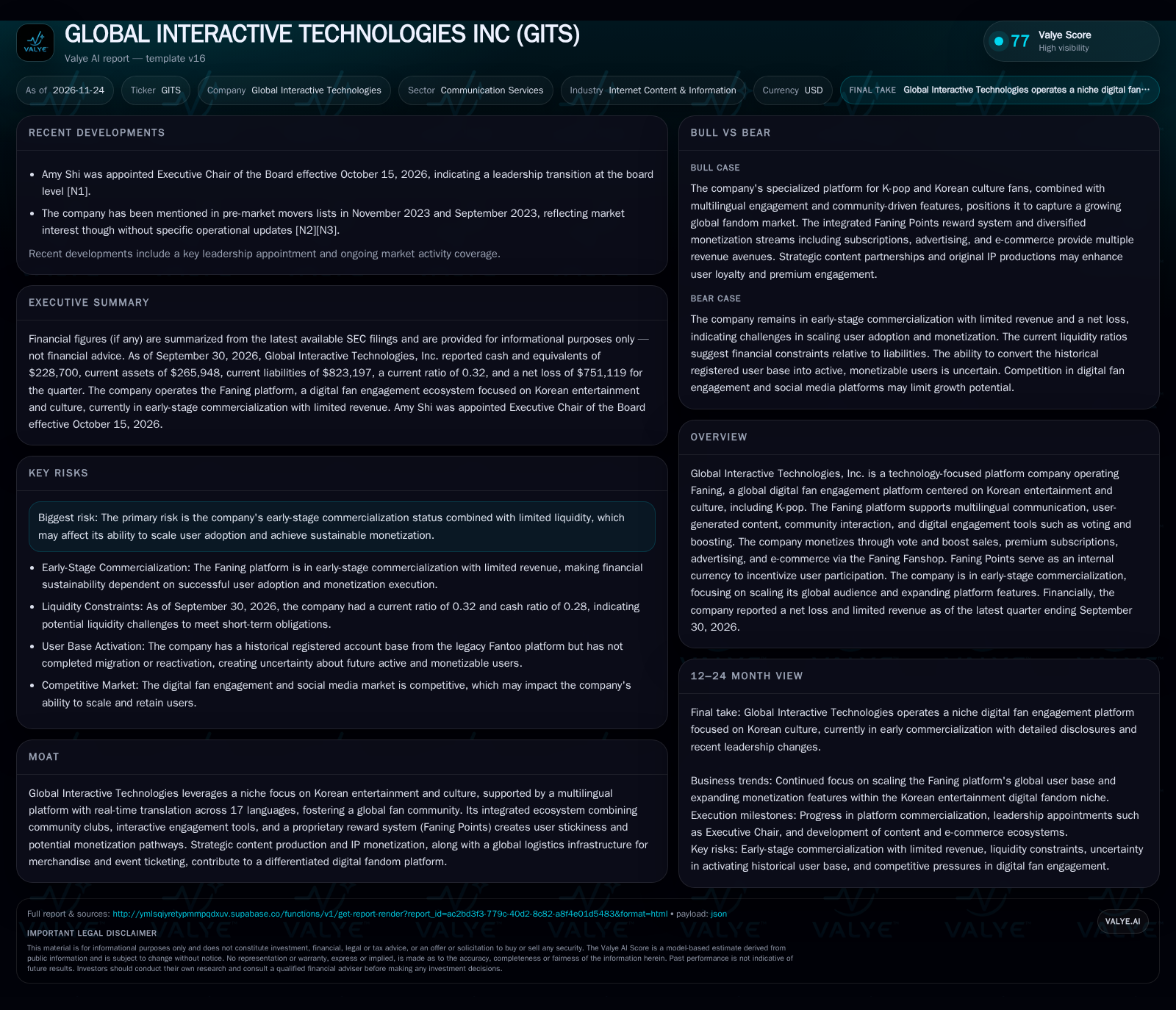
Global Interactive Technologies has shifted the Faning platform from development to early-stage commercialization as of December 2025, aiming to capture a global audience in the K-pop and Korean culture space. The platform is designed for multilingual interaction across 17 languages and leverages community features such as Clubs, interactive voting, and boosting tools to drive engagement. [S2]
Despite these ambitions, the company reported a net loss of $751,119 for the quarter ending September 30, 2026, with limited revenue traction to date. Cash and equivalents stood at $228,700, while current liabilities totaled $823,197, resulting in a current ratio of just 0.32. These figures highlight a precarious liquidity position as the company seeks to scale. [S2]
A key asset is the legacy user base from the Fantoo platform, with approximately 27 million registered accounts—though the extent of active and monetizable migration remains uncertain. Leadership transition is also underway, with Amy Shi appointed Executive Chair of the Board in October 2026, potentially indicating a renewed focus on execution. [N1]
How Faning’s Monetization Model Could Scale—And Where It May Struggle
Faning’s business model is built on multiple, complementary revenue streams: microtransactions (vote & boost sales), premium subscriptions, scalable digital advertising, and e-commerce through the Fanshop, which offers merchandise, concert tickets, and exclusive goods. The platform’s internal currency, Faning Points (FP), incentivizes participation and spending by rewarding user activity and facilitating purchases.
The economics of this model depend heavily on converting registered users into active, engaged participants who not only generate content and engagement but also transact through these channels. Microtransactions and e-commerce can offer high-margin digital revenue if sufficient user density and payment conversion are achieved. Subscriptions and advertising provide recurring and scalable income, but typically require a large, sticky user base.
Operating leverage is plausible due to the platform’s digital nature—incremental users and transactions can scale with modest increases in fixed costs. However, early-stage companies in this space often face high customer acquisition, content, and infrastructure expenses, which can depress margins until a critical mass is reached. The company reported cash and liquidity metrics for the period; these figures do not by themselves establish operating runway, investment capacity, financial flexibility, or financing capacity. [S2]
Competing for Fandom: Differentiation Versus Entrenched Social Giants
Faning’s competitive position is defined by its niche focus on K-pop and Korean culture, a segment with strong global fan engagement and spending propensity. The platform’s strengths include real-time multilingual translation, community clubs, interactive tools, and a proprietary rewards ecosystem, all of which are tailored to the social behaviors of fandoms.
However, Faning is entering a fiercely competitive market, with incumbent global social platforms (such as YouTube, TikTok, Twitter/X, and Instagram) already hosting massive K-pop communities and offering integrated content, commerce, and engagement tools. These platforms benefit from network effects, established user bases, and mature advertising ecosystems.
Faning’s edge may lie in hyper-focused community features, cultural authenticity, and direct integration with e-commerce and artist content. But the risk is that switching costs for users are low, and dominant platforms can rapidly replicate popular engagement features. Sustained differentiation will likely require ongoing innovation, exclusive content/IP, and successful conversion of legacy users into active, paying fans.
From Niche Platform to Global Fandom Engine: What Success Would Look Like
A favorable outcome for Global Interactive Technologies hinges on successfully migrating and activating a significant portion of the 27 million legacy registered users, converting them into engaged, transacting fans on the Faning platform. This could drive rapid growth in microtransactions, subscriptions, and e-commerce sales, leveraging the platform’s operating leverage and pushing the company toward break-even or profitability within several quarters.
Evidence that would confirm this thesis includes sharp month-over-month increases in daily/weekly active users, growth in average revenue per user (ARPU), and a rise in high-margin digital sales. A surge in Fanshop transactions—especially for exclusive merchandise or live-streamed events—would indicate successful e-commerce integration. Strategic content partnerships or exclusive artist collaborations could further accelerate user acquisition and engagement.
Sustained improvement in liquidity, either through positive cash flow or successful capital raises on favorable terms, would enable further investment in platform features and marketing. If Faning became the default digital home for global K-pop fandom, its niche could become a durable moat.
Faning’s Most Likely Trajectory: Gradual User Growth, Uncertain Monetization, and Ongoing Financial Pressure
The most plausible scenario is that Faning achieves moderate success in activating a portion of its legacy user base, resulting in steady but not explosive growth in daily active users and engagement metrics. Monetization through microtransactions, subscriptions, and e-commerce may begin to gain traction but remain insufficient to offset operating losses in the near term.
Platform differentiation could attract a loyal core audience, especially among international K-pop fans underserved by generic social media platforms. However, competitive responses from larger players and the challenge of scaling beyond the initial niche may limit revenue upside.
In this scenario, the company would likely need to pursue external funding or strategic partnerships to bridge the gap to profitability. Evidence supporting this path would include incremental gains in active users and transaction volume, ongoing net losses, and disclosures of fundraising or partnership activity. Failure to materially improve liquidity or accelerate monetization would keep the company in a precarious financial position. [S2]
When Fandom Isn’t Enough: Risks of User Attrition and Liquidity Exhaustion
The adverse scenario features Faning failing to convert its large registered user base into active, monetizable participants at scale. Engagement and transaction volumes remain low, with the platform struggling to break through against entrenched competitors and facing high user acquisition costs.
Without sufficient revenue growth, cash reserves dwindle rapidly given the negative net income and reported current ratio. Inability to secure timely or favorable external financing could force the company to curtail operations, delay product enhancements, or even consider strategic alternatives such as asset sales or restructuring.
Key indicators of this trajectory would be stagnant or declining active user metrics, flat or shrinking ARPU, persistent net losses, and worsening liquidity ratios. Announcements regarding cost-cutting, executive departures, or going-concern disclosures would further confirm distress. [S2]
What Will Determine If Faning’s Platform Model Delivers Sustainable Growth
Monthly active users (MAU) and daily active users (DAU) growth—if disclosed—are critical for gauging platform traction and user retention.
Migration and activation rates from the legacy Fantoo user base: Progress here would validate Faning’s potential addressable market.
Average revenue per user (ARPU) and breakdown by monetization channel (microtransactions, subscriptions, e-commerce): These would indicate success in converting engagement into revenue.
Gross margin trajectory, especially as digital revenue scales, would help assess potential operating leverage.
Growth in Fanshop transactions and international shipping volume would demonstrate e-commerce execution and global reach.
Announcements of exclusive content, artist partnerships, or new feature launches could signal differentiation and user acquisition momentum.
Any disclosures of cost-cutting, restructuring, or going-concern risks would test the platform’s viability and management’s ability to navigate financial headwinds.
Disclaimer: This is research-only, informational analysis and not investment advice. It may include AI-generated interpretation and general industry context. Always verify important details using primary sources.

Comments