
Movado Group: Leveraging Portfolio Strength and Licensing for Brand-Centric Growth
The company’s ability to convert heritage and licensing breadth into durable margin growth will test its resilience against rising competition and evolving consumer tastes.
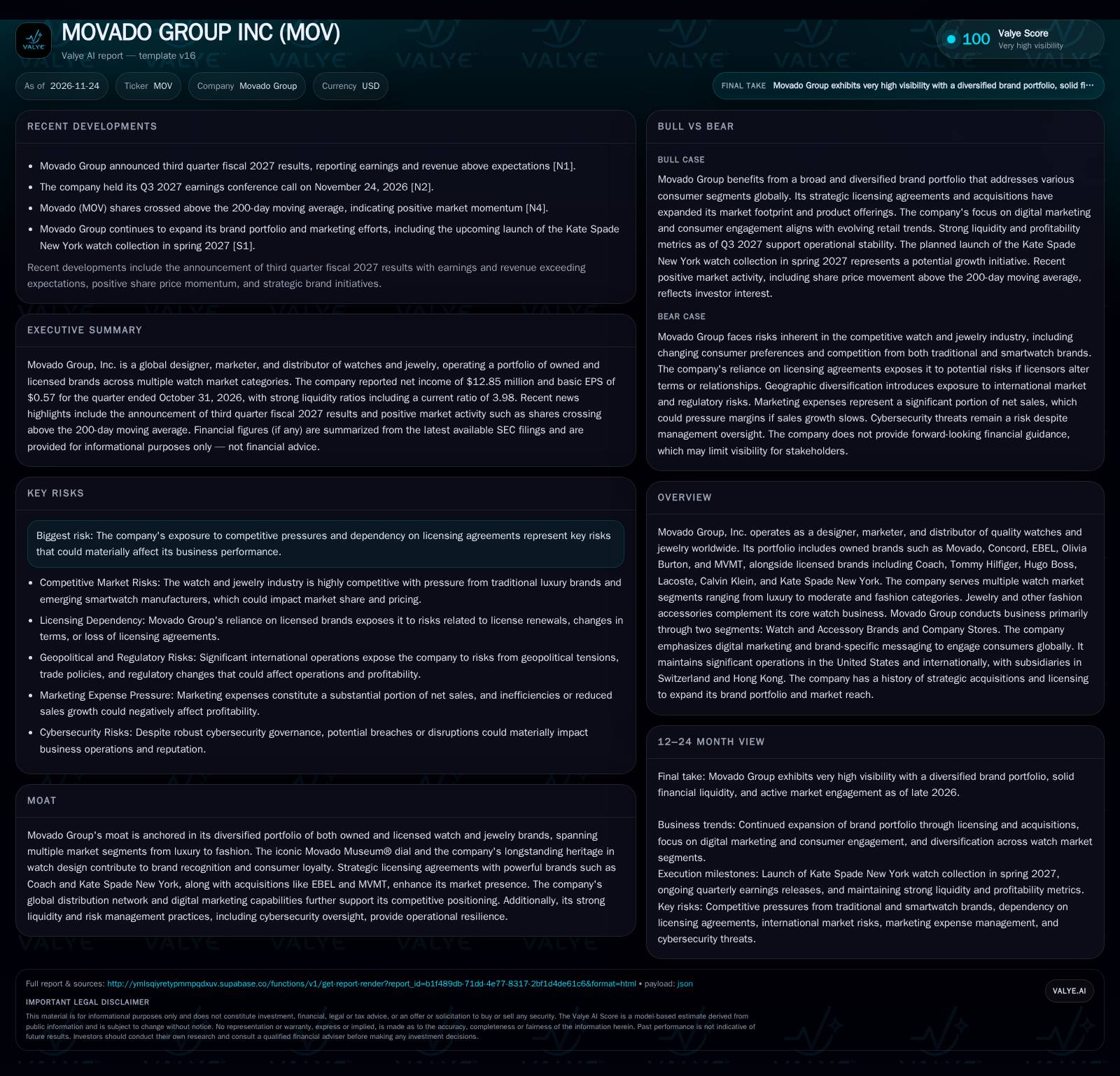
Movado Group enters late 2026 with a robust balance sheet, a diversified portfolio of owned and licensed brands, and the upcoming launch of a high-profile Kate Spade New York watch line. While recent results exceeded expectations, the company faces persistent competitive and margin pressures, especially as it ramps marketing and navigates licensing dependencies. The commercial success of new launches and continued digital engagement will be critical to sustaining momentum in a shifting global market. [S1] [S2] [N1] [N3]
Movado Group is navigating a pivotal period as it leverages a robust balance sheet and a diversified, multi-brand portfolio to drive growth in the highly competitive global watch and jewelry market. The company’s recent financial outperformance and the forthcoming Kate Spade New York watch launch highlight its tactical use of licensing and brand partnerships. Yet, with marketing expenses high and the landscape evolving—especially with smartwatches and shifting consumer preferences—the question is whether Movado can translate its strategic moves into sustained, profitable growth.
Recent Performance, Cash Position, and Emerging Brand Strategies
Movado Group reported net income of $12.85 million for the quarter ending October 31, 2026, with basic and diluted EPS of $0.57 and $0.56, respectively. The company’s cash and equivalents stood at $207.2 million, underpinned by a current ratio of 3.98 and a cash ratio of 1.77, indicating reported liquidity position as of the latest quarter. [S2] In July 2025, Movado signed a new license agreement with Coach Services, Inc. to launch Kate Spade New York watches, with the first collection slated for spring 2027—a major addition to its licensed portfolio. [S1] Jewelry sales now represent 10.2% of consolidated net sales, pointing to gradual diversification beyond core watches. [S1] These facts anchor Movado’s present: a strong financial base, a pipeline of new product launches, and a revenue mix that is broadening beyond traditional timepieces.
Understanding Revenue Streams, Margin Drivers, and Brand Portfolio Economics
Movado Group generates revenue primarily from the design, sourcing, marketing, and distribution of watches and, increasingly, jewelry and accessories, across both owned and licensed brands. The business model is characterized by a blend of wholesale distribution, direct-to-consumer retail via company stores, and digital channels. Licensing agreements, such as those with Coach, Tommy Hilfiger, Hugo Boss, and the new Kate Spade New York deal, allow Movado to access new customer segments with relatively low upfront brand-building costs, but also entail royalty payments and contractual risks.
Gross margins in the branded watch industry typically depend on brand positioning, product mix, and channel strategy. Owned brands may offer higher long-term margin potential but require sustained investment in marketing and innovation. Licensed brands can provide volume and market access, but the economics are partly shared with licensors and can fluctuate with contract terms. Movado’s marketing expenses—at 19-22% of net sales—reflect a significant ongoing commitment to brand visibility and digital engagement, which could support pricing power if brand equity grows, but may pressure margins if revenue growth stalls. Jewelry, now over 10% of sales, may offer complementary margin dynamics but often sees lower volume and higher style-driven risk compared to watches. The company’s asset-light sourcing and distribution model supports operating leverage, but exposure to inventory cycles and fashion risk remains.
Expanding Brand Reach and Navigating Licensing in a Competitive Market
Movado Group’s competitive position is built on its ability to manage a portfolio that spans luxury (Concord, EBEL), accessible luxury (Movado), and fashion/moderate segments (licensed brands and others), while deliberately avoiding the mass market. This breadth allows Movado to appeal to diverse consumer segments and geographic markets, reducing reliance on any single brand or category. The iconic Movado Museum® dial and heritage in Swiss watchmaking bolster brand equity and recognition, particularly in the accessible luxury segment.
However, the company faces formidable competition from established Swiss luxury players, global fashion houses, and the growing influence of smartwatches from technology companies. Licensed brands give Movado access to fashion-conscious consumers and fast-moving trends, but also create dependency on licensors for continued brand relevance and contract stability. New entrants and direct-to-consumer digital brands are also eroding traditional retail moats. Movado’s ongoing investment in digital marketing and influencer partnerships is a necessary response, but its effectiveness depends on the company’s ability to adapt to evolving consumer discovery and purchasing behaviors.
Potential Growth from Product Innovations and Enhanced Digital Interaction
Movado’s upside scenario hinges on the successful introduction and scaling of the Kate Spade New York watch line, alongside continued digital marketing and engagement gains. If the new collection resonates with Kate Spade’s existing customer base—known for its fashion-forward, brand-loyal demographic—Movado could see incremental revenue growth and improved operating leverage as fixed costs are spread over a larger sales base. Digital and influencer-driven campaigns may further accelerate direct-to-consumer sales, improving margins and providing valuable first-party customer data.
A sustained increase in jewelry’s share of revenue, if supported by higher-margin collections or effective cross-selling, could further diversify earnings and reduce cyclical risk. The upside is confirmed by above-expectation earnings and positive share price momentum in recent quarters. [N1] [N3] [N4] Evidence supporting this scenario would include rapid sell-through of new Kate Spade collections, increased direct-to-consumer penetration, and expanding jewelry margins. Conversely, if initial sales of the new collection are tepid or digital marketing spend does not yield higher conversion, the thesis could be challenged.
Balancing Growth Opportunities with Margin Challenges Across Brands
In the most plausible scenario, Movado continues to leverage its diversified brand portfolio to offset category-specific headwinds and geographic volatility. Incremental gains from new launches, such as Kate Spade New York watches, and steady performance from owned and established licensed brands maintain a stable revenue base. Marketing spend remains high as the company defends and grows share in a competitive environment, but margin expansion is constrained by licensing fees, promotional intensity, and the costs of customer acquisition in digital channels.
Jewelry’s gradual growth provides some diversification, but the core business remains tied to cyclical consumer discretionary spending on watches. Evidence supporting this scenario would be modest, steady revenue growth, stable gross margins, and continued brand and channel diversification without major contract losses or execution missteps. Signs to the contrary would include a material drop in sales for a major licensed brand, unexpected increases in marketing expense ratio, or a significant decline in jewelry or digital channel performance.
Risks from Licensing Issues, Cost Increases, and Brand Integrity Concerns
The downside scenario materializes if Movado faces disruption in its licensing relationships—whether through non-renewal, unfavorable renegotiation, or loss of key licenses. Such events could rapidly erode both revenue and market relevance, particularly in the fashion and moderate segments where in-house brand equity is weaker. At the same time, if marketing expenses remain elevated but fail to drive incremental sales—due to ineffective campaigns, brand fatigue, or competitive noise—margin compression could accelerate.
Further, if consumer preferences shift more aggressively toward smartwatches or direct-to-consumer microbrands, Movado’s traditional portfolio could see share loss, especially in markets where it lacks a strong owned-brand presence. Jewelry expansion, while promising, carries inventory and fashion risk if not tightly managed. Confirmation of this scenario would come from high-profile license losses, a spike in marketing-to-sales ratio without corresponding revenue growth, or persistent declines in core owned-brand sales.
Factors Influencing the Long-Term Success of Movado’s Brand Approach
Sell-through rates and early retailer/consumer feedback for the Kate Spade New York watch collection following its spring 2027 launch would help test the impact of new licensing initiatives.
The proportion of direct-to-consumer sales, if disclosed, especially through digital channels, would clarify progress in reducing wholesale dependency and capturing margin.
Gross margin trends by segment and brand (if disclosed) would reveal the effectiveness of marketing investment and product mix optimization.
Changes in marketing spend as a percentage of net sales—up or down—will signal efficiency and the return on digital and influencer campaigns.
Jewelry revenue growth and margin contribution, tracked over several quarters, will indicate whether this diversification is accretive or dilutive.
Any changes in major licensing agreements, especially renewals or terminations, could materially impact forward revenue visibility.
Inventory turnover rates and obsolescence charges, if disclosed, would help test whether the company is managing fashion and demand risk effectively.
Disclaimer: This is research-only, informational analysis and not investment advice. It may include AI-generated interpretation and general industry context. Always verify important details using primary sources.

Comments