
Scotts Miracle-Gro After the Hawthorne Divestiture: Debt, Organic Ambitions, and Margin Realities
Fresh off a strategic portfolio shift and leadership change, Scotts Miracle-Gro faces a complex mix of debt pressure, evolving consumer preferences, and margin management challenges. The company's push into organics and aggressive promotional strategies may reshape its economics, but long-term debt and ongoing legal exposures remain central to the investment debate.
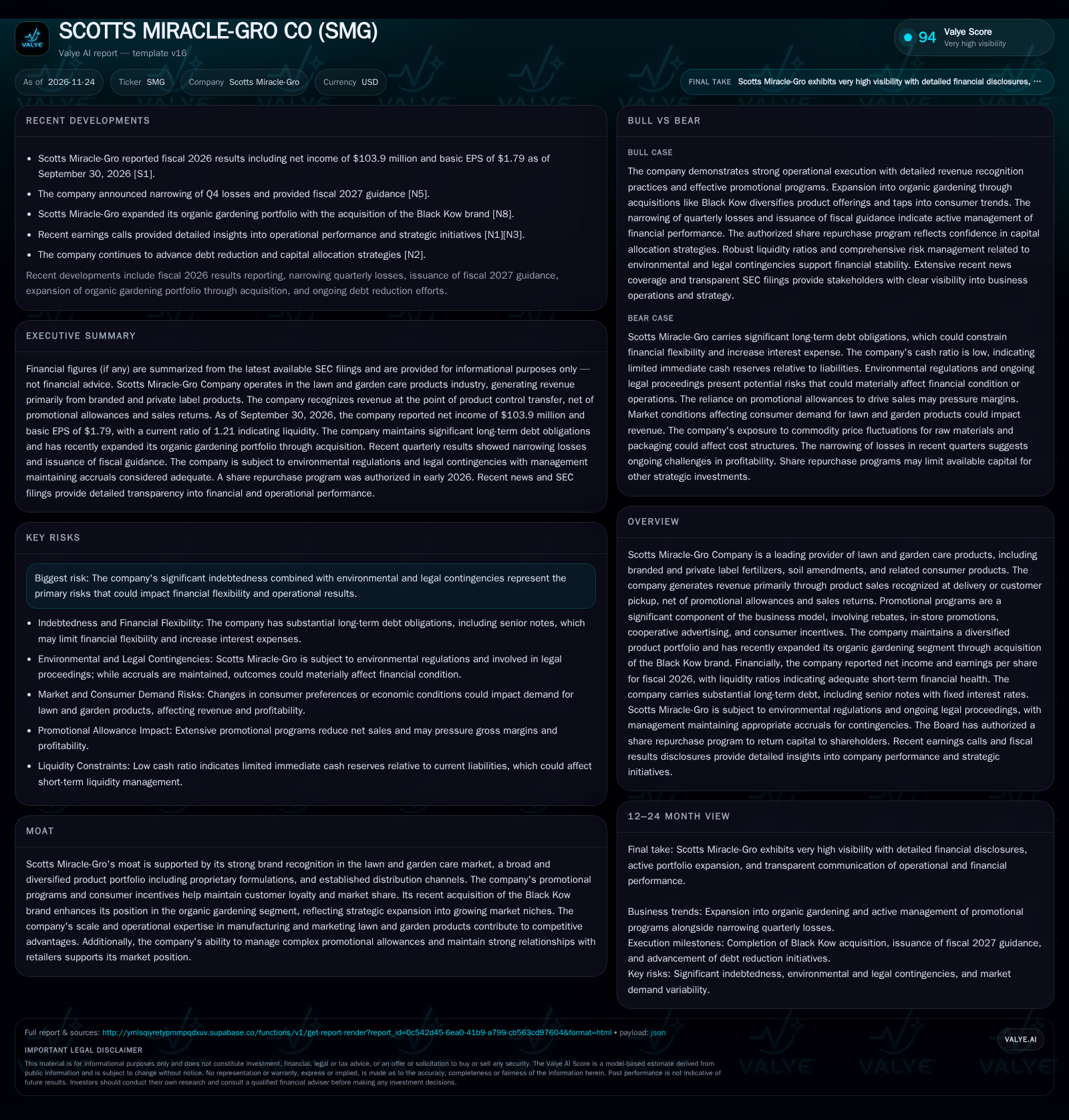
Scotts Miracle-Gro recently divested its Hawthorne business, took a $101.8 million loss on the sale, and acquired the Black Kow brand to expand in organic gardening. The company reported $103.9 million in net income for fiscal 2026 and authorized a $500 million share buyback, but faces substantial long-term debt and a reported cash ratio. Key questions center on the sustainability of margin recovery, the impact of promotional spending, and the ability to balance growth ambitions with debt reduction.[S1] [N2] [N8]
Scotts Miracle-Gro’s strategic landscape has shifted markedly in 2026. The divestiture of the Hawthorne division, a leadership transition, and the acquisition of Black Kow signal a deliberate pivot toward core consumer lawn and garden markets with a special emphasis on organic growth. Yet, this repositioning comes amid persistent debt obligations, margin pressures from heavy promotional activity, and ongoing legal and environmental exposures. The company’s future now hinges on its ability to drive profitable growth in its core segments, manage its balance sheet, and adapt to changing consumer and regulatory dynamics.
Strategic Reset: Divestiture, Acquisition, and Financial Markers Shape 2026
Scotts Miracle-Gro completed the sale of its Hawthorne business in April 2026, recording a $101.8 million loss on the transaction. This move represents a significant portfolio realignment, with the Hawthorne assets exchanged for a minority equity stake and a warrant in Vireo, alongside a manufacturing services agreement.[S2] The shift was timed with a leadership transition—Nathan E. Baxter was appointed CEO in June 2026, following the long tenure of James Hagedorn.[S2]
To complement this strategic refocus, the company acquired the Black Kow brand, enhancing its presence in the organic gardening segment. [N8][S1]
Additionally, the Board authorized a $500 million share repurchase program, underscoring management's intent to return capital to shareholders even as the company navigates substantial leverage and margin pressures.[S1]
Margin Dynamics and Capital Structure: The Economics Behind Lawn and Garden
Scotts Miracle-Gro generates the bulk of its revenue from branded and private label lawn and garden products, with sales recognized at delivery or customer pickup and net of promotional allowances.[S1] The business is highly seasonal, with the majority of sales concentrated in the second and third fiscal quarters, creating working capital swings and inventory management challenges.[S2]
Promotional programs—including rebates, cooperative advertising, and in-store incentives—are integral to the sales model but compress reported net sales and can pressure gross margins. This dynamic places a premium on operational efficiency and cost discipline, especially given the company’s fixed manufacturing and distribution infrastructure. The heavy use of promotions may stimulate sell-in to retail partners but can obscure underlying consumer demand trends and reduce the visibility of true end-user pull-through.
[S1]
Brand Power and Retail Clout vs. Margin Squeeze and Organic Disruption
Scotts Miracle-Gro’s enduring strength lies in its portfolio of recognized brands—Scotts, Miracle-Gro, Ortho, and Tomcat—and its entrenched relationships with major North American retailers.[S2] This confers strong shelf presence and bargaining power in traditional lawn and garden categories. The company’s exclusive agency for Monsanto’s consumer Roundup products further reinforces its market position.[S2]
However, the industry is not static: private label competition, new organic entrants, and shifting consumer tastes toward sustainability and chemical-free gardening chip away at traditional brand moats. The Black Kow acquisition signals a tactical move to address this organic shift, but it is unclear if this will be enough to offset margin pressure from both premium inputs and aggressive retail promotions.[N8]
Substitutes include smaller organic brands, direct-to-consumer startups, and even non-traditional gardening solutions (e.g., hydroponics, smart home grow kits), all of which can erode category loyalty. The scale and distribution network of Scotts Miracle-Gro remain substantial advantages, but the company’s ability to defend its margin structure in the face of these trends is far from assured.
Margin Recovery and Organic Tailwinds Could Drive a Re-rating
A favorable trajectory for Scotts Miracle-Gro would be driven by several reinforcing factors. First, successful integration and growth of the Black Kow acquisition could accelerate penetration into the high-growth organic gardening segment, attracting new consumers and justifying premium pricing.[N8] If the company can optimize promotional spend—shifting from volume-based incentives to more targeted, loyalty-driven programs—gross margins could recover even as top-line growth accelerates.
Progress on debt reduction would further improve the risk profile, freeing up capital for marketing and innovation. Confirmation of this scenario would be visible in rising gross margin percentages, declining interest expense, and sustained double-digit growth in organic product sales (if disclosed).
A key falsifier would be if gross margins continue to compress despite organic expansion, or if debt reduction stalls and interest costs remain elevated, signaling that promotional intensity and input inflation are overwhelming operational improvements.
Balancing Debt, Promotions, and Incremental Organic Growth
The most plausible outcome for Scotts Miracle-Gro is a period of incremental improvement but persistent constraints. The company is likely to realize moderate growth from its expanded organic portfolio, with the Black Kow brand contributing to a gradual shift in product mix. However, ongoing reliance on promotional allowances to drive sell-in, coupled with inflationary cost pressures, will continue to cap margin expansion.
The share repurchase program may provide some support to EPS, but its scale relative to total debt means it is unlikely to be transformative.[S1]
Evidence confirming this scenario would be stable, but only modestly improving, gross margins; steady, if unspectacular, growth in organic segment sales; and a slow, managed reduction in long-term debt. A falsifier would be a sharp deterioration in sales volumes or a spike in legal/environmental costs that forces a retrenchment in capital allocation.
Debt Burden Meets Margin Erosion: The Vulnerability of the Current Model
The principal risk is that Scotts Miracle-Gro’s promotional spending and cost inflation outpace any gains from organic expansion, leading to further margin compression and pressure on profitability. If consumer demand for traditional lawn and garden products softens—whether due to economic downturn, weather volatility, or accelerating preference for smaller brands—the company’s fixed cost base could amplify earnings declines.
A sustained high interest rate environment would exacerbate debt service burdens, potentially forcing cuts to marketing or R&D just as competition intensifies. Environmental or legal liabilities, if they materialize beyond current accruals, could further strain the balance sheet.
This scenario would be confirmed by declining gross margins, negative free cash flow, rising net debt, and any sign of covenant stress or credit rating downgrades. A rapid drop in retail orders or major customer losses would also be a red flag.
Milestones That Will Clarify the Core Value Proposition for Scotts Miracle-Gro
Monitoring the gross margin trend will be critical, as it directly reflects the balance between promotional spending, input costs, and pricing power.
The pace and scale of debt reduction, including any refinancing activity or early repayments, will indicate management’s ability to strengthen the balance sheet.
Organic product sales growth, specifically for the Black Kow brand and other sustainable offerings (if disclosed), will show whether the shift toward organics is gaining real consumer traction.
Updates on promotional allowance as a percentage of net sales would help gauge the sustainability of the current revenue model.
Any developments or disclosures related to environmental or legal contingencies—such as new litigation, settlements, or regulatory changes—could materially affect the risk profile.
Retailer inventory levels and order patterns, especially in the critical spring and summer quarters, would help assess channel health and demand visibility.
Progress on the authorized share repurchase program, including total repurchases and timing, will indicate management’s capital allocation priorities under leverage constraints.
Disclaimer: This is research-only, informational analysis and not investment advice. It may include AI-generated interpretation and general industry context. Always verify important details using primary sources.

Comments