
OMNIQ Corp.: AI Vision Ambitions Confront Financial Constraints and Sector Headwinds
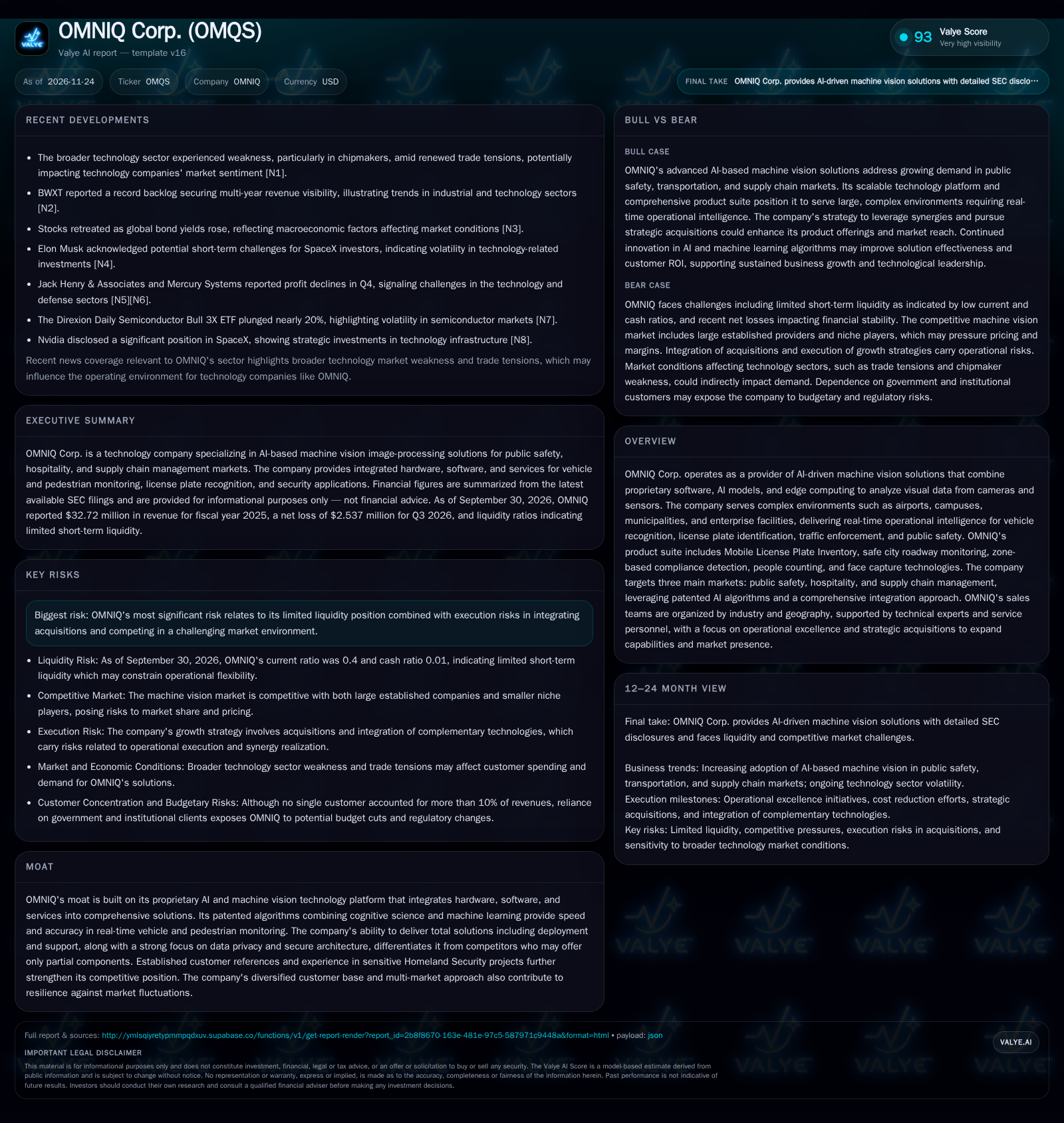
OMNIQ Corp. delivers proprietary AI-driven machine vision solutions for public safety, transportation, and supply chain markets, combining hardware, software, and services to address complex, real-time monitoring needs. Despite a diversified customer base and scalable platform, the company faces acute liquidity pressure, persistent net losses, and must navigate a fiercely competitive landscape as it seeks operational and strategic gains.
OMNIQ Corp. targets the growing demand for AI-powered machine vision across public safety, hospitality, and supply chain sectors with a comprehensive technology platform and integration focus. However, recent financials show ongoing net losses and a very low liquidity cushion, casting uncertainty on the company’s ability to execute its growth and acquisition strategies in a highly competitive market environment. [S2]
OMNIQ Corp. stands at a critical intersection of opportunity and constraint. Its AI-powered machine vision platform is tailored for high-value, complex environments like airports, municipalities, and enterprise facilities, addressing the rising demand for real-time surveillance, traffic management, and access control. The coming quarters will test whether OMNIQ can translate technological strengths into sustainable business momentum, or if financial headwinds will limit its ambitions.
Financial Stress and Technology Ambition: Where OMNIQ Stands Now
As of September 30, 2026, OMNIQ Corp. reported a net loss of $2.537 million for Q3 and basic and diluted earnings per share of -$0.17, continuing a loss trajectory despite $32.72 million in revenue for the prior fiscal year. The company’s liquidity is severely constrained, with cash and equivalents of just $402,000, a current ratio of 0.4, and a cash ratio of 0.01. On the commercial side, OMNIQ’s customer base is diverse, with no single client accounting for more than 10% of revenue in 2024 or 2025, reducing the risk of sudden revenue shocks from customer churn. Technologically, OMNIQ continues to position itself as a comprehensive provider of AI-driven machine vision solutions for public safety, hospitality, and supply chain markets, with a platform designed for scale and integration. [S2]
How OMNIQ’s Integrated Model Could (and Might Not) Generate Profits
OMNIQ’s business model relies on delivering end-to-end machine vision solutions—combining proprietary AI software, edge computing hardware, integration services, and ongoing technical support. Revenue streams likely arise from a mix of hardware sales (cameras, sensors, edge devices), software licensing or subscriptions, integration projects, and recurring service contracts. However, the company’s current financials suggest that gross margins may be under pressure, either from hardware-heavy deals, competitive pricing, or high integration/service costs. The structure implies significant upfront engineering and deployment expenses, with the possibility of higher-margin software or services over time if customer retention and upselling prove effective.
Operating leverage could become favorable as the installed base grows and higher-margin software/service revenues increase as a share of the mix. However, with ongoing net losses and limited cash, OMNIQ faces real constraints: it may struggle to invest in sales, marketing, and R&D at the scale needed to outpace competitors or to fund acquisitions that could deliver synergies.
Competitive Landscape: Differentiation, Substitution, and Sector Dynamics
OMNIQ competes in a fragmented but rapidly evolving machine vision market. Large diversified technology providers (e.g., global industrial automation and security firms) and specialized niche players both target public safety, transportation, and supply chain customers. OMNIQ’s differentiation is rooted in its proprietary AI algorithms, patented technologies, and its ability to deliver integrated solutions—hardware, software, deployment, and support—instead of mere point products. Its focus on secure architecture and experience with sensitive government projects may provide an edge in winning contracts where data privacy and reliability are paramount.
However, barriers to entry in AI-driven vision are eroding as open-source models, off-the-shelf hardware, and cloud-based analytics proliferate. Competitors with deeper pockets may outspend OMNIQ in R&D or undercut on price, while customers may increasingly seek modular or interoperable solutions rather than locked-in platforms. There is also the risk of technology substitution: advances in edge AI chips, low-cost sensors, or cloud-native analytics could shift the value proposition away from OMNIQ’s current architecture, especially if customers prioritize cost and flexibility over bespoke integration.
What It Would Take for OMNIQ to Break Out: Margin Expansion and Platform Scaling
A favorable scenario for OMNIQ would see the company successfully leveraging its technology platform to win larger, multi-site deployments in public safety and transportation, driving both top-line growth and a shift toward higher-margin software and services. Operational excellence initiatives and targeted cost reductions could improve gross and operating margins, while selective, well-integrated acquisitions might expand the addressable market and enhance the platform’s capabilities. Increased adoption of AI-driven surveillance and automation, especially in response to regulatory or security mandates, could accelerate demand for OMNIQ’s solutions.
Confirmation of this scenario would include: a measurable improvement in gross margin percentages, evidence of recurring software/service revenue growth, successful integration of acquired businesses, and a liquidity event (such as a capital raise or strategic partnership) that alleviates short-term funding risk. New, high-profile contract wins—particularly with government or large enterprise customers—would further validate the platform’s scalability and commercial appeal.
Sustaining Operations While Navigating Sector Volatility and Execution Risk
The most likely trajectory for OMNIQ, given current facts, is a period of operational triage: incremental revenue growth from existing customer segments, continued delivery of integrated solutions, but only modest margin improvement due to competitive pressure and high fixed costs. Execution of cost reduction programs and selective pursuit of synergistic partnerships or acquisitions may help offset some headwinds, but the ability to invest aggressively in growth will likely remain constrained.
Evidence supporting this scenario would be continued net losses but at a decreasing rate, stable or slightly improved liquidity ratios, and steady customer diversification. The absence of major contract wins, significant capital infusions, or transformative acquisitions would reinforce the view that OMNIQ is maintaining its current position but not breaking out.
Liquidity Pinch and Intensified Competition Could Force Strategic Retrenchment
In this case, competitors—especially those with stronger balance sheets—could win away key accounts or enter OMNIQ’s niches with lower pricing or more advanced technology. The company’s reliance on project-based revenue and integration-heavy deployments may exacerbate cash flow volatility, and any slowdown in government or enterprise IT spending could further pressure sales.
Confirmation of this downside would include: further declines in the current or cash ratio, missed debt or supplier payments, layoffs or restructuring announcements, and a lack of new bookings or contract renewals. If OMNIQ is forced to sell assets, seek emergency financing on unfavorable terms, or scale back its technology roadmap, it would suggest the thesis has moved into distress territory.
Testing OMNIQ’s Thesis: What Would Indicate Real Progress or Trouble Ahead?
Gross margin trends: A sustained improvement in gross margin percentage would indicate progress in shifting the revenue mix toward higher-value software and services.
Recurring revenue growth: If disclosed, tracking the proportion and growth rate of recurring (software/service) revenue versus project-based or hardware sales would clarify commercial traction.
Liquidity events: Any announced capital raise, strategic investment, or non-dilutive financing would be critical in assessing OMNIQ’s ability to fund operations and growth.
Major contract wins: New, multi-site deployments—especially with government or large enterprise clients—would demonstrate platform scalability and commercial relevance.
Acquisition integration: Evidence of operational or financial synergies from recent or future acquisitions would show execution capability and platform leverage.
Net loss trajectory: Persistent or widening net losses would signal ongoing business model or market challenges, while narrowing losses would suggest improving economics.
Customer retention and churn: If disclosed, metrics on customer renewal rates or churn would help assess solution stickiness and revenue visibility.
Product roadmap milestones: Announcements of new platform features, integrations, or reference deployments—particularly in high-growth market segments—would test OMNIQ’s innovation and responsiveness.
Disclaimer: This is research-only, informational analysis and not investment advice. It may include AI-generated interpretation and general industry context. Always verify important details using primary sources.

Comments