
CATO CORP: Retail Volatility, Margin Pressures, and the Search for Sustainable Profitability
CATO CORP’s latest quarter underscores the volatility and margin pressure endemic to mid-tier apparel retail. Despite maintaining a current ratio above 1, the company posted a $10.35 million net loss, with revenue softness reflecting both operational and macroeconomic headwinds. Absent a clear competitive moat or proprietary advantage, CATO’s path forward hinges on cost discipline, consumer demand recovery, and the ability to differentiate in a crowded market.
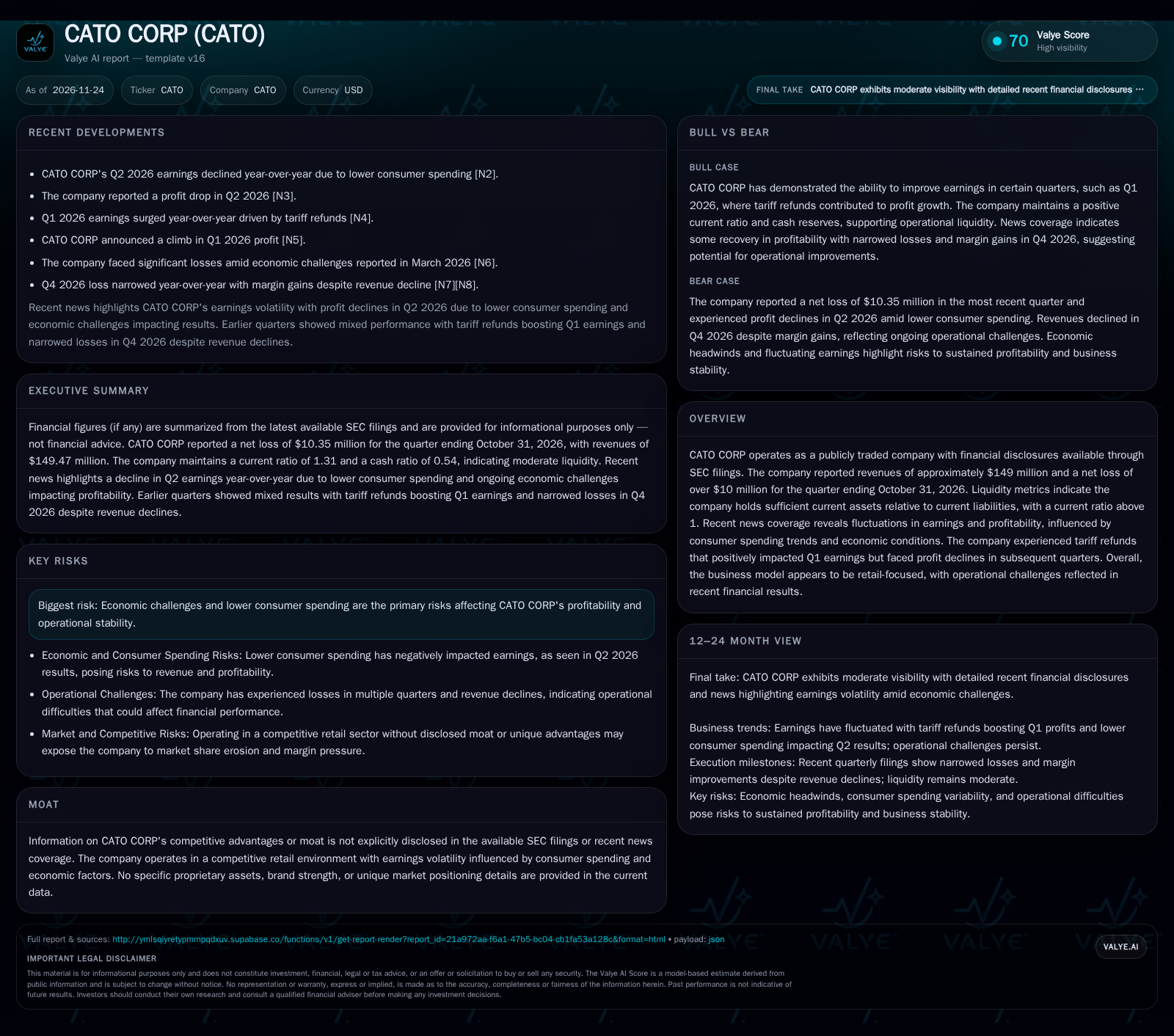
CATO CORP reported a $10.35 million net loss on $149.47 million revenue for the quarter ending October 31, 2026, continuing a pattern of earnings volatility amid economic and operational challenges. Margin improvement and stabilization likely require improved cost efficiency and stronger brand differentiation. [S2] [N6]
CATO CORP’s recent financials capture the classic struggles of mid-market apparel retail in a challenging economic environment. With no clear evidence of a proprietary advantage or defensible niche, CATO faces ongoing risk from fluctuating consumer sentiment and sector-wide competition. The company’s future will likely turn on its ability to adapt its cost structure, drive customer engagement, and withstand further shocks to consumer discretionary spending.
Q3 2026 Results: Losses Deepen as Revenue Softens
CATO CORP reported $149.47 million in revenue for the quarter ending October 31, 2026, but posted a net loss of $10.35 million, translating to basic and diluted EPS of -$0.54. Reported liquidity position, with $22.58 million in cash and $59.7 million in short-term investments, supporting a current ratio of 1.31 and a cash ratio of 0.54. These figures indicate that while the company can meet its immediate obligations, operations are under strain. The quarterly loss extends a pattern of earnings volatility, with recent quarters reflecting both profit surges (aided by tariff refunds in Q1 2026) and profit declines as consumer spending softened through Q2 and Q3. The absence of a disclosed competitive moat or unique positioning further heightens the importance of operational discipline and cost management in the near term. [S2] [N2] [N4] [N6]
Retail Economics: Low Margins, High Sensitivity to Demand and Costs
CATO CORP operates in a sector characterized by thin gross margins and high operating leverage, meaning small changes in sales volumes or input costs can drive outsized changes in profitability. The company’s revenue base is vulnerable to shifts in discretionary consumer spending, which has been pressured by recent macroeconomic headwinds. Fixed costs—such as leases, store staffing, and inventory—are significant, so revenue shortfalls quickly translate into operating losses, as evidenced by the latest quarter.
Pricing power is typically limited in the mid-market apparel segment, with heavy discounting and promotions common amid intense competition. While one-time events—such as tariff refunds—can temporarily boost earnings, they do not address the underlying business model fragility. Operational improvements (e.g., inventory discipline, supply chain optimization, and cost control) could enhance margins, but structural headwinds remain unless accompanied by differentiated offerings or a stronger brand pull.
Moreover, the apparel retail sector's sensitivity to supply chain disruptions adds another layer of complexity to CATO CORP’s operating environment. Delays or cost increases in raw materials, manufacturing, or logistics can compress margins further, particularly when the company lacks pricing power to pass these costs on to consumers. This dynamic necessitates robust supply chain agility and vendor management to mitigate risks. Additionally, consumer trends toward sustainability and ethical sourcing may impose incremental costs or require strategic shifts in product development, which could either differentiate the brand or increase expenses if not managed efficiently.
Competing in a Crowded Field: Structural Challenges and Lack of Moat
CATO faces competition from a wide range of apparel retailers, including fast fashion, value chains, department stores, and digital-native brands. No evidence is supplied of proprietary product, exclusive vendor relationships, or technology-driven advantages. The lack of a disclosed moat or defensible market niche exposes CATO to margin compression and share loss when consumer demand weakens or rivals intensify promotions.
Switching costs for consumers are minimal in apparel, and brand loyalty in the value segment is typically low. Larger or more nimble competitors may have greater pricing flexibility, supply chain efficiencies, or digital capabilities, increasing the risk that CATO’s business could be squeezed further if it cannot differentiate on experience, assortment, or price. Without a unique proposition, CATO’s survival likely depends on relentless cost discipline and the ability to adapt quickly to changing consumer preferences.
In addition to pricing pressures, digital transformation represents both a threat and opportunity for companies like CATO. Competitors with advanced e-commerce platforms and data-driven marketing can capture market share more effectively, especially among younger demographics. Without proprietary technology or a seamless omnichannel presence, CATO risks losing relevance in an increasingly digital-first retail landscape. Investments in digital infrastructure and customer analytics could improve targeting and personalization, but such initiatives require capital and expertise that may be constrained by current financial performance. The balance between investing for growth and maintaining cost discipline is thus critical.
Margin Recovery through Cost Restructuring and Demand Rebound
The most plausible upside for CATO is a scenario where management executes effective cost reductions, streamlines inventory, and captures any rebound in consumer discretionary spending. If the company can reduce fixed overhead (e.g., via store closures, renegotiated leases, or supply chain improvements) and avoid heavy discounting, even modest sales growth could drive significant margin recovery due to operating leverage.
Confirmation would come from a return to quarterly profitability (positive net income), sustained margin expansion, and evidence of stable or growing same-store sales. Additional upside could be realized if CATO introduces more compelling private-label products or enhances the in-store and digital customer experience, leading to improved traffic and higher conversion rates. Falsification would occur if cost actions fail to stem losses or if revenue declines accelerate despite restructuring efforts.
Operational Triage amid Persistent Demand Headwinds
The most likely scenario is a period of continued operational triage: CATO manages liquidity prudently and attempts incremental cost improvements but struggles to generate consistent profits due to muted consumer demand and ongoing competition. Revenue may remain stagnant or decline modestly, with occasional quarters of breakeven or small profit driven by one-time items rather than core business strength.
This scenario would be confirmed by continued earnings volatility, limited or no net income growth, and management commentary focusing on cost control and inventory management rather than expansion or innovation. Falsification would require either a sustained return to profitability on core retail operations or, conversely, a sharp deterioration in liquidity or market share.
Prolonged Losses and Potential Liquidity Squeeze
If consumer sentiment worsens or CATO fails to adapt its cost base, the company could face a prolonged period of losses that erode its cash and short-term investments. In this scenario, operating losses would persist or deepen, fixed costs would remain burdensome, and the company could be forced to close stores, liquidate inventory at deep discounts, or seek external financing under less favorable terms.
Confirmation would come from consecutive quarters of widening net losses, declining cash balances, negative operating cash flow, or announcements of major restructuring actions. Falsification would require evidence of stabilization or improvement in both top-line and bottom-line performance, as well as preservation of liquidity without asset sales or dilutive capital raises.
External and Internal Markers for CATO’s Retail Resilience
Quarterly same-store sales trends, if disclosed, would help clarify whether core consumer demand is stabilizing or deteriorating.
Gross and operating margin progression over the next several quarters will reveal the effectiveness of cost control and pricing strategies.
Inventory turnover and markdown rates, if available, would indicate how well CATO is managing product assortment and minimizing excess stock.
Trends in cash and short-term investment balances will show whether the company is burning through liquidity or stabilizing its financial position.
Store count changes (openings, closures, or relocations) would provide insight into management’s strategy for optimizing the physical footprint.
Any announced partnerships, exclusive product launches, or digital platform enhancements could signal attempts to differentiate and drive growth.
Management commentary on capital allocation, particularly regarding dividends or share buybacks, would illustrate confidence in future cash flows and business stability.
Disclosure of customer acquisition and retention metrics, if provided, would shed light on CATO’s ability to build loyalty and compete effectively in a crowded market.
Disclaimer: This is research-only, informational analysis and not investment advice. It may include AI-generated interpretation and general industry context. Always verify important details using primary sources.

Comments