
Cencora’s Scale, Specialty Focus, and Acquisition Integration Drive Margin Expansion—But Regulatory and Customer Risks Loom
Cencora, Inc. has delivered robust revenue and profit growth on the back of specialty pharmaceutical sales and strategic acquisitions, but its business model faces structural pressures from regulatory changes, competitive threats, and customer concentration. The next phase hinges on extracting operational leverage from integration efforts while navigating a shifting healthcare landscape.
Cencora’s latest results show accelerated margin gains and revenue growth, underpinned by specialty product demand and benefits from recent acquisitions. However, the company’s below-par current ratio, exposure to large customers, and intensifying regulatory scrutiny highlight persistent vulnerabilities. Margin sustainability will depend on successful integration, operational improvements, and the ability to withstand industry shifts in pricing and reimbursement.
Cencora, Inc. stands at the intersection of scale-driven pharmaceutical distribution and the rapidly evolving specialty drug market. Its most recent financials reveal a business benefiting from both operational leverage and targeted acquisitions, resulting in margins expanding faster than revenue. Yet this apparent strength is balanced by structural vulnerabilities: regulatory pressure on drug pricing, a customer base where a handful of players wield substantial influence, and a working capital position that, while typical for the sector, leaves little margin for error. Whether Cencora can sustain its current momentum will depend on the company’s execution in integrating recent acquisitions, maintaining compliance, and adapting to shifting industry economics.
Recent Results: Margin Expansion Outpaces Top-Line Growth
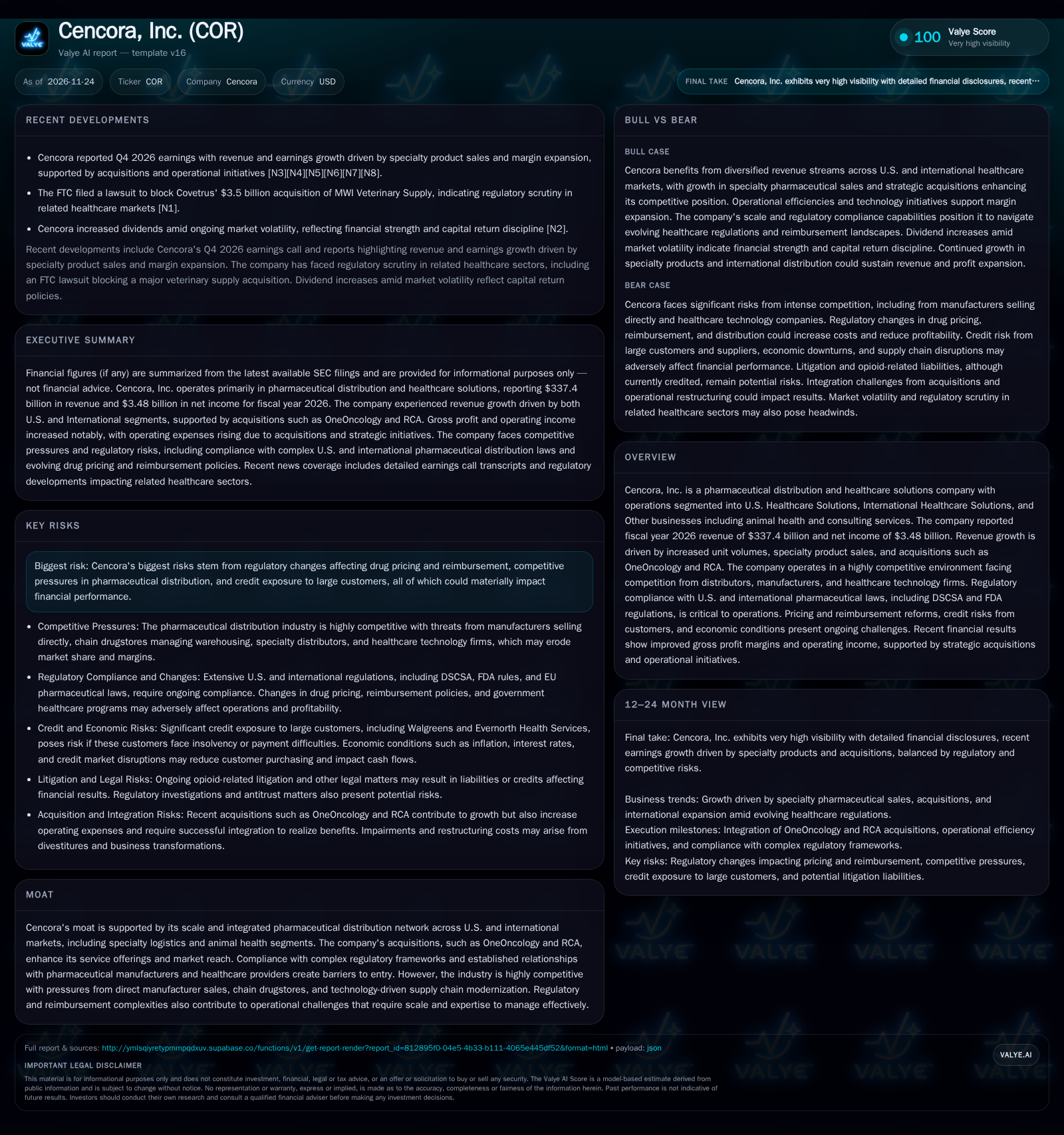
Cencora closed fiscal 2026 with $337.4 billion in revenue and $3.48 billion in net income. For the June 2026 quarter, revenue rose 5.1% year over year, but gross profit surged 24.1% and operating income jumped 29.1%—indicating meaningful operating leverage and improved profitability. The main drivers were growth in specialty pharmaceutical sales and the integration of recent acquisitions, particularly OneOncology and RCA. U.S. Healthcare Solutions revenue grew 4.9%, attributed to higher unit volumes and increased sales of GLP-1 drugs, while International Healthcare Solutions grew 5.9% on European distribution gains. Operating expenses increased, reflecting costs from acquisitions and tech/efficiency initiatives. The company reported a current ratio of 0.94 for the period. Notably, two customers accounted for nearly 39% of trade receivables, heightening credit risk concentration [S1].
How Scale, Specialty Mix, and Acquisitions Shape Cencora’s Margins
Cencora’s core economics hinge on high-volume, low-margin pharmaceutical distribution combined with selective exposure to higher-margin specialty products and services. Gross margin expansion in 2026 was driven by a favorable mix shift toward specialty drugs (such as GLP-1 therapies) and the absorption of acquired businesses. Specialty pharmaceuticals often command better pricing, offer distribution complexity that entrenches intermediaries, and can sometimes involve service or consulting fees that boost margins.
The company’s revenue is predominantly volume-driven, but mix and negotiated contract terms with manufacturers and payers also matter. Increases in specialty unit sales and operational improvements from acquisitions (e.g., OneOncology’s oncology practice network and RCA’s European footprint) can lift profitability, but integration costs and incremental SG&A tend to offset some gains.
Fixed costs—such as distribution center infrastructure, compliance systems, and IT investments—create the potential for operating leverage as revenue scales. However, variable costs (inventory purchases, logistics, credit losses) remain tightly linked to sales. Capital intensity is high, and the cash conversion cycle is structurally constrained by the need to advance payables to suppliers while extending credit to customers.
Competitive Pressures Intensify from Distributors, Manufacturers, and Tech Entrants
Cencora’s principal competitors include other large pharmaceutical distributors, vertically integrated pharmacy chains, specialty distributors, and increasingly, healthcare technology companies seeking to disrupt traditional supply chains. Manufacturers are also expanding direct-to-provider sales, eroding the intermediary’s role in some drug classes.
The company’s scale, regulatory compliance infrastructure, and breadth of services (including specialty logistics and animal health) provide some barriers to entry. Acquisitions like OneOncology and RCA extend its reach into higher-value, service-driven segments, but also require successful integration to realize synergies.
However, competitive intensity is rising: chain drugstores are investing in their own distribution networks, and technology firms are exploring new models for procurement, supply chain visibility, and even alternative payment and reimbursement solutions. Regulatory scrutiny—as seen in the FTC’s recent lawsuit to block a veterinary supply acquisition—signals heightened antitrust and competitive oversight in the broader healthcare distribution space [S1].
Margin Gains Persist If Specialty Growth, Integration, and Regulatory Clarity Align
If Cencora continues to execute on specialty product sales growth—especially in fast-expanding therapeutic areas like diabetes and oncology—and successfully integrates recent acquisitions, margin expansion could persist. Technology and operational efficiency initiatives may further reduce SG&A as a percent of revenue, unlocking additional operating leverage.
A favorable regulatory environment, where drug pricing reforms do not significantly compress distributor margins and reimbursement clarity emerges, could enable sustained top- and bottom-line growth. Confirmation of this scenario would include ongoing gross and operating margin improvement, stable or expanding specialty segment share, and evidence that integration costs are not eroding realized synergies.
Indicators would also include reduced customer concentration risk—either through diversification or strengthened contracts—and minimal disruption from regulatory or antitrust actions.
Steady Growth Amid Ongoing Integration and Regulatory Headwinds
The most plausible trajectory is one of moderate revenue growth, primarily from specialty pharmaceuticals and international expansion, offset by persistent cost pressures and regulatory complexity. Integration of OneOncology and RCA yields incremental margin benefits, but these are partially absorbed by higher SG&A and investment in compliance and technology.
Customer concentration remains a structural risk, though not one likely to trigger acute disruption unless a major partner experiences distress.
Regulatory and reimbursement changes—especially in the U.S.—create periodic volatility in gross margins, but the company’s scale and compliance capabilities allow it to adapt over time. This scenario would be confirmed by continued (but decelerating) margin expansion, stable revenue from key customer segments, and absence of major regulatory or litigation shocks.
Adverse Shifts in Regulation, Customer Solvency, or Integration Could Pressure Margins and Liquidity
A negative outcome could materialize if regulatory reforms aggressively compress distributor margins, restrict reimbursement for high-priced specialty drugs, or mandate structural changes in the supply chain. If a large customer representing a significant portion of receivables defaults or renegotiates terms, Cencora’s liquidity and net income could be materially impacted.
Integration stumbles—such as failure to realize cost synergies, unexpected restructuring charges, or operational disruptions—could erode the profit gains seen in 2026. Litigation or regulatory penalties, particularly related to opioid liability or antitrust actions, could further pressure cash flows.
Downside confirmation would include contracting gross and operating margins, a spike in bad debt expense, increased litigation or compliance costs, and negative working capital turning into a liquidity crunch.
What Could Shift Cencora’s Thesis—Signals to Track in 2027 and Beyond
Sustained gross and operating margin expansion relative to revenue growth would indicate continued success in specialty mix and acquisition integration.
A useful metric would be the proportion of revenue derived from specialty pharmaceuticals and services—clarity on this mix would help test the margin thesis.
Trends in customer concentration, particularly the share of receivables held by the top two customers, should be monitored for credit risk exposure.
Any material changes in regulatory or reimbursement policy, especially those affecting drug pricing or distributor compensation, would directly impact the company’s economics.
Integration milestones for OneOncology and RCA—such as realized cost synergies, retention of key personnel, and operational system harmonization—are critical for validating acquisition benefits.
If disclosed, net working capital trends and days sales outstanding (DSO) would help assess liquidity and exposure to shifts in payment cycles.
Updates on litigation or regulatory proceedings, particularly opioid-related cases or new antitrust actions, may signal future financial liabilities.
Disclaimer: This is research-only, informational analysis and not investment advice. It may include AI-generated interpretation and general industry context. Always verify important details using primary sources.

Comments