
CleanSpark’s Data Center Ambitions: Transitioning from Bitcoin Mining to AI Infrastructure
CleanSpark, Inc. is attempting a high-stakes pivot from pure-play bitcoin mining to a dual model that includes large-scale data center infrastructure for AI and high-performance computing. With its first major AI lease signed but no infrastructure revenue yet realized, the company’s future will hinge on execution, regulatory navigation, and its ability to attract new hyperscale customers while managing bitcoin market risks.
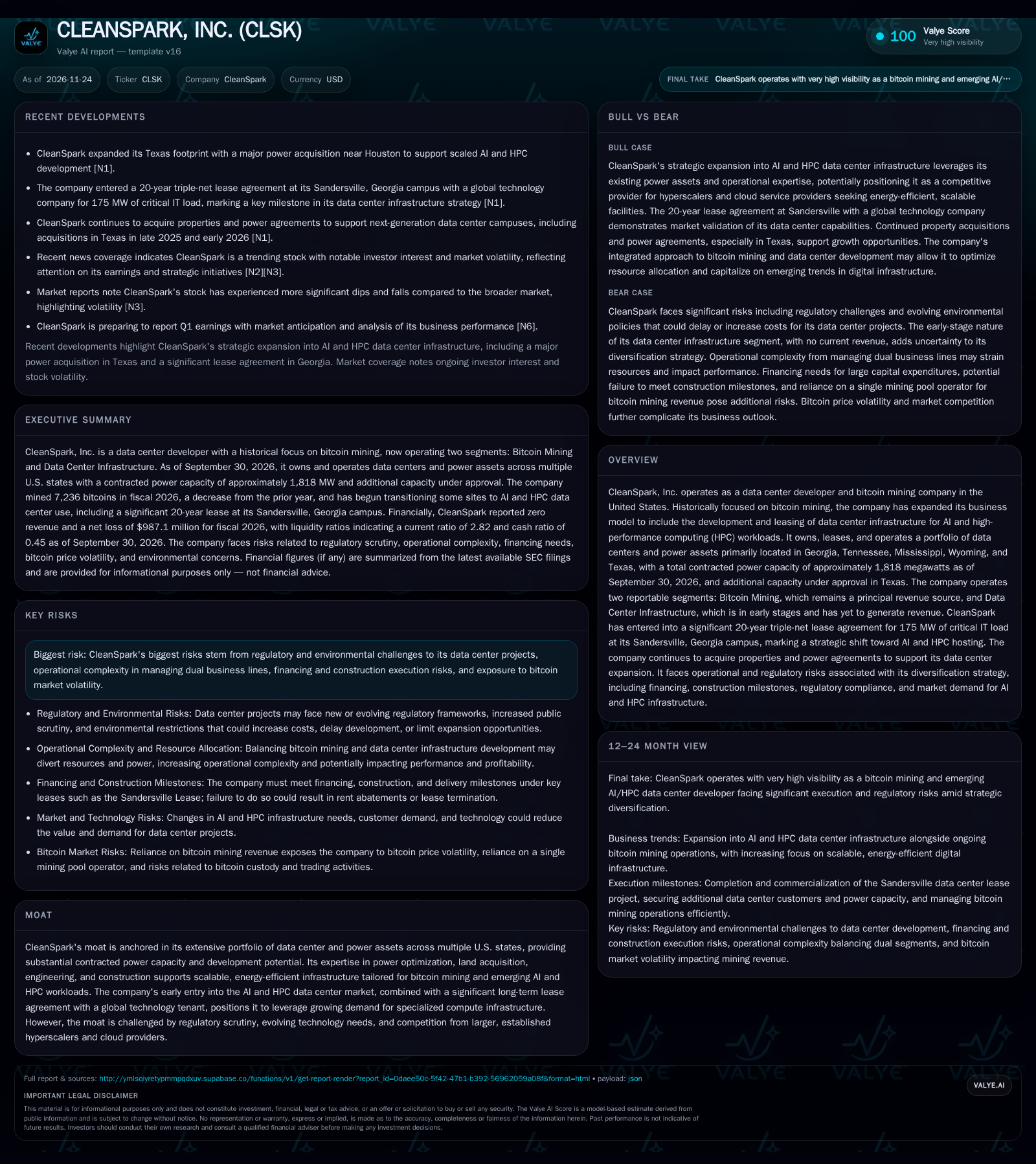
CleanSpark remains fundamentally a bitcoin miner, but its future now depends on whether it can successfully transition to AI and HPC data center leasing. Its inaugural 20-year 175 MW lease signals potential, but zero current revenue from this segment, a nearly $1 billion net loss in FY26, and operational complexity highlight both the upside and the formidable risks ahead. Execution on the Sandersville project and signing additional customers will be decisive over the next 18-24 months. [S1] [N1]
CleanSpark, Inc. stands at a strategic crossroads, seeking to shift from a bitcoin mining pure-play into a diversified digital infrastructure developer focused on AI and high-performance computing (HPC) hosting. The company’s first major data center lease—a 20-year, 175 MW agreement with a global technology firm—signals ambition and market validation but arrives with no infrastructure revenue yet realized and a nearly $1 billion net loss for fiscal 2026. As CleanSpark juggles operational complexity, substantial capital needs, and regulatory headwinds, its ability to execute on high-profile projects like Sandersville and attract additional hyperscale customers will define whether this pivot yields durable value or exposes the company to new layers of risk and competition. [S1] [N1]
Pivot Point: Major Lease Signed, No Infrastructure Revenue Yet
As of September 30, 2026, CleanSpark remains primarily a bitcoin miner, having mined approximately 7,236 bitcoins in fiscal 2026—a 7.9% decrease year-over-year due to network difficulty and lower uptime. The company owns or controls about 1,818 MW of power capacity (potentially rising to roughly 2.1 GW with approved expansions), mostly across Georgia, Texas, Tennessee, Mississippi, and Wyoming. The most consequential recent development is the signing of a 20-year triple-net lease for 175 MW at its Sandersville, Georgia campus with a global technology company, marking CleanSpark’s first major foray into data center infrastructure leasing. However, as of the latest reporting date, the Data Center Infrastructure segment has not recognized any revenue, and CleanSpark reported a net loss of $987.1 million for fiscal 2026. These facts highlight the early and unproven nature of the pivot, as well as the scale of execution risk. [S1] [N1]
Economic Model in Flux: Mining Margins vs. Infrastructure Leasing
CleanSpark’s historical economics are rooted in bitcoin mining, where revenue depends on network hash rate, bitcoin prices, energy costs, and the efficiency of mining hardware. Margins are volatile, with fixed costs (property, plant, equipment, and power contracts) and variable costs (energy, maintenance, mining pool fees). In 2026, mining became less profitable due to increased network difficulty and site downtime, while CleanSpark’s revenue from mining is entirely dependent on a single pool operator. This concentration risk and bitcoin price volatility make for an unpredictable earnings base.
The move into data center infrastructure could yield a more stable, contract-driven revenue stream with lower direct exposure to commodity price swings. The 20-year Sandersville lease is structured as a triple-net agreement, which, if executed as planned, shifts operating costs (maintenance, upgrades, utilities) to the tenant, leaving CleanSpark with a predictable rental income and potential for strong operating leverage once initial capital outlays are absorbed. However, the capital intensity of building and delivering data center capacity—especially to hyperscale or AI tenants—demands substantial up-front investment and precise execution on construction milestones. Delays or overruns could erode returns and trigger punitive lease terms such as rent abatements or termination rights for tenants. [S1]
Strategic Positioning: From Commodity Mining to Hyperscaler Rivalry
CleanSpark’s competitive position is in transition. In bitcoin mining, it competes primarily on scale, energy cost, and operational efficiency, but is exposed to low switching costs and undifferentiated economics. The company’s expansion into data center infrastructure targets the rapidly growing demand for AI and HPC hosting, where hyperscalers (such as Amazon, Microsoft, Google) and established colocation providers set the industry standard. CleanSpark’s advantage lies in its large, contracted power footprint, especially in power-constrained markets like Texas and Georgia, and its early move to secure long-term leases with major tenants.
However, CleanSpark faces formidable counterforces: regulatory uncertainty, environmental scrutiny, and the need to meet stringent reliability, security, and sustainability requirements demanded by hyperscale and enterprise customers. Its lack of a track record in delivering large-scale data center projects and the absence of recurring data center revenue place it at a disadvantage relative to entrenched peers. The company’s ability to convert its power assets and mining infrastructure into best-in-class, AI-ready data centers will determine whether it can carve out a defensible niche or remains a secondary player vulnerable to both price and execution pressure.
If the Pivot Works: Sandersville as Proof Point and Platform
The bullish scenario for CleanSpark hinges on successful execution and commercialization of the Sandersville lease. If CleanSpark delivers the project on time and on budget, meeting all construction and delivery milestones, it will secure a long-term, inflation-protected revenue stream with a high-quality global tenant. This would validate its AI/HPC infrastructure capabilities and could catalyze further leases—especially if the Texas pipeline (up to 300 MW more) is brought online and finds hyperscale or enterprise tenants.
Confirmation of this scenario would include: (1) on-schedule commissioning of the Sandersville site; (2) material revenue recognition from the Data Center Infrastructure segment; (3) announcements of additional large-scale AI/HPC leases; and (4) evidence of operating leverage as incremental sites come online. A successful pivot could also allow CleanSpark to redeploy capital from bitcoin mining to higher-value infrastructure projects, potentially smoothing earnings volatility and improving capital efficiency.
Dual-Track Strategy: Gradual Data Center Ramp and Ongoing Mining Volatility
The most plausible near-term outcome is a gradual ramp in data center operations, with CleanSpark still primarily reliant on bitcoin mining for cash flow. The Sandersville project will likely proceed, but the transition from mining to data center use may encounter delays, cost overruns, or regulatory friction. Initial revenue from the lease could be modest relative to the scale of capital deployed, and CleanSpark may be forced to balance resource allocation between mining and infrastructure development.
In this scenario, CleanSpark’s financial results will remain volatile, reflecting the cyclical nature of bitcoin mining, while the infrastructure segment contributes incrementally as projects are delivered. Confirmation would come from initial revenue recognition on the Sandersville lease, continued mining output, and incremental progress on new customer signings. Falsification would include persistent delays, cost blowouts, or failure to secure additional tenants for new capacity.
Execution Risks and Capital Constraints Derail the Transition
CleanSpark’s downside scenario is defined by failure to deliver critical milestones on the Sandersville lease or inability to secure additional data center customers. Construction or permitting delays, regulatory setbacks, or cost overruns could trigger rent abatements or lease termination, eroding the company’s credibility and straining liquidity. If the data center segment fails to scale, CleanSpark will remain exposed to the highly volatile and increasingly competitive bitcoin mining sector, with declining profitability and limited strategic alternatives.
Downside confirmation would be evidenced by missed project deadlines, lack of infrastructure revenue, negative tenant actions (such as lease modifications or terminations), significant cash burn without offsetting inflows, and growing financial stress. Broader industry headwinds—such as tighter environmental rules or a collapse in bitcoin prices—would compound these risks.
Milestones That Will Determine CleanSpark’s Trajectory
Timing and successful completion of construction and delivery milestones for the Sandersville lease, especially any evidence of cost overruns or delays. [S1]
First revenue recognition from the Data Center Infrastructure segment—this would signal commercial viability of the new business line. [S1]
Announcements of additional AI/HPC data center leases or new large-scale customers, especially in Texas or other recently acquired sites. [N1]
Updates on the transition timeline for winding down bitcoin mining at Sandersville and redeploying power assets to data center use. [S1]
Quarterly mining output, network hash rate, and realized margin per mined bitcoin, as these will continue to drive near-term cash flows. [S1]
Regulatory developments or community opposition that could affect permitting, site development, or operating costs for new data center projects. [S1]
If disclosed, customer retention rates, average lease terms, and renewal activity in the Data Center Infrastructure segment would help test the long-term stickiness and economics of the new business.
Disclaimer: This is research-only, informational analysis and not investment advice. It may include AI-generated interpretation and general industry context. Always verify important details using primary sources.

Comments