
Dycom Industries at a Crossroads: Navigating Margin Pressures and Telecom Infrastructure Cycles
Despite topping Q3 estimates, Dycom Industries faces a shifting telecom infrastructure landscape marked by earnings declines, capital allocation moves, and execution risks.
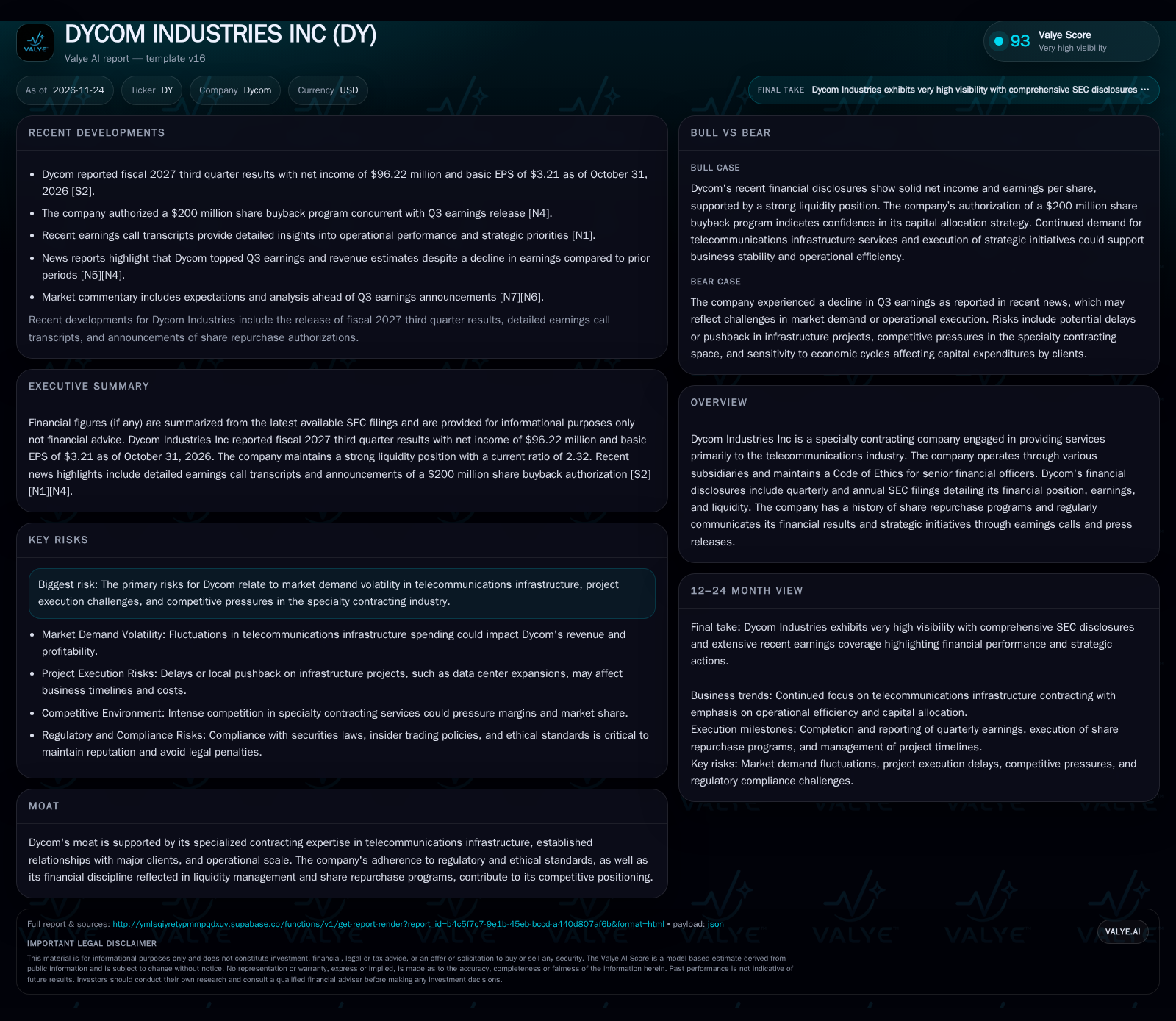
Dycom Industries reported Q3 2027 results with $96.22 million in net income, a current ratio of 2.32, and a newly authorized $200 million share buyback. The company surpassed quarterly earnings and revenue estimates, yet earnings declined compared to prior periods, highlighting margin pressures and demand uncertainty. Dycom's business model remains anchored in specialty contracting for telecom infrastructure, but future performance will hinge on project execution, capital discipline, and navigating cyclical client spending.
Dycom Industries, a key player in specialty contracting for the telecommunications sector, delivered a mixed Q3 2027: it beat top-line and bottom-line estimates but posted a year-over-year earnings decline. However, the central question is whether Dycom can sustain profitability as telecom clients cycle their capital spending and project execution risks rise. The company's future will depend on its ability to maintain operational discipline, defend margins, and adapt to industry volatility.
Recent Results Reveal Margin Pressures and Capital Allocation Moves
In the fiscal 2027 third quarter, Dycom Industries reported net income of $96.22 million, with diluted EPS of $3.19 [S2]. The company’s current assets stood at $3.18 billion against current liabilities of $1.37 billion, resulting in a current ratio of 2.32 and a cash ratio of 0.15 [S2]. Despite topping earnings and revenue estimates, Dycom experienced a year-over-year earnings decline, as highlighted in recent news coverage [N4] [N5]. The newly authorized $200 million share buyback marks a notable capital return initiative, suggesting management’s intent to deploy excess liquidity amid uncertain project pipelines [N4]. These facts underscore a business at the intersection of financial strength and rising operational uncertainty.
How Dycom Makes Money: Project Volume, Margins, and the Challenge of Fixed Overheads
Dycom’s revenue model is fundamentally project-driven, delivering specialty contracting services—primarily for telecom infrastructure buildouts and upgrades. Revenues are likely tied to the volume, scale, and complexity of projects awarded by major telecom clients. Pricing is typically negotiated on a per-project or per-unit basis, and margins depend on efficient project execution, labor productivity, and the ability to manage subcontractor and material costs.
The company’s cost structure blends significant fixed costs (equipment, field management, and administrative overhead) with variable costs (labor, materials, subcontractors). This creates operating leverage: when project volumes are high, incremental revenues can drive disproportionate profit gains, but sharp volume declines can compress margins quickly as fixed costs are spread over fewer projects.
The company reported cash and liquidity metrics for the period; these figures do not by themselves establish operating runway, investment capacity, financial flexibility, or financing capacity. While the current balance sheet snapshot shows ample current assets, Dycom’s cash conversion can be sensitive to project delays, client payment terms, and change orders.
Specialized Scale vs. Intense Rivalry: Dycom’s Position in a Fragmented Sector
Dycom operates in a highly competitive industry, with rivals ranging from national-scale specialty contractors to regional and local players. Its primary advantages include deep expertise in telecom infrastructure, established relationships with large network operators, and the ability to scale crews and resources for complex, multi-geography projects.
However, barriers to entry are moderate: while technical know-how and compliance are nontrivial, much of the work is labor-intensive, and pricing competition can erode margins. Substitution risk is limited in the near term, as telecom infrastructure buildouts require specialized capabilities, but larger clients have significant bargaining power and may shift volume among contractors.
Potential threats include new entrants leveraging technology or more flexible cost structures, and clients insourcing select project types. The question is whether Dycom can defend its share and pricing power as the industry cycles and as clients seek greater cost efficiencies.
If Telecom Infrastructure Cycles Reaccelerate, Operating Leverage Could Drive Earnings Recovery
A favorable scenario for Dycom hinges on a renewed wave of telecom infrastructure investment—driven by 5G densification, rural broadband initiatives, or fiber-to-the-home expansions. In this case, Dycom’s project pipeline would expand, allowing the company to leverage its fixed cost base and drive margin expansion as utilization rates climb.
Evidence that would confirm this scenario includes a sustained uptick in backlog or new contract awards, improving project margins, and management commentary pointing to robust client demand or new multi-year program wins. Sequential improvement in revenue and gross margin, together with reduced earnings volatility, would further support the upside thesis.
Falsification would come from muted backlog growth, continued earnings declines, or a lack of visibility on large-scale project awards.
Telecom Spend Cycles Keep Results Volatile, Forcing Focus on Cost Discipline
The most plausible forward path is one of continued volatility: telecom clients remain cautious, selectively funding new infrastructure while deferring or reprioritizing projects in response to macroeconomic and regulatory signals. Dycom maintains a reported balance sheet position and wins its share of work, but project volumes and margins fluctuate quarter to quarter.
In this scenario, Dycom’s results are highly sensitive to execution: cost overruns, project delays, or unfavorable contract terms could quickly erode profitability, while strong project management and disciplined bidding help defend margins. Capital allocation—including the new buyback—serves to offset some earnings variability but does not fundamentally change the underlying cyclicality.
Confirmation would come from ongoing swings in quarterly earnings, stable but not accelerating backlog, and management emphasizing operational discipline and selective bidding. Falsification would require either a sustained move toward margin expansion or a sharp, persistent earnings contraction.
Project Delays and Client Spending Cuts Could Trigger Margin Compression and Cash Flow Stress
The bear case for Dycom involves a material downturn in telecom infrastructure spending—either from macroeconomic slowdown, regulatory delays, or a pause in major client capex. Project deferrals and cancellations would reduce utilization, spreading fixed costs over a smaller revenue base and compressing margins sharply.
Execution missteps—such as cost overruns, labor shortages, or contract disputes—could exacerbate the impact. In this environment, working capital needs may rise as receivables stretch, and Dycom’s cash conversion cycle could become stressed despite the current asset base.
Downside confirmation would include a steep drop in new awards or backlog, negative free cash flow, and management guidance cuts. Falsification would require evidence of resilient client demand and effective cost containment even as industry headwinds mount.
What Could Shift Dycom’s Thesis: Project Pipeline, Margin Trends, and Capital Allocation Outcomes
Quarterly backlog growth or decline: A sustained increase would signal improving demand visibility, while contraction would suggest a weaker pipeline and rising risk.
Gross and operating margin trends: Sequential improvement would support upside, while persistent margin compression would confirm downside risk.
Project award announcements and contract wins: New multi-year or large-scale awards would validate Dycom’s competitive position and future revenue base.
Cash flow from operations: Consistent positive cash generation would help test the resilience of Dycom’s business model through cycles.
Client concentration metrics, if disclosed: Higher concentration could amplify volatility if a major client slows spending.
Buyback execution pace and impact: Monitoring actual share repurchases and their effect on EPS could clarify capital allocation effectiveness.
Management commentary on project pipeline, labor markets, and client capex intentions: Shifts in tone or guidance would be early signals of changing industry dynamics.
Labor cost inflation and subcontractor availability, if disclosed: Rising costs or shortages could erode project economics and margins.
Disclaimer: This is research-only, informational analysis and not investment advice. It may include AI-generated interpretation and general industry context. Always verify important details using primary sources.

Comments