
TFS Financial’s Funding Shift and Margin Expansion: Navigating Deposit Outflows and Loan Growth
A rising loan portfolio and improved net interest margin highlight TFS Financial’s asset-liability management, but increased reliance on borrowed funds and higher non-interest expense signal evolving risks as the deposit base shrinks and competitive pressures mount.
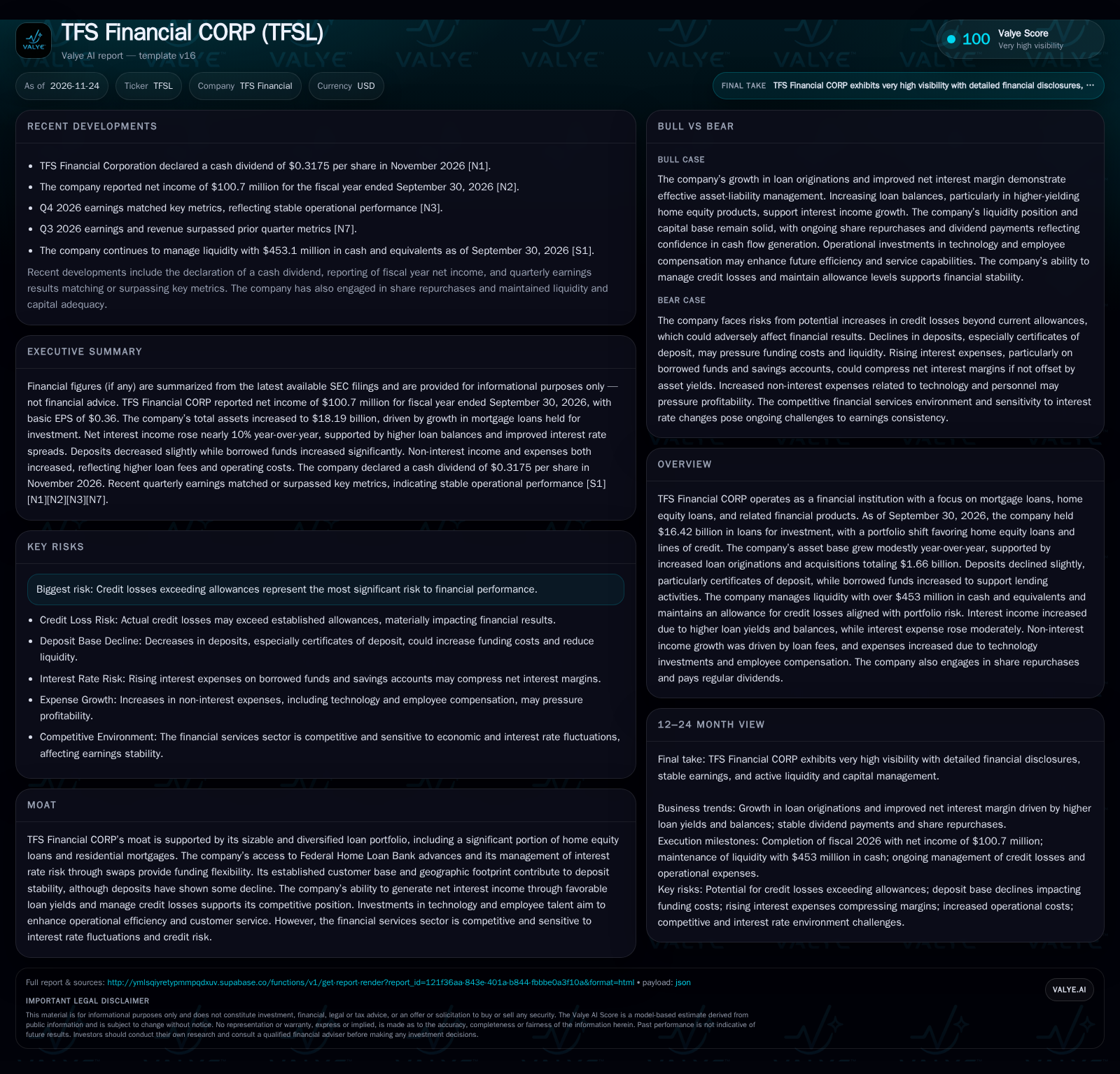
TFS Financial CORP’s 2026 results show strong loan growth, improved net interest margin, and stable net income. However, a notable decrease in deposits and higher dependence on Federal Home Loan Bank borrowings reshape funding dynamics. Expense growth and sector competition could pressure profitability, making credit quality, funding mix, and margin sustainability key areas to watch. [S1] [N2]
TFS Financial CORP’s latest financials underscore the classic balancing act facing regional lenders: accelerating loan growth and improved margins come at the price of a shrinking deposit base and rising funding costs. In fiscal 2026, the company boosted its loan book—especially in home equity products—while deposits continued to erode and reliance on wholesale borrowings jumped. With non-interest expenses climbing and the competitive environment for deposits intensifying, the sustainability of TFS’s margin gains and funding model will be tested by future credit and rate cycles. The real question is whether the company’s asset growth and operational investments can outpace the mounting costs and risks of its evolving funding mix. [S1] [N2]
Recent Funding Dynamics and Margin Trends Redefine TFS Financial’s Risk Profile
TFS Financial ended fiscal 2026 with total assets of $18.19 billion and a loan portfolio up 4.8% to $16.42 billion, reflecting aggressive growth in home equity loans and lines of credit. Loan originations and acquisitions reached $1.66 billion for the year, with a tilt toward purchase transactions and a minority share of adjustable-rate loans. At the same time, deposits fell 2.6% to $10.18 billion, driven by a marked drop in certificates of deposit, while savings accounts saw some countervailing inflows. To fund its expanding loan portfolio, the company increased its borrowings by 17.8% to $5.74 billion, primarily via Federal Home Loan Bank advances. Despite these funding shifts, net interest margin improved to 1.88% from 1.76%, and net interest income climbed nearly 10% to $321.8 million. Non-interest expenses also rose by over 10%, led by technology and compensation spending. Net income for the year was $100.7 million, and the company declared a $0.3175 per share dividend in November 2026. [S1] [N1] [N2]
How Asset Growth and Funding Costs Shape Profitability
TFS Financial’s core economics are rooted in the spread between interest earned on loans and paid on funding sources. The company’s 2026 performance demonstrates classic bank leverage: loan growth boosts interest income, but the mix and cost of funding are critical levers. The rising net interest margin suggests that TFS was able to reprice loans upward or shift toward higher-yielding products faster than funding costs rose—a dynamic that may not persist if deposit outflows continue or if wholesale funding rates climb.
The shift from deposit funding toward greater reliance on borrowed funds introduces both flexibility and risk. Borrowings, particularly from the Federal Home Loan Bank, tend to be more expensive and volatile than core deposits, especially if market rates rise or access tightens. Meanwhile, the shrinking deposit base—especially the outflow of certificates of deposit—could signal increased competition for retail funding or changing customer preferences, both of which may drive up the marginal cost of funds over time.
On the expense side, non-interest costs rose 10.3%, outpacing revenue growth. Investments in technology and talent could pay off in future efficiency or customer retention, but near-term, these higher fixed expenses reduce operating leverage and could pressure margins if revenue growth slows. The steady allowance for credit losses (0.63% of loans) suggests current credit quality is stable, but any deterioration would quickly impact earnings given the thin net interest margin.
Funding Mix and Niche Focus Define TFS’s Place in a Crowded Market
TFS Financial’s competitive position is anchored by its sizable and diversified loan book, with an emphasis on home equity and residential mortgage products. This focus can be advantageous if housing demand remains stable and credit quality holds, but it exposes the company to sectoral downturns and geographic concentration risk. Its ability to access wholesale funding through the Federal Home Loan Bank offers flexibility, but also places it in competition with other regional banks for both retail deposits and institutional funding.
The decline in certificates of deposit and the move toward greater reliance on borrowings highlight the intense competition for low-cost, sticky deposits—a challenge shared by many regional peers as customers seek higher yields elsewhere or shift to digital-first alternatives. TFS’s investments in technology may help differentiate its offerings and improve customer experience, but the financial services sector remains highly commoditized, and switching barriers for most depositors are low.
Long-term, TFS’s competitive differentiation may hinge on its ability to maintain asset quality, manage funding costs, and innovate in customer service delivery. However, its relatively low net interest margin and rising cost base suggest that any slip in credit performance or funding access could quickly erode its competitive standing.
Margin Expansion and Loan Growth Drive Earnings Outperformance—If Funding Costs Remain Contained
The most favorable scenario for TFS Financial is one where the company continues to expand its loan book—especially in higher-yielding home equity products—without a commensurate rise in funding costs. If deposit outflows stabilize and the company can attract new or returning retail deposits (particularly savings accounts), its funding mix could shift back toward cheaper, more stable sources. Continued improvements in net interest margin, combined with disciplined credit risk management and operating efficiency gains from technology investments, would drive sustainable earnings growth and support ongoing dividends and share repurchases.
Evidence that would confirm this scenario includes a reversal or stabilization of deposit trends, further margin expansion, and flat or declining funding costs relative to asset yields. Additionally, falling non-interest expense ratios and steady or improving credit quality would reinforce the thesis that operational investments are paying off. Robust loan originations and stable asset quality metrics would round out the bull case.
Funding Pressure Offsets Asset Growth Amid Tight Margins and Rising Expenses
The most plausible trajectory for TFS Financial is a steady-state environment where loan growth continues, but is increasingly offset by higher funding costs and expense growth. In this scenario, net interest margin plateaus or narrows slightly as deposit competition remains fierce and wholesale funding rates inch upward. Non-interest expenses continue to rise with ongoing technology and personnel investments, absorbing much of the incremental revenue from loan growth.
Earnings remain stable but show limited growth, with dividend payments and share repurchases continuing but not accelerating. Credit quality remains sound, but any uptick in losses or delinquencies is quickly reflected in higher provisions, given the low allowance coverage. Confirmation of this scenario would include persistent deposit outflows, a modest decline in net interest margin, and rising non-interest expense, with only gradual improvement in efficiency ratios. Loan originations remain healthy, but funding mix and cost become the primary constraints on profitability.
Rising Credit Losses and Escalating Funding Costs Erode Earnings Power
A more adverse scenario would see TFS Financial’s credit quality deteriorate, with actual loan losses exceeding the current allowance. This could result from a downturn in the housing market, economic stress in its core regions, or a spike in delinquencies in home equity products. Simultaneously, if deposit outflows accelerate and access to wholesale funding tightens or becomes more expensive, the company could face a margin squeeze—especially if it cannot reprice loans quickly in a competitive lending environment.
Higher non-interest expenses, especially if technology investments fail to deliver efficiency gains, would compound the pressure on profitability. In this scenario, net income could fall, dividend sustainability would come into question, and share repurchases could be curtailed. Evidence confirming this scenario would include a spike in non-performing loans, rising provisions for credit losses, further drops in deposits, increasing cost of funds, and stagnant or falling net interest margin.
What Will Shape TFS Financial’s Resilience and Returns?
Quarterly trends in total deposits, especially the mix between certificates of deposit and savings accounts, will signal funding stability or stress.
Cost of funds relative to asset yields—if disclosed—will reveal whether net interest margin expansion is sustainable.
Loan portfolio composition and growth, particularly in home equity and adjustable-rate products, should be monitored for risk concentration and margin impact.
Non-performing loan and delinquency ratios would help assess the risk of rising credit losses, especially if housing markets weaken.
Allowance for credit losses as a percentage of total loans—movement here would indicate changing risk assessment by management.
Non-interest expense trends, with particular focus on technology and compensation line items, will show whether operational investments are translating into efficiency.
Quarterly updates on Federal Home Loan Bank advances and other borrowings will clarify the evolving funding mix and potential liquidity risk.
Disclaimer: This is research-only, informational analysis and not investment advice. It may include AI-generated interpretation and general industry context. Always verify important details using primary sources.

Comments