
Smucker’s Margin Gains: Navigating Cost Wins and Near-Term Obligations in Consumer Staples
Competitive intensity and shifting consumer trends remain ongoing threats, but operational execution has supported margins for now.
Competitive intensity and shifting consumer trends remain ongoing threats, but operational execution has supported margins for now. [S2] [N3] [N4] [N8]
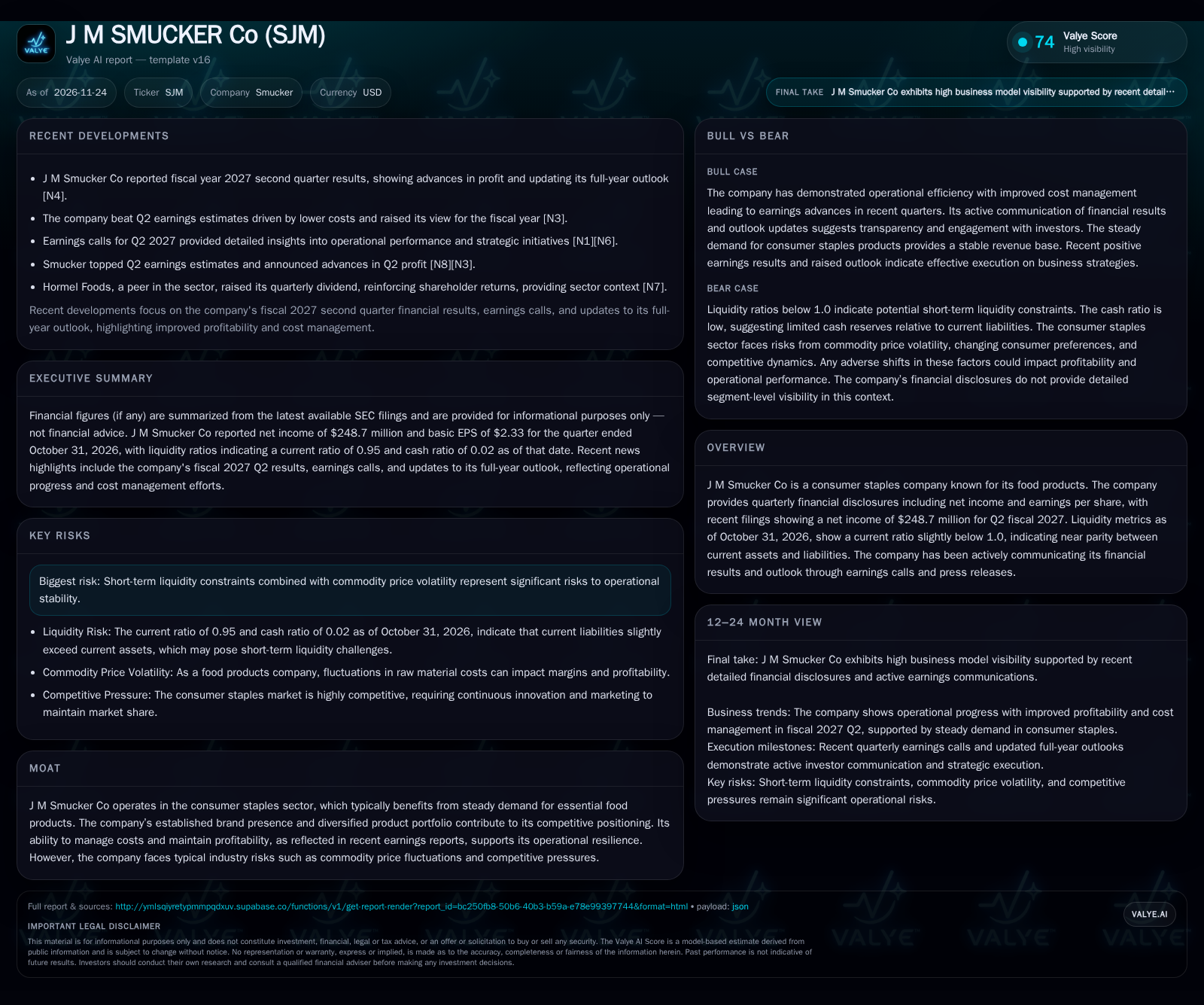
J M Smucker Co enters the latter part of fiscal 2027 with a decisive profit beat and an upwardly revised outlook, spotlighting its ability to capture cost efficiencies in a reliably steady consumer staples market. The interplay between operational excellence and potential financial flexibility will define whether recent margin gains are sustainable or vulnerable to reversal if market or cost conditions shift. [S2] [N3] [N4] [N8]
Recent Profit Gains and Liquidity Tension Set the Stage
J M Smucker Co reported net income of $248.7 million for the quarter ending October 31, 2026, with basic earnings per share of $2.33 and diluted EPS of $2.32. This earnings performance exceeded Wall Street expectations, driven largely by lower costs, and prompted the company to raise its full-year outlook. However, the company’s balance sheet as of the same date reveals near-term pressures: current assets of $2.14 billion against current liabilities of $2.24 billion (current ratio 0.95), and a cash ratio of just 0.02. These figures indicate that while profitability has improved, Smucker is operating with limited immediate liquidity, leaving little margin for error in cash management. [S2] [N3] [N4] [N8]
How Smucker’s Margin Structure and Working Capital Needs Shape Its Economics
Smucker’s revenue model is grounded in branded packaged foods, where pricing power is generally moderate and volume growth is closely tied to broad consumer demand trends. In periods of cost inflation, the company’s ability to raise prices or enhance mix can support margins, but input cost volatility—especially in commodities like fruit, coffee, and grains—remains a persistent threat. Fixed costs are meaningful due to manufacturing, logistics, and marketing investments, creating operating leverage when volumes or prices rise. If top-line growth stalls or working capital cycles lengthen, Smucker could face elevated refinancing or supplier pressure. The balance between ongoing cost discipline and the need to fund operations with constrained liquidity will be central to the company’s near-term economics.
The interplay between Smucker’s fixed and variable cost structures further complicates margin dynamics. Fixed costs, such as manufacturing overhead and marketing expenses, create operating leverage, meaning that incremental volume gains can disproportionately enhance profitability. However, this leverage can work in reverse if volumes decline, amplifying margin pressure. Additionally, working capital management is critical; lengthening receivables or inventory days can strain cash flow, especially in a low liquidity environment. The timing of payables relative to receivables also affects cash conversion cycles, with any deterioration potentially necessitating external financing. Thus, Smucker’s economics hinge not only on cost control but also on efficient capital deployment and cycle management.
Brand Strength vs. Industry Headwinds: Smucker’s Place in the Staples Landscape
Smucker leverages a portfolio of established brands in categories with habitual, recurring consumer demand, which historically dampens volume volatility relative to discretionary food peers. Brand loyalty and shelf presence provide some insulation against private label encroachment and promotional pressures. However, the consumer staples sector is highly competitive, with global food conglomerates and aggressive store brands constantly vying for share. Substitution risk is ever-present, especially as consumer preferences shift toward health, convenience, or premiumization. The company’s ability to manage input costs and innovate in response to evolving tastes is crucial.
In the context of shifting consumer preferences, Smucker’s innovation pipeline and responsiveness to health and wellness trends will be pivotal. The company must balance maintaining core brand equity with adapting product portfolios to meet demands for cleaner labels, organic ingredients, or convenience formats. Failure to do so risks losing relevance to more agile competitors or private labels that can capitalize on niche trends. Moreover, the competitive landscape is influenced by retailer power, where large grocery chains can dictate terms and shelf space, pressuring margins. Smucker’s ability to negotiate favorable terms and maintain premium positioning amidst these pressures will shape its competitive resilience.
Sustained Cost Discipline and Stable Input Prices Unlock Further Margin Expansion
The most favorable outcome for Smucker would be a continuation of disciplined cost controls alongside benign commodity price trends, allowing the company to further expand margins even if top-line growth remains steady. Additional upside could come from targeted product innovation or mix shifts into higher-margin categories, provided these initiatives do not require outsized upfront investment. Conversely, if commodity prices spike or cost savings plateau, this scenario would be challenged.
If Smucker successfully leverages economies of scale while maintaining disciplined procurement strategies, it could realize incremental margin expansion beyond current expectations. This would require not only stable commodity prices but also operational improvements such as enhanced supply chain efficiencies or automation reducing overhead costs. Additionally, a favorable consumer response to premium or innovative products could shift sales mix toward higher-margin items without significant marketing spend increases. However, these gains depend on the company’s capacity to invest selectively without compromising liquidity, highlighting the importance of capital allocation decisions aligned with margin enhancement objectives.
Operational Progress Sustained, but Liquidity Remains a Persistent Constraint
The most plausible outcome is that Smucker maintains recent operational improvements, with stable-to-modestly growing earnings powered by ongoing cost management and resilient consumer demand. In this scenario, Smucker neither dramatically improves nor deteriorates its liquidity position, remaining exposed to swings in input costs or payment cycles. Confirmation would come from steady profit margins and similar liquidity ratios in subsequent quarters.
A Shock to Working Capital or Input Costs Triggers Margin Compression and Financing Strain
The principal risk is that an adverse event—such as a sharp increase in commodity costs, slowdown in sales, or a disruption in supply chains—forces Smucker to extend payables, draw on lines of credit, or seek external funding to meet obligations. If the company is unable to pass through higher costs or if consumer demand softens, profitability would erode. Evidence of this scenario would include rising short-term debt, negative working capital trends, or guidance revisions tied to input costs or liquidity actions.
How Smucker’s Next Moves Will Clarify the Margin-Liquidity Tradeoff
Inventory turnover and days sales outstanding, if disclosed, would provide insight into the efficiency of working capital management and the company’s ability to generate cash internally.
Gross and operating margin trends will reveal whether cost controls remain effective or if input price pressures are eroding profitability.
Any new short-term borrowings or changes in credit facility usage should be tracked as signals of underlying liquidity stress or improved potential financial flexibility.
Updates on commodity cost exposure and procurement strategies, if provided, will be crucial for assessing forward margin risk.
Management commentary on capital allocation—including dividends, buybacks, or growth investments—will indicate confidence in cash flow stability versus a need to conserve resources.
Segment or product-line performance details, if disclosed, would help test whether margin improvements are broad-based or concentrated in specific categories.
Disclaimer: This is research-only, informational analysis and not investment advice. It may include AI-generated interpretation and general industry context. Always verify important details using primary sources.

Comments