
Amentum Holdings: Backlog Strength, Contract Mix, and the Realities of Government Services Economics
Amentum Holdings sits atop a $48.2 billion backlog and delivers profit growth even as revenues dip amid contract transitions—underscoring both the strengths and operational complexities of government services at scale. Future performance will hinge on backlog conversion, contract mix, and resilience to budgetary and cost pressures.
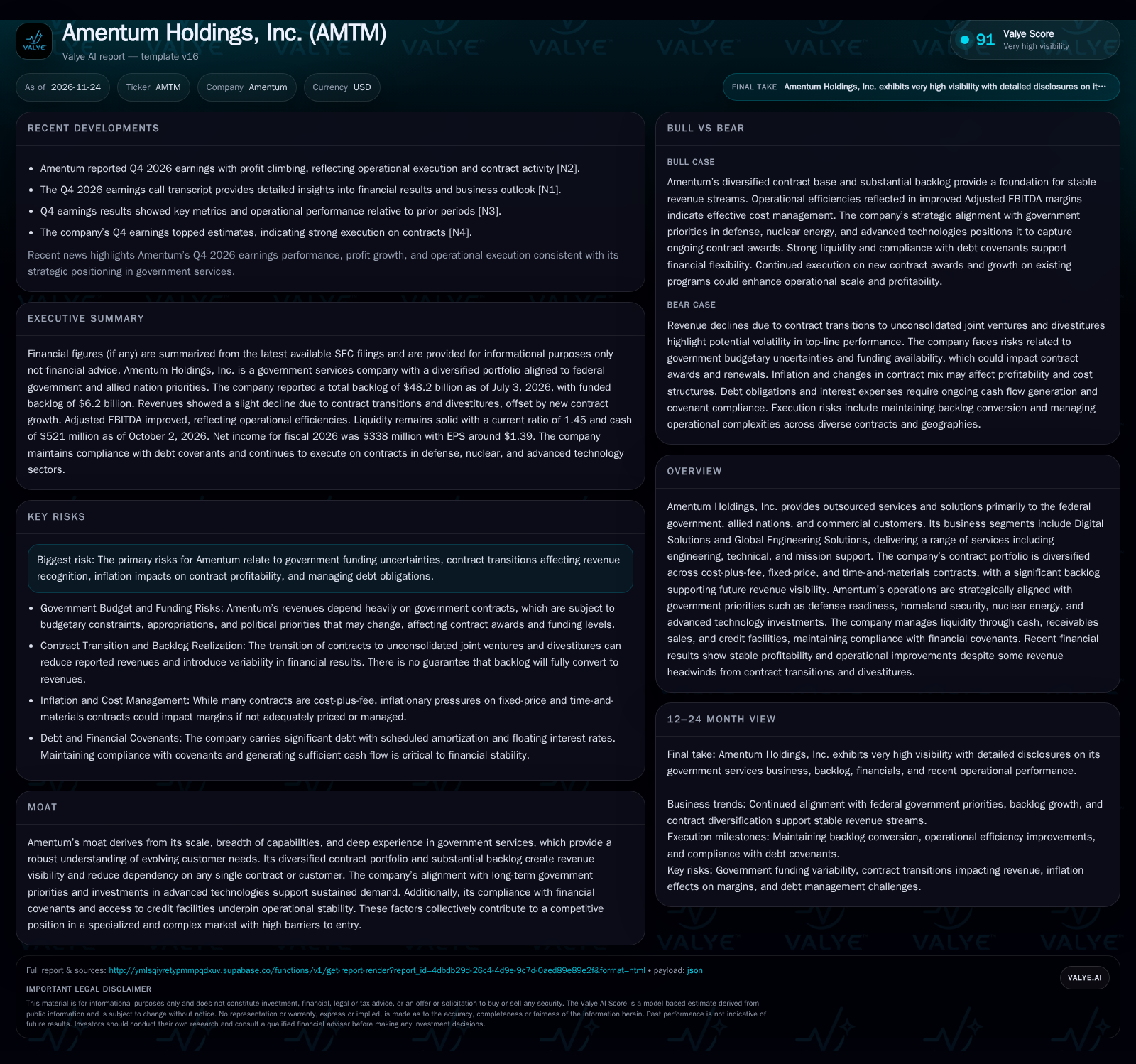
Amentum Holdings reported a $48.2 billion backlog and improved adjusted EBITDA despite a slight revenue decline, reflecting operational discipline amid contract transitions. The company’s exposure to cost-plus-fee contracts and strategic alignment with government priorities support revenue visibility, but risks remain from funding uncertainties and inflation impacts on margins. Backlog realization and contract mix will be critical watchpoints for sustained performance. [S1] [N3]
Amentum Holdings, Inc. exemplifies the scale, complexity, and risk profile of a modern government services contractor. With a $48.2 billion backlog and profit improvement even as headline revenues slipped, the company is navigating a landscape defined by long-term government priorities, shifting contract structures, and the ever-present specter of federal budget cycles. The interplay between backlog realization, contract mix, and cost management will determine whether Amentum can sustain its operational momentum—or if execution and macro risks will erode its current visibility.
Recent Performance: Backlog Depth and Profit Growth Amid Revenue Transition
As of July 3, 2026, Amentum reported a total backlog of $48.2 billion, with $6.2 billion funded, offering multi-year revenue visibility. Notably, the latest quarter saw a slight revenue decline year-over-year, attributed to the transition of contracts to joint ventures and divestitures, partially offset by new contract awards and growth on existing programs. Despite this, both the Digital Solutions and Global Engineering Solutions segments improved adjusted EBITDA, signaling operational discipline. Net income for fiscal 2026 was $338 million with diluted EPS of $1.38. The company reported a current ratio of 1.45 for the period. [S1] [N3] [N4]
Contract Structures and Margin Dynamics in Federal Services
Amentum’s revenue streams are diversified across cost-plus-fee (53% of revenues), fixed-price, and time-and-materials contracts. Cost-plus-fee arrangements, common in government services, allow for reimbursement of allowable costs plus a negotiated fee, providing margin stability and some inflation protection. However, fixed-price and time-and-materials contracts expose the company to margin compression if costs rise faster than pricing adjustments. The company’s mix of long-dated, often complex contracts creates a degree of revenue predictability but requires disciplined project execution and cost control.
Operating leverage in this sector is modest due to the labor-intensive nature of services and the prevalence of pass-through costs. EBITDA gains typically come from incremental efficiency improvements, not from rapid scaling. The company reported cash and liquidity metrics for the period; these figures do not by themselves establish operating runway, investment capacity, financial flexibility, or financing capacity. Debt service is a material ongoing obligation—floating-rate debt and scheduled amortization require steady cash generation and careful covenant management.
Scale, Customer Relationships, and Barriers in Government Contracting
Amentum’s competitive position is shaped by its scale, breadth of technical capabilities, and entrenched relationships with federal agencies. The government services market is characterized by high switching costs for customers, owing to the complexity of mission requirements, security clearances, and integration with legacy systems. This creates barriers to entry for new competitors, though incumbents must continually demonstrate performance to win contract renewals and new awards.
Peer competitors include other large federal contractors with expertise in engineering, mission support, and advanced technologies. Substitution risk is low at the level of core federal missions, but pricing pressure can emerge from competitive bidding, government cost control initiatives, and the potential for in-sourcing or re-bidding of contracts. Technology advances—such as automation and digital tools—can provide efficiency advantages, but also require ongoing investment to remain competitive.
If Backlog Conversion Accelerates and Contract Mix Shifts Favorably
The most favorable scenario for Amentum would involve an acceleration in converting its substantial backlog—especially the funded portion—into recognized revenue, coupled with a rising share of cost-plus-fee or indexed contracts that protect margins from inflation. Continued alignment with federal priorities in defense, nuclear, and advanced technologies could drive additional contract wins, while operational efficiencies further expand EBITDA margins.
Evidence for this outcome would include sequential growth in recognized revenue from backlog, a trend toward higher-margin contract types, and ongoing improvement in segment EBITDA. Confirmation would also come from new contract announcements consistent with strategic federal initiatives and minimal slippage in backlog realization rates.
Sustained Revenue and Margin Stability—But with Ongoing Volatility from Contract Transitions
The most plausible scenario is one in which Amentum maintains stable revenues and margins, with modest growth tempered by episodic revenue volatility due to contract transitions, joint venture accounting, and divestitures. Cost-plus-fee contracts continue to anchor profitability, but fixed-price and T&M work introduce periodic margin pressure, especially if inflation persists. Management maintains operational discipline and debt covenant compliance, but improvements are incremental rather than dramatic.
This scenario would be confirmed by steady—but not rapid—revenue growth, relatively stable adjusted EBITDA, and periodic fluctuations in reported revenues tied to contract accounting. Falsification would come from either sustained revenue declines or sharp margin compression not offset by cost controls or contract re-pricing.
If Government Funding Tightens and Backlog Realization Slows
A more adverse scenario would see government budget uncertainties or political disruptions leading to delayed or reduced contract awards, slowing the conversion of backlog into revenue. If a greater share of work shifts to fixed-price contracts during a period of elevated inflation, margin compression could intensify. Debt service becomes more challenging if cash generation falters, and covenant compliance could be tested.
Warning signs would include a declining funded backlog, sequential revenue declines not offset by new wins, rising interest expense, or a shift in contract mix away from cost-plus-fee arrangements. Evidence of project execution challenges or inability to control costs on fixed-price work would further support this scenario.
Factors to Assess the Durability of Amentum’s Revenue and Margin Profile
Quarterly conversion rates of total and funded backlog into recognized revenue—if disclosed—will clarify the pace and reliability of future sales.
Shifts in contract mix, particularly the balance between cost-plus-fee and fixed-price/time-and-materials contracts, as this will affect margin resilience to cost inflation.
Segment-level adjusted EBITDA trends, to gauge operational efficiency and the sustainability of recent profit improvements.
Updates on government budget cycles, appropriations, and contract award pipelines, given the company’s heavy exposure to federal spending priorities.
Debt service coverage and covenant headroom, especially if interest rates rise or cash flows become more volatile.
Material contract wins or renewals in strategic sectors (defense, nuclear, advanced technologies), which would support backlog replenishment.
Evidence of execution risks such as cost overruns, delays, or disputes on large fixed-price contracts.
Any changes in government procurement policy or competitive dynamics that could alter the bidding environment or contract structures.
Disclaimer: This is research-only, informational analysis and not investment advice. It may include AI-generated interpretation and general industry context. Always verify important details using primary sources.

Comments