
Aramark’s Post-Pandemic Growth: Shareholder Returns, Margin Management, and Sector Diversification
Aramark’s 2026 results highlight accelerating revenue and operating income growth across a diversified client base, but rising costs and sector-specific risks complicate the margin outlook. The cited source reports dividend-related activity; that disclosure alone does not establish dividend-policy continuity, management confidence, or a material constraint on capital flexibility.
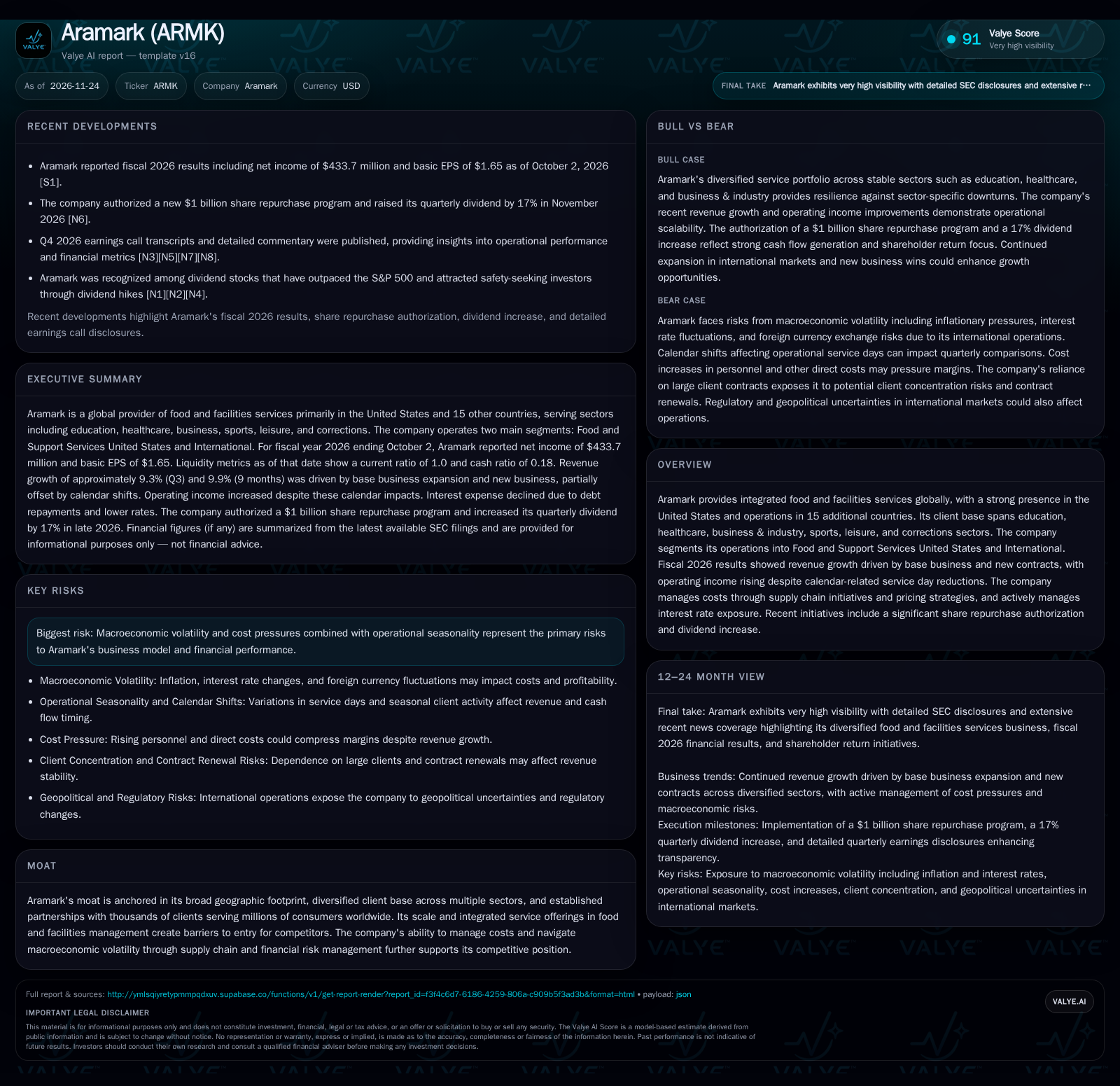
Aramark reported strong revenue and operating income growth for fiscal 2026, driven by base business expansion and new contract wins, despite calendar-related headwinds. The company authorized a $1 billion share repurchase and increased its dividend by 17%, underscoring a focus on shareholder returns. However, rising costs, exposure to macroeconomic swings, and dependence on large client contracts present ongoing risks. Margin management and sustained client retention will be critical as Aramark seeks to balance growth ambitions with financial discipline. [S1] [S2] [N6]
Aramark’s fiscal 2026 performance reflects the company’s ability to drive top-line growth through both expanded base business and new client wins across its core food and facility services segments. The cited source reports dividend-related activity; that disclosure alone does not establish dividend-policy continuity, management confidence, or a material constraint on capital flexibility. However, as cost pressures mount and the company remains exposed to both macroeconomic swings and sector-specific contract cycles, the ultimate sustainability of margin expansion and capital returns will hinge on disciplined execution and the durability of Aramark’s client relationships.
2026 Results: Shareholder Returns Accelerate Amid Broad-Based Revenue Growth
Aramark reported net income of $433.7 million for fiscal 2026, with basic earnings per share of $1.65 as of October 2, 2026 [S1]. Revenue increased by 9.3% for the quarter and 9.9% for the nine months ended July 3, 2026, reflecting a combination of base business growth and net new contract wins, partially offset by negative calendar effects [S2]. Operating income rose faster than revenue—up 18.1% for the quarter and 13.7% for the nine months—indicating some operating leverage despite rising direct costs [S2]. In November 2026, Aramark authorized a new $1 billion share repurchase and raised its quarterly dividend by 17%, marking a clear commitment to returning capital to shareholders [N6]. The company’s cash position was $688 million, with a current ratio of 1.0 as of fiscal year-end, reflecting a neutral short-term liquidity profile [S1].
How Aramark Makes Money: Contract Structures, Cost Pressures, and Margin Management
Aramark’s core business model is built on multi-year service contracts in food and facilities management, primarily in the United States but with a presence in 15 other countries [S2]. Revenue is typically tied to the volume of services delivered, which can include on-site food operations, catering, janitorial, and maintenance services. Pricing mechanisms often involve fixed fees, cost-plus arrangements, or per-service/per-meal charges, with the mix varying by sector and client. While this provides some revenue visibility, contract terms can include renewal risk and periodic repricing, especially in competitive bids or public-sector accounts.
The cost structure is dominated by food and support service costs, personnel expenses, and other direct costs, all of which rose in line with revenue in 2026 due to business expansion and higher commissions in the Sports & Entertainment segment [S2]. This suggests a largely variable cost base, but the scale of operations creates opportunities for supply chain leverage and process efficiencies. Operating income outpaced revenue growth in 2026, indicating some margin expansion, but the sustainability of this depends on Aramark’s ability to offset wage inflation and input cost volatility through pricing, procurement, and operational discipline.
Capital requirements are moderate, as the business is service-heavy rather than asset-intensive, though investments are periodically needed for kitchen, facility upgrades, and digital enablement. Interest expense fell in 2026 due to term loan repayments and lower prevailing rates, though partially offset by higher fixed rates on new swaps [S2].
Sector Breadth and Scale: Defensive Moat or Margin Trap?
Aramark’s competitive position is anchored in its broad sector coverage—education, healthcare, business, sports, leisure, and corrections—which provides resilience against sector-specific downturns [S2]. Large, integrated contracts with institutional clients create moderate switching costs, as transitions between providers can disrupt daily operations and require complex onboarding. However, the competitive landscape includes other global service giants, regional players, and, increasingly, technology-enabled upstarts offering targeted solutions.
Scale enables Aramark to negotiate better procurement terms and spread fixed overheads, but it can also lead to margin dilution if the company is forced to compete aggressively on price to win or retain major contracts. The risk is particularly acute in public-sector and education accounts, where contract cycles and budget constraints can drive commoditization. Technology adoption (e.g., digital ordering, analytics for labor management) could create incremental differentiation, but the moat is primarily one of operational scale and embedded client relationships, not proprietary technology or network effects.
Margin Expansion and International Growth Unlock Shareholder Value
In a favorable scenario, Aramark continues to expand its base business and secures net new contracts at attractive margins, particularly in international markets where penetration is lower and competition is more fragmented. If cost inflation moderates and the company leverages scale to drive further supply chain savings, incremental margin expansion could be sustained.
Evidence to confirm this scenario would include continued operating income growth outpacing revenue, a rising operating margin, and visible international revenue gains. New contract wins in high-growth sectors (such as healthcare or corporate campuses) at favorable terms and positive commentary on client retention rates would further support the case.
Growth Balances Cost Headwinds as Contract Cycles Drive Variability
The most plausible path is one of continued, but moderating, revenue growth driven by steady performance in the core U.S. segments and selective international expansion. Operating income likely tracks revenue, with modest margin improvement as supply chain and operational efficiencies partially offset ongoing labor and input cost inflation. Contract renewal cycles and calendar-related service day variations introduce periodic volatility, but the underlying business remains resilient due to sector diversification.
Confirmation would come from stable or slightly rising operating margins, consistent net new business wins, and manageable cost escalation. Any material deviation—such as a spike in personnel costs not offset by pricing or efficiency gains, or a downturn in major segments like education or healthcare—would challenge this scenario.
Margin Compression Risk: Cost Inflation and Client Losses Pressure Earnings
In a less favorable scenario, persistent inflation in wages and food costs outpaces Aramark’s ability to adjust pricing or drive efficiency gains, leading to margin compression even if revenue continues to grow. The loss or non-renewal of large contracts—especially in sectors with budget constraints or heightened competition—could further pressure revenue visibility and profitability. Geopolitical or regulatory shocks in international markets may compound these risks.
This scenario would be confirmed by declining operating margins, rising direct costs as a percentage of sales, and any reported setbacks in contract renewals or major client relationships. Negative revisions to earnings guidance, or delays in executing the share repurchase/dividend program due to cash flow constraints, would also be red flags.
Testing the Aramark Thesis: Client Retention, Margins, and Capital Allocation
Net new business wins and retention rates: If disclosed, this would indicate Aramark’s ability to expand and maintain its client base amid competition and contract cycles.
Operating margin trends: Sustained improvement would support the case for effective cost management and pricing power.
Personnel and input cost inflation: Monitoring the pace of wage and materials expense increases relative to revenue growth is crucial for margin outlook.
Contract renewal pipeline and major account churn: Details on upcoming renewals, wins, or losses would help gauge revenue stability.
International revenue mix and growth: Expansion outside the U.S. could diversify risk and offer higher-margin opportunities if successfully executed.
Execution of share repurchase and dividend increases: Actual outlays versus authorization will test management’s commitment to capital returns.
Commentary on supply chain initiatives and digital transformation: Updates on procurement, automation, or technology investments would clarify Aramark’s ability to contain costs and differentiate service.
Disclaimer: This is research-only, informational analysis and not investment advice. It may include AI-generated interpretation and general industry context. Always verify important details using primary sources.

Comments