
Analog Devices: Record Results, AI Tailwinds, and the Challenge of Sustained Outperformance
Analog Devices posts record fiscal 2026 results and strong profitability, driven by a diversified end-market mix and AI-related opportunities. As the company leverages scale and R&D capabilities, it faces the perennial pressures of semiconductor cyclicality, technological disruption, and macroeconomic volatility.
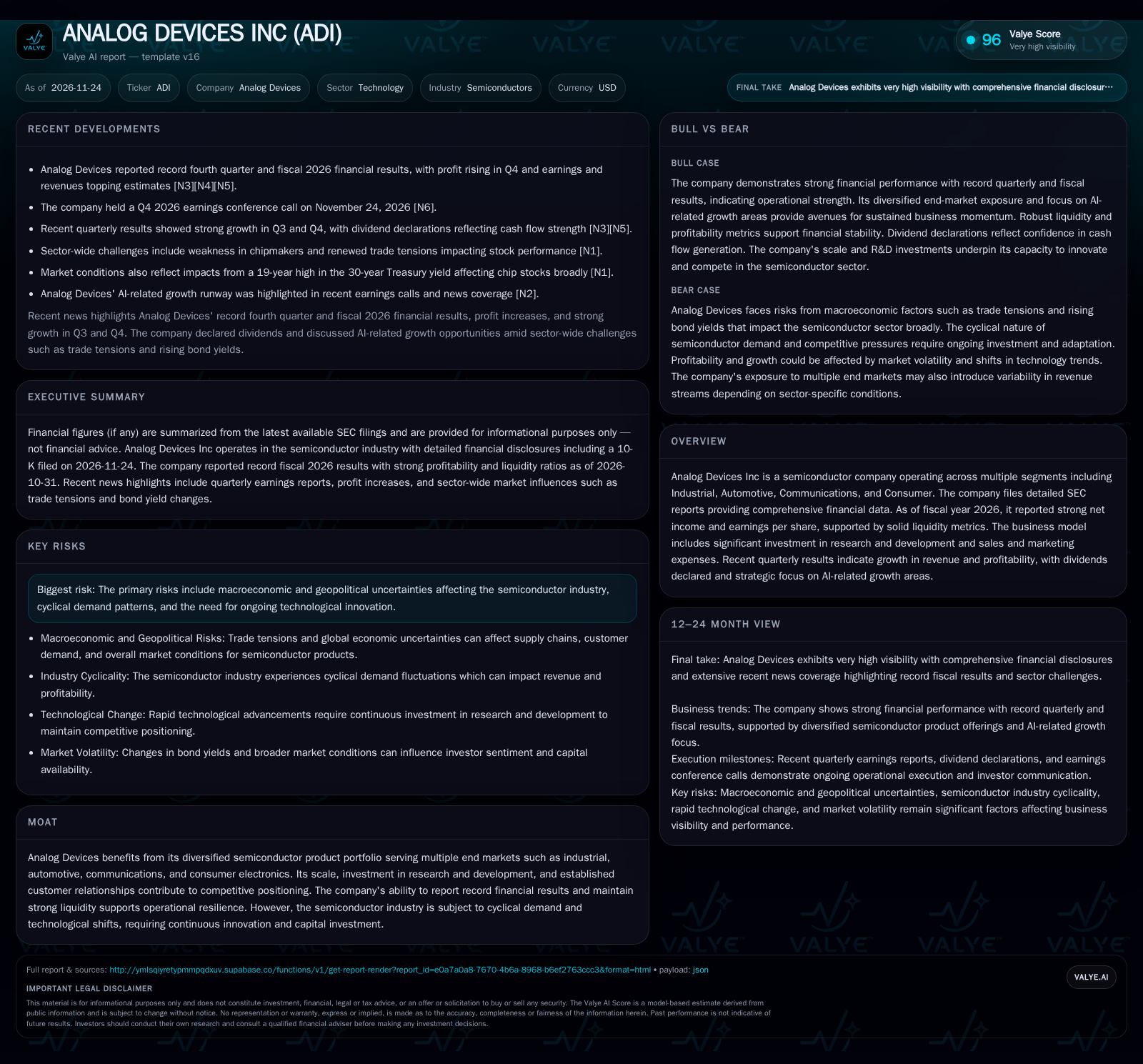
Analog Devices delivered record net income and reported liquidity position as of fiscal 2026, with profits and revenues exceeding estimates. The company’s exposure to industrial, automotive, communications, and consumer segments—alongside a strategic focus on AI—underpins growth potential, but cyclicality and sector headwinds remain persistent risks. Monitoring end-market demand, R&D progress, and the ability to capitalize on AI-driven opportunities will be critical going forward. [S1] [N2] [N3] [N4] [N5]
Analog Devices (ADI) has capped fiscal 2026 with record financial results, including nearly $5 billion in net income and a reported cash position. The company’s performance reflects both the breadth of its end-market exposure and its ongoing investment in research and development. With AI-related growth opportunities now a central theme, ADI faces the dual challenge of capturing new demand while navigating the ever-present risks of macroeconomic volatility and technology disruption. The next phase will test whether scale, diversification, and innovation can continue to deliver outperformance as sector dynamics shift. [S1] [N3] [N4]
The company reported cash and liquidity metrics for the period; these figures do not by themselves establish operating runway, investment capacity, financial flexibility, or financ
Analog Devices reported net income of $4.997 billion and basic earnings per share of $10.27 for the fiscal year ending October 31, 2026. Cash and cash equivalents stood at $4.9 billion, with a current asset base of $10.4 billion and current liabilities of $5.7 billion, yielding a current ratio of 1.84 and a cash ratio of 0.87. [S1]
Fourth quarter and full-year financial results set new records for both profit and revenue, with Q4 performance exceeding analyst estimates. This momentum comes against a backdrop of sector-wide headwinds—trade tensions and bond yield volatility—highlighted in recent news coverage. [N3] [N4] [N5]
Management has publicly emphasized AI as a core strategic growth area, suggesting that future capital and R&D allocation may tilt increasingly toward intelligent edge and data-centric markets. [N2]
How ADI’s Diversified Model and Scale Could Unlock Operating Leverage
Analog Devices generates revenue across industrial, automotive, communications, and consumer segments. This diversification can buffer the company from single-sector downturns, but it also introduces complexity in demand forecasting and inventory management. The company’s business model typically involves designing and selling both standard and application-specific integrated circuits (ICs), with a mix of higher-margin proprietary products and more commoditized offerings.
Pricing power in analog and mixed-signal semiconductors is often tied to customer switching costs, product performance, and long-term relationships. ADI’s history of R&D investment is designed to support differentiated products—especially in industrial and automotive applications, where reliability and integration are critical. If the company can maintain technological leadership, it may be able to sustain premium pricing and margin resilience even as volume cycles fluctuate.
Fixed costs are substantial due to ongoing R&D and capital equipment needs, but high gross margins (67.3% in recent quarters) indicate operating leverage when volumes rise. This means that incremental revenue growth—driven by secular trends like AI adoption, electrification, and sensor proliferation—could disproportionately benefit operating income, provided competitive pressures do not trigger price erosion or excess inventory.
ADI’s Edge: R&D Depth and Customer Entrenchment Versus Sector Volatility
Analog Devices’ competitive position is built on a broad product portfolio, strong R&D capabilities, and established relationships across multiple end markets. In analog and mixed-signal ICs, barriers to entry include design expertise, longstanding customer integration, and the need for high reliability—especially in industrial and automotive verticals.
However, the semiconductor industry remains intensely competitive, with major rivals in both analog and digital domains. Technological substitution—such as the shift from traditional analog signal chains to more integrated digital solutions—could pressure legacy product lines. The company’s ability to pivot toward higher-value solutions, including AI-enabled and edge-compute applications, will be critical as customers demand more functionality and integration.
Switching costs for industrial and automotive customers can be high due to qualification cycles and the long lifespans of deployed systems. This can provide revenue stability, but only if ADI continues to innovate and meet evolving technical standards. Price-based competition, particularly from lower-cost international suppliers, remains a structural risk in more commoditized product categories.
AI-Driven Demand and End-Market Expansion Fuel Outperformance
A favorable scenario for Analog Devices is one in which AI adoption accelerates across industrial, automotive, and communications markets, driving increased demand for high-performance analog, mixed-signal, and sensor solutions. If ADI’s R&D investments yield differentiated products that become embedded in next-generation platforms—such as autonomous vehicles, smart factories, and advanced communications infrastructure—revenue growth could outpace the broader semiconductor cycle.
Confirmation would come from sustained revenue and gross margin expansion in segments exposed to AI and data-centric applications, as well as new design wins with top-tier customers. Announcements of strategic partnerships or multi-year supply agreements in AI-adjacent verticals would further validate the thesis.
Early signs of this scenario are present in management’s emphasis on AI-related growth and recent record-breaking financial results. [N2] [N3] [N4] However, evidence of outsized market share gains or durable product leadership in AI-enabling technologies would be required to fully confirm the upside.
Diversification and Incremental Innovation Support Stable Performance
The most plausible near-term trajectory is that Analog Devices continues to deliver solid results through a combination of end-market diversification and incremental product innovation. Revenue may grow in line with secular trends—such as electrification, industrial automation, and connectivity—while profitability remains anchored by gross margin discipline and operational scale.
[S1] [N3] [N4] [N5] Cyclical headwinds and competitive pressures may limit upside, but the core business remains resilient due to the stickiness of customer relationships and continued R&D investment.
A deviation from this scenario would be signaled by a sharp decline in gross margins, loss of key customers, or a failure to keep pace with technological shifts in core end markets.
Cyclical Downturn, Tech Disruption, or Execution Missteps Undermine Momentum
In an adverse scenario, Analog Devices could face a convergence of headwinds: a cyclical downturn in global semiconductor demand, intensifying price competition, or disruptive technology shifts that erode the relevance of its core product lines. Macroeconomic pressures, such as trade tensions or rising interest rates, could further dampen capital spending by industrial and automotive customers.
The risk of technological obsolescence is especially acute if competitors leapfrog ADI in AI-enabling or advanced sensor solutions, or if digital integration cannibalizes traditional analog content. Execution missteps—such as delayed product launches, failed acquisitions, or cybersecurity incidents—could also impair customer trust and erode margins.
Confirmation of a downside scenario would include revenue contraction, declining gross margins, unexpected inventory build-up, or public loss of major customers. Material impacts from security breaches—such as the June 2026 incident referenced in SEC filings—would also be red flags if they escalate or recur. [S2]
Milestones and Metrics That Will Define ADI’s Next Chapter
Revenue growth by end market (industrial, automotive, communications, consumer) would help test the durability of diversification and identify where secular versus cyclical trends are playing out. If disclosed, segment-level margin trends would be equally informative.
Gross margin trajectory—especially in the face of rising input costs or competitive pricing—remains a key signal of operating leverage and product mix quality.
R&D spending as a percentage of revenue, and qualitative disclosures about AI-related projects, will help assess the company’s innovation pipeline and future competitive position.
Customer concentration and retention metrics—if disclosed—would clarify the stickiness of ADI’s business and vulnerability to major account losses.
New design wins or long-term supply agreements in AI, automotive, or industrial automation would confirm progress on strategic growth priorities.
Inventory levels and days of inventory outstanding, particularly during periods of market volatility, will indicate supply chain health and demand visibility.
Material cybersecurity incidents or disclosures of operational impacts—such as those mentioned in recent filings—could alter the risk profile and should be monitored closely.
Disclaimer: This is research-only, informational analysis and not investment advice. It may include AI-generated interpretation and general industry context. Always verify important details using primary sources.

Comments