
Brown-Forman Corp's Earnings Dip Raises Capital Allocation Questions
A pronounced earnings decline at Brown-Forman spotlights operational pressures and tests capital return strategies amid commodity cost volatility.
Brown-Forman experienced a significant drop in operating income and net income in its latest fiscal year, driven largely by commodity price inflation impacting cost structures. The company’s capital allocation shifted away from share repurchases, while dividend payments increased modestly, signaling a cautious approach to shareholder returns. Strong liquidity and the recent executive Change in Control Severance Plan aim to stabilize leadership amid uncertain market conditions. Growth prospects remain restrained given persistent input cost challenges and absent new guidance, with close attention warranted on upcoming earnings and capital deployment updates.
Brown-Forman’s Financial Trajectory: Earnings Under Pressure
Brown-Forman's financials for FY2025 reveal a notable contraction in profitability compared with preceding years. Operating income declined sharply by 21.7% from $1.41 billion in FY2024 to $1.11 billion [F1]. This decline surpasses the modest fluctuations seen historically between FY2022 to FY2024, where operating income remained relatively stable around the $1.12–$1.41 billion range. Net income followed suit with a 15.1% decrease from $1.02 billion in FY2024 down to $869 million in FY2025 [F1].
Operating cash flow also shrank by 7.6%, from $647 million to $598 million, indicating tighter free cash flow generation capacity under current market conditions [F1]. Capital expenditures were slashed by approximately 27%, falling from $228 million to just $167 million — a clear signal of restrained reinvestment likely aimed at preserving liquidity amid margin pressure [F1]. Equity grew steadily over the four-year period but at a decelerated pace; FY2025 equity reached roughly $4 billion compared to about $3.52 billion in FY2024 [F1].
Historical performance (annual)
| FY | Net ($mm) | CFO ($mm) | OpInc ($mm) | Capex ($mm) | Net YoY |
|---|---|---|---|---|---|
| 2025 | 869 | 598 | 1107 | 167 | -15.1% |
| 2024 | 1024 | 647 | 1414 | 228 | +30.8% |
| 2023 | 783 | 640 | 1127 | 183 | -6.6% |
| 2022 | 838 | 936 | 1204 | 138 |
Source: SEC companyfacts cache [F1].
Capital returns and efficiency (annual)
| FY | Div ($mm) | Buybacks ($mm) | FCF ($mm) |
|---|---|---|---|
| 2025 | 420 | 0 | 431 |
| 2024 | 404 | 400 | 419 |
| 2023 | 378 | 457 | |
| 2022 | 831 | 0 | 798 |
Source: SEC companyfacts cache [F1].
The marked decrease in dividends paid between FY2022 and later years reflects a prior exceptional payout, with more normalized distributions around $400 million from FY2023 onward [F1]. No buybacks were executed during FY2025 despite the prior year’s active $400 million repurchase program, highlighting a pause or reconsideration of capital return tactics.
Drivers Behind the Year-Over-Year Income Contraction
The chief driver behind Brown-Forman's diminished earnings has been input cost inflation linked to commodity price swings affecting raw materials vital for production processes [S6][S2]. Recent SEC risk disclosures reiterate this ongoing vulnerability without revealing new material risks [S6], implying continual exposure rather than fresh challenges.
Commodity movements are material; cocoa prices recently surged due to dollar weakness encouraging short covering [N13], while crude oil prices faced downward pressure following bearish inventory reports from EIA [N14]. Both commodities feed into Brown-Forman’s supply chain costs either directly or via logistics and packaging expenses, translating into input cost volatility that impedes margin stability.
These fluctuations introduce challenges associated with pass-through pricing in mature beverage markets where consumer pricing elasticity limits the company's ability to offset all cost increases [S2]. Hence, margins compress when commodity inputs climb swiftly or unpredictably.
Capital Allocation Strategy: Dividends, Buybacks, and Cash Flow
Brown-Forman’s approach towards returning capital balances cautiousness with shareholder value preservation amid earnings pressure. The company awarded dividends aggregating $420 million in FY2025, up modestly from previous periods despite lower profits [F1][S12]. This demonstrates commitment toward consistent dividend flows beneficial for income-focused investors.
Conversely, share repurchases ceased entirely in FY2025 after deploying $400 million during FY2024 under an authorized repurchase plan initiated October 2025 and valid through October 2026 [S4][S7][S9][S12]. This suspension arguably reflects strategic conservatism given reduced free cash flow availability caused by lowered operating results and elevated uncertainty.
Capital expenditures have been scaled back notably as well, preserving liquidity but potentially deferring growth investments critical for future competitiveness [F1]. Approximate return on equity remained healthy near an estimated ~21.8% based on most recent net income-to-equity ratios but may face downward pressure if earnings stagnate further without capitalizing on premiumization or expansion initiatives [F1].
Overall, the total returns mindset plays out as management prioritizes dividend reliability while temporarily sidelining buybacks amid input cost headwinds—a prudent balancing act within consumer staples frameworks appreciating steady cash flows.
Liquidity Position and Balance Sheet Health
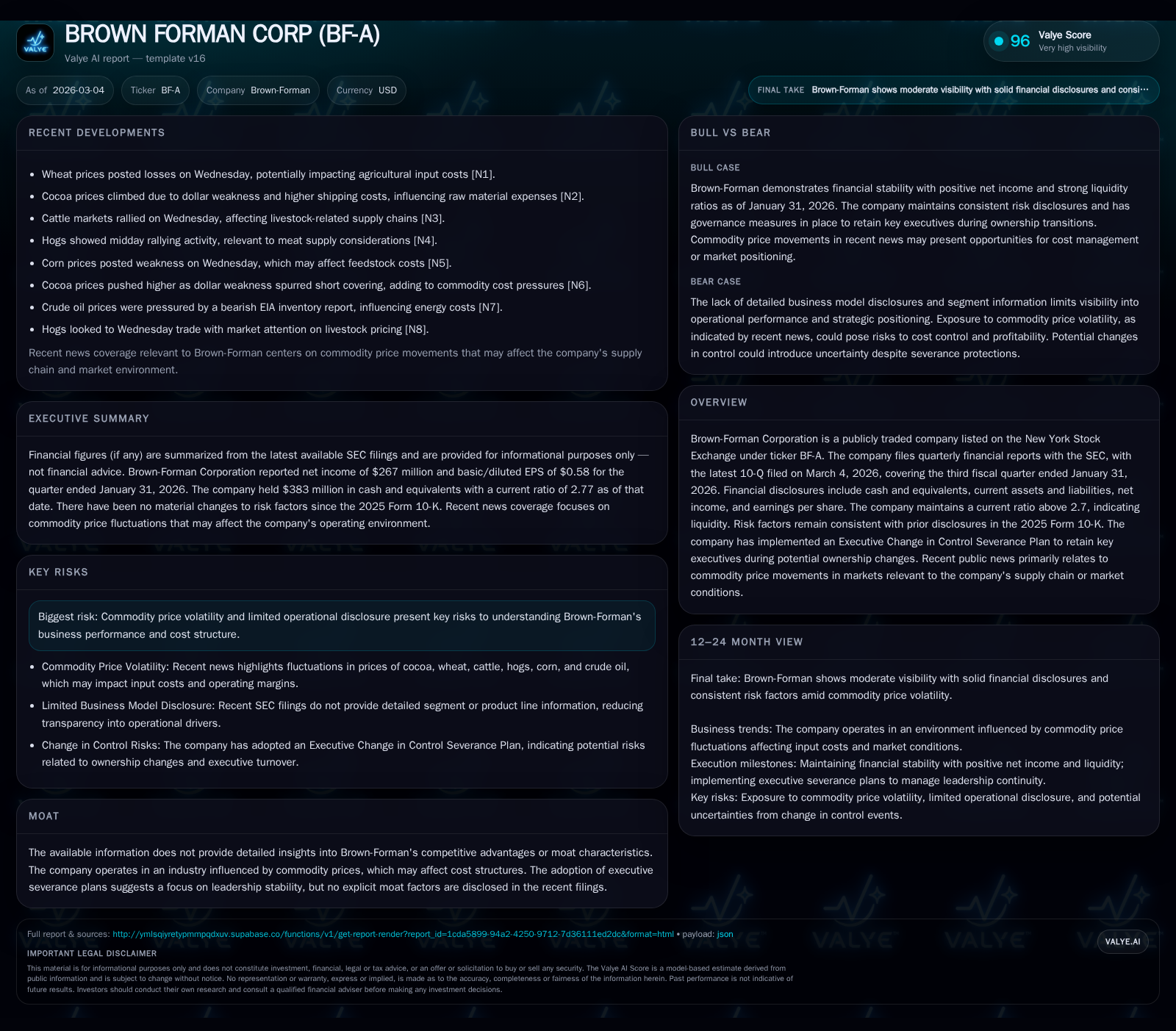
Liquidity remains robust with reported current assets of approximately $4.23 billion versus current liabilities around $1.53 billion as of January 31, 2026 — yielding an encouraging current ratio of roughly 2.77 [F1][S20]. The company holds solid cash and equivalents totaling $383 million enhancing near-term financial flexibility.
Capital structure details denote outstanding debt notes nearing maturity dates — specifically the 1.200% notes due in fiscal year ending 2026 and the longer-dated 2.600% notes maturing in fiscal year ending 2028 [S3][S18][S20]. Staying ahead of these maturities without covenant stress suggests manageable refinancing risk currently but warrants vigilance as those deadlines approach given macroeconomic rate environments.
Financial flexibility seems sufficient for operational needs and stabilizing measures including potential opportunistic investments or balance sheet maneuvers.
Commodity Price Volatility: A Persistent Risk Factor
Input cost inflation related to commodities poses a lasting challenge for Brown-Forman’s operational management [N13][N14]. Cocoa prices’ uptick driven by currency dynamics directly impacts flavorings or ingredients tied to certain beverage lines while crude oil price variability influences transportation expenses crucial across their distribution networks.
This persistent volatility forces Brown-Forman into complex procurement planning with heightened sourcing risks that are difficult to hedge fully given global supply-demand imbalances common in the distilled spirits sector.
Hence, controlling exposure while maintaining product quality under fluctuating input costs remains imperative for margin protection going forward.
Leadership Stability Through Executive Severance Plan
To mitigate governance risks linked with potential ownership changes amidst market uncertainties, Brown-Forman recently established an Executive Change in Control Severance Plan effective late October 2025 [S14].
The plan provides severance pay and benefits—including annual bonus protections, continued medical coverage through COBRA, accelerated vesting of equity awards—for executives involuntarily terminated within a defined Change in Control Protection Period spanning approximately two years post-transition. Severance multiples are higher for the CEO at three times base salary plus bonus metrics versus two times for other leadership team members.
This strategic move aligns with typical "change in control protection" policies found among mature consumer goods companies seeking executive retention and continuity during potentially disruptive ownership transitions.
Growth Prospects and Market Constraints Going Forward
Though Brown-Forman offers no updated guidance beyond reaffirming prior risk disclosures [S6], growth drivers remain tied to potential geographic expansion opportunities or tapping into premiumization trends within the distilled spirits category—a sector known for consumers gravitating towards high-margin craft or luxury products albeit tempered by competitive dynamics.
However, persistent commodity price volatility caps margin expansion possibilities absent effective cost pass-through mechanisms or productivity gains.
Management’s restrained capex budgeting signals measured caution regarding near-term growth investments until clearer visibility emerges over input costs and macroeconomic factors impacting consumer demand.
Analyst Watchlist: Key Milestones Ahead
Market participants should monitor forthcoming quarterly earnings releases closely for confirmation of margin trends post-FY2025 pressures and any commentary on planned reactivation or modification of share repurchase programs after their pause thus far.
Additionally, updates regarding executive incentive adjustments or further governance policies could impact forecast assumptions centered on leadership stability during evolving corporate strategies.
Continued scrutiny of raw material price movements combined with sales execution effectiveness will shape expectations around revenue resilience and capital allocation priorities moving deeper into fiscal calendar years.
Disclaimer: This analysis is based solely on publicly available filings and news data up to March 4, 2026, without projecting undisclosed future events or offering investment advice.
Disclaimer: This is research-only, informational analysis and not investment advice. It may include AI-generated interpretation and general industry context. Always verify important details using primary sources.

Comments