
Black Hawk Acquisition Faces Critical Nasdaq Compliance Deadline with Liquidity Strain
Latest filings reveal Black Hawk Acquisition Corp's urgent liquidity challenges and regulatory compliance issues that critically impact its SPAC business trajectory.
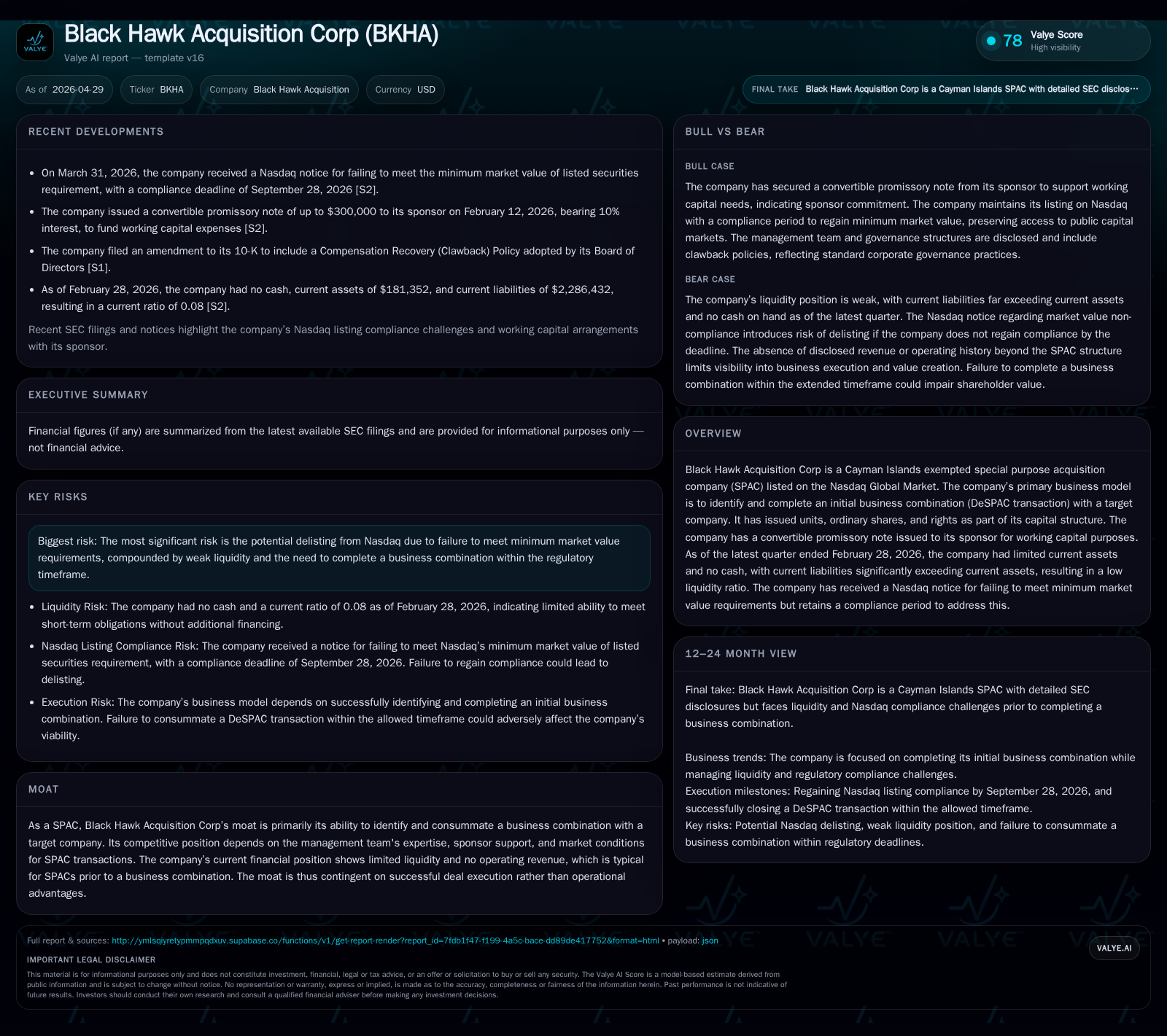
Black Hawk Acquisition Corp's April 2026 quarterly report exposes a pressing liquidity crunch, with a current ratio of just 0.08 and zero cash on hand, compounded by significant current liabilities. Concurrently, the company faces a Nasdaq notice for failing to meet minimum market value requirements, triggering a compliance period that places intense pressure on completing its initial business combination (DeSPAC transaction). As a Cayman Islands-registered SPAC, Black Hawk’s value hinges entirely on timely deal execution amid challenging market and regulatory dynamics. Sponsor support, management expertise, and milestone-driven deal progress will be vital in navigating these constraints.
Latest Quarterly Developments Highlight Urgent Compliance Challenge
Black Hawk Acquisition Corporation’s latest SEC Form 10-Q filing dated April 21, 2026 highlights significant regulatory pressure. As of February 28, 2026, the company reported current assets totaling $181,352 against current liabilities approximating $2.29 million—yielding a current ratio of 0.08 [F1]. This imbalance signals challenging short-term solvency conditions.
Compounding financial strain, Black Hawk received a formal notice from Nasdaq on March 31, 2026 citing failure to maintain the minimum market value of listed securities threshold ($50 million) as required under Nasdaq Listing Rule 5450(b)(2)(A). The notice triggers an extended compliance period lasting until September 28, 2026 during which BKHA must demonstrate regaining and sustaining required market capitalization to avoid delisting actions [S3]. While trading remains uninterrupted at present under symbols BKHAU (units), BKHAR (rights), and BKHA (ordinary shares), this regulatory ultimatum imposes high-stakes timing pressure on sealing its initial DeSPAC transaction.
This juncture crystallizes BKHA’s existential reliance on executing an initial business combination promptly—failure which could lead to forced liquidation or marketplace removal.
SPAC Business Model: Mechanics and Market Dynamics
Formed as a Cayman Islands exempted special purpose acquisition company (SPAC) with no operating revenue or commercial operations pre-DeSPAC completion, Black Hawk’s core mandate is raising capital via issuance of public units composed of ordinary shares combined with rights that convert upon consummation of its initial business combination [S1]. Fundraising utilizes typical SPAC modalities: units comprise one ordinary share plus fractional rights entitling holders to shares upon closing the DeSPAC deal.
Importantly, BKHA maintains a convertible promissory note with its sponsor—Black Hawk Management LLC—granting working capital advances up to $300,000 at a 10% interest rate. This note is repayable either in cash or via equity conversion at $1 per share following DeSPAC execution or liquidation [S1], [S26]. Such financing underscores limited internal liquidity options ahead of deal closure while illustrating aligned sponsor incentive structures contingent on merger success.
Without any revenue stream prior to the merger event target announcement and closing, Black Hawk’s financial viability is squarely contingent on completing an accretive transaction within the stipulated timeframe.
Competitive Positioning and Industry Context for SPACs
Black Hawk operates within a sharply competitive SPAC marketplace where identifying credible DeSPAC candidates demands deep management expertise alongside sponsor reputation credibility. Since its IPO in late 2024/early 2025 timeframe and extending amidst increasingly stringent Nasdaq listing standards post-2025 reforms, BKHA competes among numerous rivals for scarce suitable target deals amid volatile equity markets impacting PIPE capital availability and investor risk appetites [S1], [S3].
Nasdaq’s recently heightened maintenance standards for market value alongside broader regulatory scrutiny elevate de-risking premiums needed in underwriting acquisition candidates. Consequently, smaller or less established sponsors face hurdles securing downstream PIPE investments—a common mechanism to close DeSPAC financings—which compresses potential deal capacity and increases dilution risk.
Sponsor backing remains critical not only financially but also strategically in deal origination pipelines. BKHA’s negotiating leverage likely constrains compared to better-capitalized peers enjoying sponsor-funded operational runways.
Drivers Behind Potential Business Combination Success
Growth drivers revolve around management's acuity in finalizing an initial DeSPAC transaction before expiration dates imposed by Nasdaq rules and trust agreement amendments. Notably, existing shareholder approvals enable monthly extensions through approximately December 22, 2026 contingent on trust account deposits ($150k per month) easing some deadline pressures temporarily but at incremental costs diluting eventual post-merger equity value if protracted delays occur [S5], [S18], [S21].
Moreover, Black Hawk’s ability to secure favorable terms in transaction structure such as valuation thresholds acceptable to both public shareholders and PIPE investors will be pivotal in restoring minimum market value levels mandated by Nasdaq. The appointment of Vesicor Therapeutics' CEO by the proposed target reflects some transactional advancement but precise timeline milestones remain key indicators for successful closure [S29].
Ultimately, measurable near-term KPIs will include public announcements confirming definitive agreements or regulatory filings evidencing escalating due diligence progress.
Key Risks Including Delisting Threat and Fundraising Constraints
The company's most salient risk resides in failure to resolve minimum market value deficiencies triggering Nasdaq delisting notices that could culminate in withdrawal from trading platforms absent corrective actions completed by late September 2026 [S3]. This risk intertwines tightly with liquidity constraints highlighted by total absence of cash juxtaposed against multi-million dollar current liabilities recorded at quarter end—a situation placing tangible limits on operational flexibility or new capital deployment without immediate financing inflows [F1].
Further exacerbating these externalities are prevailing market headwinds hindering SPAC sponsors from securing PIPE backers given tightened credit conditions and elevated due diligence standards following industry-wide cyclical corrections.
Finally, delay penalties implicit in monthly extension payments incrementally erode net asset values potentially deterring critical investor confidence crucial for successful DeSPAC closing negotiations.
Near-Term Milestones and What to Watch Next
Investors and observers should closely monitor several critical upcoming milestones:
- Any formal announcement regarding progress toward signing definitive agreements for the initial business combination,
- Subsequent SEC filings related to proxies or shareholder votes concerning merger approvals,
- Sponsor disclosures on ongoing extension deposits into the trust account preserving contractually mandated deadlines,
- Updated Nasdaq correspondences offering insights into compliance status recalibrations or further remedial measures,
- Operational updates from proposed DeSPAC targets such as executive leadership appointments signaling organizational shifts tied directly to merger timetables.
These event horizons constitute leading indicators signaling whether Black Hawk Acquisition can surmount liquidity barriers and firm up transaction certainty before looming regulatory constraints tighten further.
Compact Financial Snapshot: Liquidity and Leverage
Latest financial snapshot
| Metric | Value | Period |
|---|---|---|
| Cash & equivalents | 0 USD | |
| 2026-02-28 | ||
| Total debt | $2541 | |
| 2026-02-28 | ||
| Net debt | $2541 | |
| 2026-02-28 | ||
| Current assets | $181352 | |
| 2026-02-28 | ||
| Current liabilities | $2,286,432 | |
| 2026-02-28 | ||
| Current ratio | 0.08x | |
| 2026-02-28 |
Source: SEC companyfacts cache [F1].
| Metric | Value |
|---|---|
| Cash & Equivalents | $0 |
| Total Debt | $2,541 |
| Current Assets | $181,352 |
| Current Liabilities | $2,286,432 |
| Current Ratio | 0.08 |
| Net Debt | $2,541 |
This snapshot encapsulates the critical liquidity challenges underpinning the firm's regulatory compliance risk as described above—the minuscule cash position paired with substantial current liabilities underscores stark imbalance demanding rapid resolution through strategic transaction execution or external recapitalization avenues [F1].
Disclaimer: This analysis is for informational purposes only based strictly on publicly available SEC filings as of April 29, 2026; it does not constitute investment advice or recommendations.
Disclaimer: This is research-only, informational analysis and not investment advice. It may include AI-generated interpretation and general industry context. Always verify important details using primary sources.

Comments