
Baker Hughes Advances Energy Innovation Amid Shifting Global Market Dynamics
Latest quarterly developments underscore Baker Hughes’ strategic capital management and technology-driven growth amid evolving geopolitical challenges.
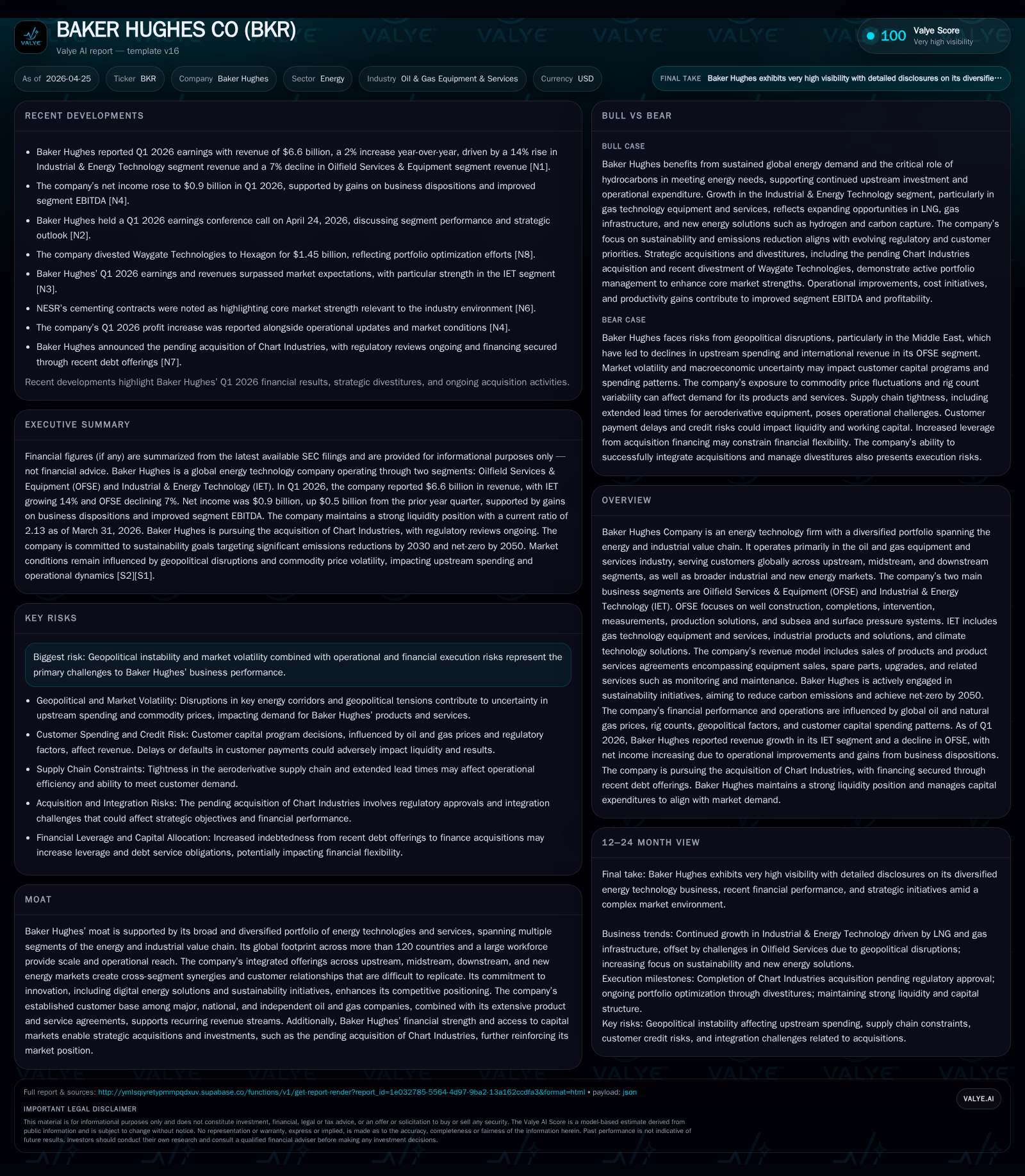
Baker Hughes closed its short-term bridge facility in Q1 2026, bolstered by a substantial issuance of USD and Euro-denominated notes to fund the pending Chart acquisition. The quarter showed a mixed revenue trend with a 7% decline in Oilfield Services & Equipment (OFSE) due to portfolio optimization and Middle East disruptions, contrasting with a 14% gain in Industrial & Energy Technology (IET), driven by gas technology segments. The company navigates macroeconomic uncertainty shaped by geopolitical tensions impacting upstream spending patterns, while emphasizing a diversified technology portfolio that supports energy transition initiatives alongside traditional oil and gas services.
Recent Quarterly Update: Strategic Capital Moves and Market Outlook
In its Q1 2026 Form 10-Q filed April 24 [S2], Baker Hughes officially terminated the short-term Bridge Facility entered on July 28, 2025. This followed a large-scale capital raise completed March 11, where the company issued $6.5 billion USD-denominated senior unsecured notes spanning maturities through 2056 coupled with €3 billion Euro-denominated notes [S10], establishing a stronger debt platform to support upcoming strategic investments—most notably the pending acquisition of Chart Industries [S20]. With this financing closure, Baker Hughes returned $228 million to shareholders via dividends during the quarter whilst not engaging in share repurchases [S12].
Operationally, revenue increased modestly by $0.2 billion or approximately 2% to $6.6 billion for the quarter ended March 31 compared to Q1 2025 [S19]. However, segment trends were divergent: OFSE revenue declined $262 million (7%), primarily attributable to portfolio realignments involving divestitures such as Surface Pressure Control (SPC) and Precision Sensors & Instrumentation (PSI), alongside international revenue declines tied to Middle East disruptions [S25][S26]. Conversely, IET advanced $422 million (14%) driven by robust performance in Gas Technology Equipment (+14%) and Gas Technology Services (+34%), partially offset by declines in Industrial Solutions reflecting PSI disposition [S25][S26]. Net income nearly doubled to $0.9 billion led by gains on these business sales totaling approximately $721 million [S25].
Management commentary frames ongoing geopolitical instability around strategic chokepoints like the Strait of Hormuz as a structural factor reshaping upstream capital allocation [S2]. These conditions elevate the importance of energy security investments outside the Middle East as regional upstream spending is expected to decline materially while North American and other international markets remain stable year-over-year [S2]. This underscores mid-cycle pricing strength supportive of incrementally higher global supply incentivization during tightening LNG market balances.
Business Model and Portfolio Quality: A Synergistic Two-Segment Approach
Baker Hughes operates chiefly through two synergistic business segments: Oilfield Services & Equipment (OFSE) and Industrial & Energy Technology (IET) [S1]. OFSE focuses on well construction, completions/intervention/measurements, production solutions, and subsea/surface pressure systems—a core legacy offering focused on upstream E&P customers worldwide [S1]. The product/service mix includes equipment sales complemented by product services agreements encompassing spare parts provisioning, equipment upgrades, digital monitoring technologies, maintenance services, and outfitted aftermarket support [S8].
In contrast, IET offers gas technology equipment and services (serving midstream/downstream), industrial products/solutions including turbomachinery for distributed power generation, climate technology deployments such as emissions abatement systems alongside newer energy transition innovations including hydrogen infrastructure components and carbon capture utilization/storage technologies [S1]. The integrated portfolio allows Baker Hughes to leverage cross-segment synergies that deepen customer relationships through bundled offerings enhancing switching costs while tapping recurring revenue from long-duration service contracts.
Recent portfolio adjustments manifest through spinoffs/divestitures: notable exits like PSI being sold to Crane Company mark strategic pruning of non-core assets enabling reallocation toward scalable digital energy platforms within IET [N14][S25]. Concurrently, Baker Hughes formed joint ventures such as Surface Pressure Control with Cactus Inc., focusing capital more efficiently toward high-margin subsea controls hardware/services aligned with deepwater development trends [S27].
Digital transformation constitutes a critical vector underpinning improved product quality and customer retention via enhanced real-time data analytics delivering predictive maintenance capabilities among upstream operators—a sector increasingly prioritizing operating expenditure optimization amid volatile price environments.
Industry Structure: Competitive Landscape and Geopolitical Influences
Within the highly fragmented Oil & Gas Equipment & Services industry where BKR competes against players ranging from Schlumberger to TechnipFMC as well as regional service providers, Baker Hughes’ scale—operating in over 120 countries—and diversified product set provide a defensible competitive position. The industry’s pricing power is tempered by cyclical rig count fluctuations but bolstered structurally by rising complexity in resource extraction requiring advanced surface pressure control technologies or bespoke gas processing components.
Geopolitical developments intensify competitive dynamics as supply chain constraints driven by Middle Eastern unrest increase lead times for critical aeroderivative turbines used across distributed power markets under BKR’s IET umbrella [S20]. This creates pricing leverage opportunities but demands operational agility to manage extended supplier cycles effectively.
Additionally, regulatory landscapes around emissions reductions propel investment in cleaner energy tech where BKR’s innovation pipeline—geothermal drilling tech coupled with CCUS capture modules—differentiates it from competitors primarily focused on conventional hydrocarbons. Growing investor scrutiny towards sustainability enforces compliance risks but simultaneously opens channels for growth accelerating deployment of clean power solutions aligned with emerging market decarbonization goals.
Growth Opportunities: Upstream Investment and Energy Transition Innovation
Underlying BKR's growth thesis is an expectation of sustained upstream spending driven by ongoing undersupply concerns despite regional disparities; Middle East spending contraction contrasts with relatively flat North American budgets emphasizing sustaining capex programs aimed at production optimization rather than expansion alone [S2]. Operators are increasingly reallocating budgets toward operating expenditure driven interventions utilizing Baker Hughes’ completions/production solutions products designed for enhanced reservoir recovery efficiency.
Simultaneously, global LNG demand growth supports expansion within IET's Gas Technology Equipment segment given its role in liquefaction trains and downstream processing infrastructure upgrades [S19]. Baker Hughes benefits from this secular demand element aligned with energy security imperatives heightened after recent supply corridor disruptions.
Energy transition market penetration presents longer-term optionality through multiple avenues. Hydrogen production equipment integration into existing gas asset frameworks leverages established relationships within industrial client bases while carbon capture technologies address tightening regulatory emission thresholds incentivizing retrofit projects alongside new build developments across power generation sectors [S20]. Additionally, geothermal technology rollouts represent another niche vertical with promise for growth outside fossil-based portfolios.
Risks and Growth Constraints: Customer Credit Risk and Macroeconomic Headwinds
Despite historical stability without material non-payment events, Baker Hughes acknowledges potential delays in customer receivables payments due to reduced cash flows or restricted credit access among oilfield operator clients amid ongoing macroeconomic uncertainty [S4][S12]. The company actively mitigates collection risk by negotiating debt restructurings coupled with available trade receivable facilities ensuring liquidity resilience.
On a macro basis, volatile oil prices combined with policy uncertainty over energy transitions could moderate capital intensity in some end-markets challenging top-line acceleration particularly within OFSE’s upstream well construction activities currently experiencing softness related to Middle East weakening demand dynamics despite partial offset from Latin America [S26][S27]. Moreover, inflationary pressures contribute cost challenges partially countered via productivity programs though margin expansion remains subject to shifting price-volume-cost mixes globally.
Near-Term Catalysts: Chart Acquisition Closure and Segmented Performance Signals
Investors should monitor progress on closing the acquisition of Chart Industries expected potentially mid-2026 contingent upon ongoing regulatory approvals across jurisdictions—a transaction poised to expand BKR’s footprint notably in cryogenic equipment vital for LNG/end-to-end gas value chains [S2][S20].
Segmental performance indicators such as an uptick in OFSE order backlogs outside Middle East markets or accelerating bookings within clean energy solutions under IET will serve as near-term barometers signaling demand momentum shifts supporting broader growth narratives.
Financial Overview: Liquidity, Debt Profile, and Capital Returns
As of March 31, 2026, Baker Hughes reported cash and cash equivalents of approximately $5.6 billion and total debt near $15.4 billion, resulting in net debt of about $9.8 billion, with a current ratio of 2.13 indicating solid short-term liquidity coverage per companyfacts data at quarter-end [F1].
Operating cash flow for FY2025 was strong at over $3.8 billion facilitating free cash flow north of $2.5 billion after capex near $1.3 billion annually confirming disciplined capital stewardship supporting dividends exceeding $900 million paid during that period backed also by modest share repurchases historically albeit paused through Q1 2026 reflecting allocation toward strategic uses like acquisitions [F1].[S12]
Historical performance (annual)
|
| FY | Net ($bn) | CFO ($bn) | OpInc ($bn) | Capex ($mm) | Net YoY |
|---|---|---|---|---|---|
| 2025 | 2.6 | 3.8 | 1273 | -13.1% | |
| 2024 | 3.0 | 3.3 | 3.1 | 1278 | +53.3% |
| 2023 | 1.9 | 3.1 | 2.3 | 1224 | +423.3% |
| 2022 | -0.6 | 1.9 | 1.2 | 989 |
Source: SEC companyfacts cache [F1].
Capital returns and efficiency (annual)
|
| FY | Div ($mm) | Buybacks ($mm) | FCF ($bn) |
|---|---|---|---|
| 2025 | 910 | 384 | 2.5 |
| 2024 | 836 | 484 | 2.1 |
| 2023 | 786 | 538 | 1.8 |
| 2022 | 726 | 828 | 0.9 |
Source: SEC companyfacts cache [F1].
In summary, Baker Hughes combines resilient financial footing amidst volatile commodity environments with proactive portfolio reshaping focused on technology-led differentiation supporting steady-to-improving segment fundamentals beyond near-term regional headwinds.
This analysis synthesizes publicly disclosed SEC filings up through April 24th, 2026 alongside contemporaneous news reporting without offering investment advice or price targets.
Disclaimer: This is research-only, informational analysis and not investment advice. It may include AI-generated interpretation and general industry context. Always verify important details using primary sources.

Comments