
Brenmiller Energy's Thermal Storage Tech: Evaluating Growth and Capital Strategy
Brenmiller Energy leverages its patented bGen™ thermal energy storage technology to transition from early-stage innovation to commercial scalability amid ongoing financial challenges.
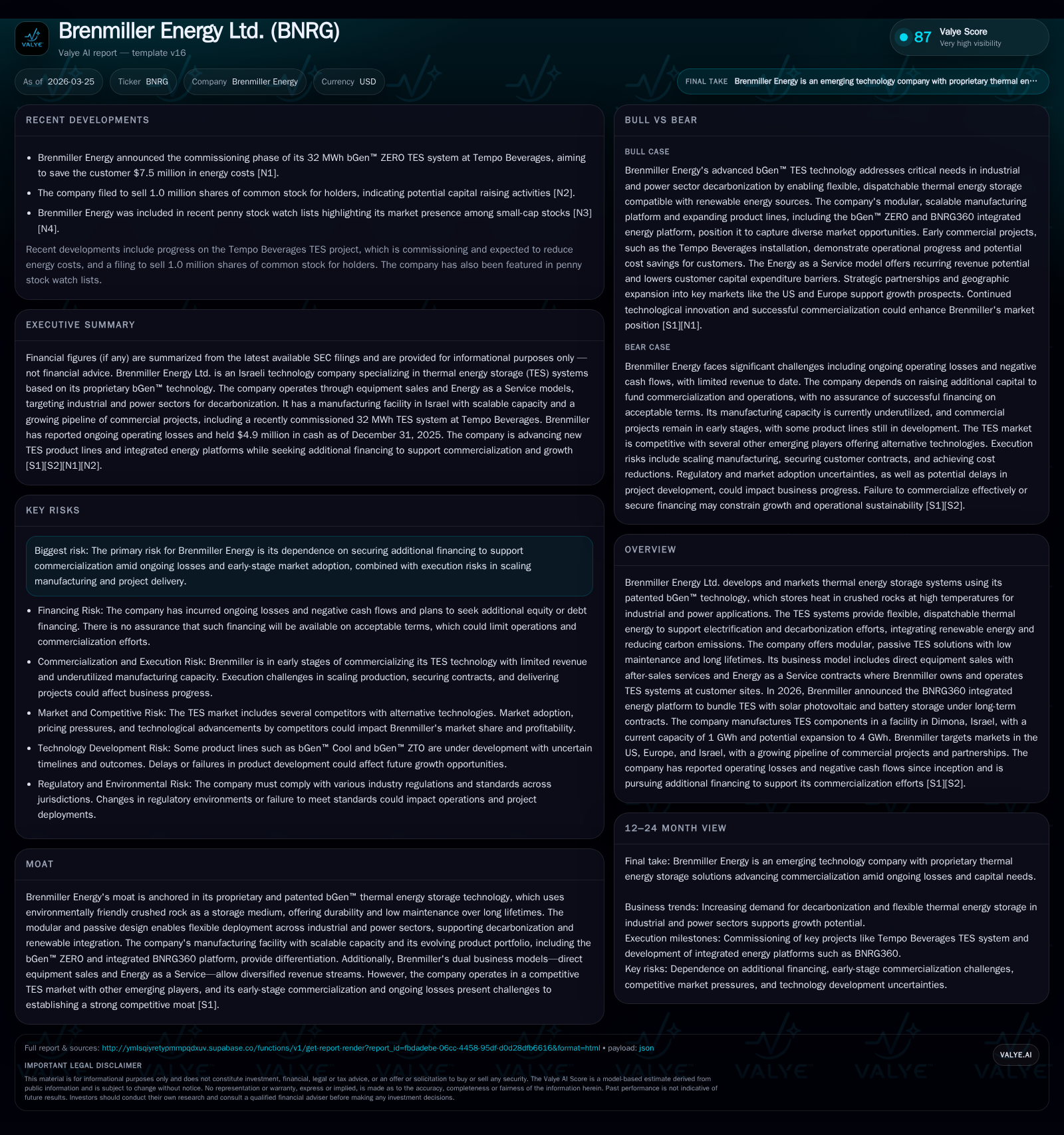
Brenmiller Energy Ltd. is advancing the commercialization of its proprietary bGen™ thermal energy storage (TES) systems, designed for industrial and power sector decarbonization. While revenues remain modest with recent declines, the company continues to invest in production capacity expansion and innovative business models, including Energy as a Service and the integrated BNRG360 platform that combines TES with solar PV and battery storage. Persistent operating losses and negative cash flows highlight the critical importance of securing additional financing and managing execution risks as Brenmiller scales manufacturing operations in Israel and broadens its market footprint.
Innovative Beginnings: The bGen™ Technology Emergence and Patent Portfolio
Brenmiller Energy’s foundation rests on its patented bGen™ thermal energy storage technology, which distinguishes itself by storing heat in crushed rocks at high temperatures while integrating heat exchange and steam generation functionalities within a modular thermal unit. This integrated design underpins the technology’s durability and efficiency advantages compared to conventional TES media such as molten salts or water. The company holds key patents granted between 2017 and 2019 across major jurisdictions—including the US (expiring in 2035), Europe (expiring in 2034), Israel (expiring in 2034), and South Africa—covering the core inventive concept of "Integrated Thermal Storage, Heat Exchange, and Steam Generation" [S1][S14]. The patents secure intellectual property that supports Brenmiller’s moat by preventing easy replication of their proprietary thermal media combinations and system architecture.
Moreover, Brenmiller has pursued trademark registrations for the bGen™ brand name internationally (including US, EU, Israel, China, India, Brazil), reinforcing brand identity within the specialized industrial TES market [S1][S22]. This legal positioning is crucial given emerging competition from firms using alternate storage media such as solid carbon (Antora), concrete-based solutions (Energy Nest), or refractory bricks (Rondo).
Challenges in Scaling: Revenue Evolution and Operational Losses
Financially, Brenmiller remains a technology-centric early commercial-stage company facing typical revenue fluctuations reflective of commercialization cycles. Revenues declined sharply by approximately 37.7% year-over-year to $387,000 in FY2025 from $621,000 recorded in both FY2023 and FY2024 [F1], reflecting ongoing developmental project focus rather than volume sales growth as scale-up proceeds. Despite generating some revenue from equipment sales and nascent EaaS contracts, operating losses widened significantly to $12.7 million in FY2025 from $10.6 million a year earlier [F1], indicating elevated spending on product development, project implementation staffing, and sales expansion.
Net losses amplified even more steeply to $13.9 million in FY2025 versus $6.8 million in FY2024 [F1], partly due to non-cash expenses but also ongoing operational expenditures without corresponding revenue inflows. Operating cash flow remained firmly negative at roughly -$10.4 million free cash flow after minimal capital expenditures ($13,000) spent mostly on maintenance rather than expansion [F1]. The company’s equity base contracted slightly to $3.49 million by end-2025 [F1], squeezed by accumulated losses.
Historical performance (annual)
| FY | Rev ($) | Net ($mm) | CFO ($mm) | OpInc ($mm) | Rev YoY | Net YoY |
|---|---|---|---|---|---|---|
| 2025 | 387000 | -14 | -10 | -13 | -37.7% | -105.3% |
| 2024 | 621000 | -7 | -10 | -11 | 0.0% | +29.8% |
| 2023 | 621000 | -10 | -7 | -10 |
Source: SEC companyfacts cache [F1].
Capital returns and efficiency (annual)
| FY | FCF ($mm) | ROE% |
|---|---|---|
| 2025 | -10 | -398.0 |
| 2024 | -10 | -151.0 |
| 2023 | -7 | -335.0 |
Source: SEC companyfacts cache [F1].
Table: Brenmiller Energy historical financials FY2023-FY2025 USD thousands [F1]
Business Model Duality: Balancing Equipment Sales with Energy-as-a-Service Contracts
Brenmiller operates a hybrid business model combining direct equipment sales with an expanding Energy as a Service (EaaS) offering [S5][S12]. Initially reliant on selling bGen™ TES systems outright—where customers purchase, own, and operate their units while Brenmiller provides installation warranty and maintenance—this model delivers upfront revenues but slower recurring cash flow.
Since 2023, Brenmiller has piloted EaaS contracts whereby it owns financed TES assets onsite at customer facilities and sells thermal energy services such as steam or hot air through fixed-price contracts over multi-year terms [S5]. This recurring revenue stream enhances customer value propositions by transferring operational risk away from clients while providing Brenmiller greater lifetime value extraction from each installation.
Strategically, this dual approach enables flexibility across various industrial sectors that differ in capital intensity appetite and operational outsourcing preferences—particularly attractive for industries seeking rapid decarbonization without upfront CAPEX commitments.
Introducing BNRG360: Integration of TES with Solar PV and Battery Storage Solutions
A notable evolution in Brenmiller’s strategy emerged with the January 2026 launch of BNRG360—a fully integrated clean heat-and-power platform bundling bGen™ Thermal Energy Storage with solar photovoltaic panels and battery storage into long-term contractual arrangements [S4][N1].
This platform aims to position Brenmiller not merely as a TES provider but as a comprehensive renewable energy integration partner capable of dispatchable clean power delivery alongside electrified industrial heat solutions. Leveraging its proprietary technology ownership differentiates it from traditional utilities or system integrators relying on third-party tech.
However, projects under BNRG360 remain subject to technical development sequencing priorities and limited capital resources [S4]. The complexity of coordinating multi-technology installations presents typical execution challenges for scaling timeline-sensitive commercial rollouts.
Manufacturing Capacity Utilization and Expansion Plans in Dimona, Israel
Brenmiller's main manufacturing facility resides in Dimona, Israel with an engineering-designed annual production capacity of approximately 1 GWh of TES modules currently underutilized [S4]. The factory’s modular design supports scalable capacity expansion plans targeting up to quadruple throughput at about 4 GWh annually contingent upon incremental capital investment.
At full expanded capacity utilization levels—assuming supportive market demand—the company estimates potential system revenues approaching $200 million per annum [S4]. While this represents aspirational upside from current low-volume operations generating sub-million-dollar revenues annually, this gigafactory framework aligns well with anticipated global industrial electrification trends requiring gigawatt-hour scale TES deployments.
Localized manufacturing pilots planned for Europe and North America will complement Dimona output while aiming to reduce logistical costs through supply chain proximity advantages [S9]. Nonetheless, gap between capacity availability versus demand represents both financial risk—due to possible idle asset drag—and an opportunity runway for growth contingent on successful sales expansion.
Capital Allocation Review: Operating Cash Flows, Capital Expenditures, and Shareholder Returns
Brenmiller demonstrated persistent negative operating cash flows over the last three fiscal years totaling nearly $28 million outflows cumulatively through ongoing R&D expenditures, sales/marketing investments aimed at commercial traction pacing—and project onboarding costs [F1]. Free cash flow turned strongly negative again in FY2025 totaling approximately minus $10.4 million.
the extremely low capital expenditures ranging around $13k indicate restrained fixed asset expansion despite scaling ambitions [F1][S29]. The company has focused available cash toward ramping operational capabilities rather than heavy new investments.
Dividend payouts or share repurchases are absent consistent with retaining all liquidity resources for growth-stage commercialization activities [S6][S10][S17]. Return on equity is severely negative at circa -398% FY2025 due to net losses dramatically outweighing equity base [$13.9M loss / $3.49M equity] [F1].
Liquidity depends largely on equity issuances evidenced by prior private placements including CEO leader strategic purchases alongside institutional warrants exercised partially during growth phases [S6][S10]. This structure underscores management’s commitment yet flags significant financing dependency going forward.
Risks on Horizon: Financing Needs, Market Adoption, and Competitive Pressures
Brenmiller faces material risks arising chiefly from its continued reliance on external capital infusions needed to bridge early-stage commercialization losses before positive free cash flow attainment materializes.[S7][S13][S14][S16][S22] Execution risk predominates regarding factory ramp-up schedules tied closely to demand forecast accuracy plus operational challenges inherent to complex TES system delivery & integration across diverse geographic markets.[S7] Competitive threats stem from an ecosystem populated by advanced TES developers such as KraftBlock or Kyoto competing primarily in Europe while others like Rondo address US markets leveraging alternative materials blending sensible heat principles but varying TRL maturity levels.[S11] Patent protections serve somewhat mitigating but do not eliminate market adoption dynamics highly sensitive to regulatory incentives favoring decarbonization trajectory acceleration.[S18] Moreover,lenient enforceability around executive noncompetition clauses elevate potential talent mobility risks impacting organizational knowledge retention. Reliance on regional licensing approvals per installation site adds compliance layers that may delay deployment pace. Strong environmental compliance records coupled with ISO-type certifications manifest competitive differentiation yet regulatory shift volatility remains an unfixed variable. Overall,the path toward large-scale commercial success entails navigating financing milestones concomitant with sealing breakthrough customer contracts while accelerating operational expertise transition.
Key Milestones Ahead: Commercial Deployment Sequencing and Contractual Growth Catalysts
Looking forward,Brenmiller's near-term value inflection points revolve around progressing commissioning activities related primarily to the Tempo Beverages project—a flagship deployment featuring a 32 MWh bGen™ ZERO unit undergoing system start-up tests during H1 2026 following mechanical installation completion announced in early March [S4],[N1],. This milestone would mark Brenmiller’s first revenue-generating scaled pilot under its modernized product lineup designed for zero-carbon heat applications suitable for industrial process integration. Further milestones include formal contracting under the BNRG360 framework intended to leverage synergies among TES,battery,and solar PV subsystems aligned within unified commercial agreements designed for long-tenor revenue predictability[S4],[N1]. Besides these designated projects,Brenmiller Europe joint venture activities launching across southern & central European markets via distributors are expected to broaden Tesla solution adoption pathways, supported eventually by localized project execution hubs such as the fully owned Hungarian entity managing PPF TES initiatives. Significant topline growth will require successful orchestration between order intake timing,cash deployment pace,and manufacturing throughput optimizations—all integral variables shaping path from loss-heavy development phase toward positive earnings territory.Analytically monitoring backlog conversions,cost overruns,and recurring EaaS contract ramp metrics becomes essential performance indicators absent explicit guidance disclosure. In summary,Brenmiller's growth trajectory depends critically on converting technological maturity into scalable commercial operations anchored by milestone-driven contractual wins progressively boosting stable cash inflows over multi-year horizons.
This report synthesizes available SEC filings up through March 25th, 2026 without conjecture beyond documented data or management commentary disclosed therein.Selections reflect publicly available historical financials,intellectual property frameworks,business models,and known strategic initiatives.Brenmiller Energy Ltd.'s status as an emerging growth company entails typical financial volatility; thus,future performance should be contextualized within evolving market conditions,risk factors,and financing execution outcomes outlined herein.The absence of explicit future forecasts mandates close observation of company releases regarding order books,revenue recognition events,and broader industry developments impacting thermal energy storage adoption cycles.
Disclaimer: This is research-only, informational analysis and not investment advice. It may include AI-generated interpretation and general industry context. Always verify important details using primary sources.

Comments