
Blueport Acquisition’s Blueprint: Crafting Value through SPAC Execution and Capital Strategy
An exploration of Blueport Acquisition Ltd’s early-stage financial posture, strategic approach, and executional challenges as a nascent SPAC.
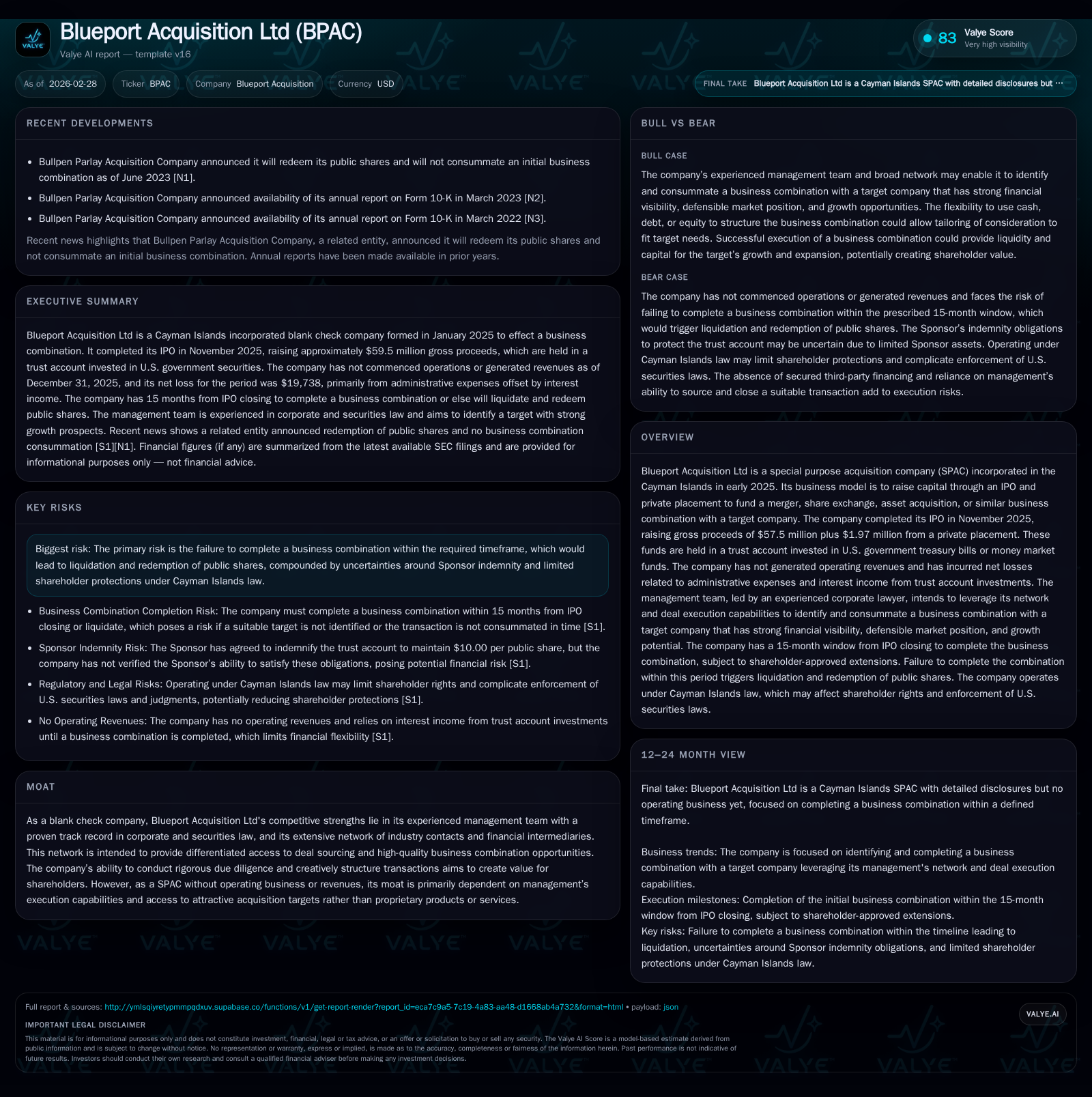
Blueport Acquisition Ltd launched its IPO in late 2025, securing $57.5 million in gross proceeds supplemented by a private placement, positioning it to pursue a business combination. Despite reporting no operating revenue and modest net losses attributable to administrative activities, the company benefits from a strong liquidity buffer and an experienced management team. The path forward hinges on executing a suitable acquisition within regulatory timeframes, leveraging its legal and deal-making expertise to identify high-potential targets. Risks include geopolitical uncertainties and inherent execution risks characteristic of blank check companies incorporated in the Cayman Islands.
SPAC Genesis and Capital Raise: Foundations of Blueport Acquisition
Established on January 13, 2025, as a Cayman Islands exempted company, Blueport Acquisition Ltd embodies the archetype blank check special purpose acquisition company (SPAC) formed to complete one or more business combinations [S1]. Its inception culminated with an initial public offering (IPO) on November 13, 2025, where it sold 5.75 million units at $10 each, including full exercise of underwriters’ over-allotment—netting gross proceeds of $57.5 million [S1]. Simultaneously, a private placement of approximately $1.97 million to its Sponsor further bolstered capital resources [S1]. Each unit comprises one Class A ordinary share coupled with fractional rights convertible into additional shares upon conversion [S1].
These net proceeds (subject to underwriting fees approximating $2.44 million) were largely deposited into a trust account invested conservatively in U.S. Treasury bills or money market funds [S1]. The Company has discretion over utilizing proceeds from the IPO and private placements principally toward consummating its initial business combination but has yet to designate any sector focus or geographic limitation on prospective targets [S1]. This capital foundation sets the stage for growth via acquisition given the absence of proprietary revenue streams at this stage.
Financial Snapshot: Early Fiscal Performance and Cost Drivers
For its inaugural fiscal year ending December 31, 2025, Blueport reported no operating revenues consistent with typical SPACs that remain pre-combination [F1]. The company incurred general and administrative expenses of approximately $304K driven primarily by professional services, regulatory compliance costs, audit fees, and administrative support agreements with its Sponsor [F1][S4]. Interest income earned on cash held within the trust account partially offset expenses but was insufficient to generate operating profits.
Consequently, Blueport reported a marginal net loss close to $20K for fiscal 2025 [F1]. The balance sheet reflects liquid assets with cash & equivalents totaling roughly $481K alongside current assets aggregating $543K supported by minimal current liabilities near $135K—yielding a current ratio of about 4.02 that indicates solid short-term liquidity management [F1]. The company has no long-term debt and does not engage in off-balance-sheet financing structures typical for operational enterprises but uncommon for SPAC startups [S9][S13][F1].
Historical performance (annual)
| FY |
|---|
| 2025 |
Source: SEC companyfacts cache [F1].
Note: Absence of revenues is due to Blueport Acquisition's status as a pre-business combination blank check company.
Strategic Vision to Completion: Target Identification and Deal Structuring Approach
Blueport intends to deploy its capital toward acquiring or merging with one or more businesses exhibiting compelling economics aligned with shareholder value creation [S4][S12]. The company's leadership leans heavily on legal expertise—anchored by CEO William Rosenstadt, a seasoned corporate attorney—and rigorous due diligence processes encompassing comprehensive industry assessments, stakeholder interviews, financial reviews, and competitor benchmarking [S4][S19].
This methodical approach aligns with evolving SPAC-sector standards requiring target businesses to possess intrinsic value beyond headline valuations. Management seeks transaction structures navigating competing stakeholder priorities skillfully; typically pursuing deals whereby at least 80% of assets held in trust underpin the fair market value consideration of the target at signing [S1]. Post-transaction ownership standards mandate that shareholders retain minimum controlling interest of 50% or greater [S1][S7].
Additionally, Blueport’s strategy includes identifying under-exploited expansion opportunities benefiting from capital infusion and operational enhancements managed by experienced teams incentivized toward growth acceleration [S12][S21]. This tailored tactic differentiates Blueport from peers focused solely on headline valuations or rapid deal execution.
Capital Allocation Framework: Trust Account, Working Capital Loans, and Sponsor Commitments
Capital proceeds are securely held in compliance with trust account mandates governed primarily by investment in U.S. government-backed instruments ensuring preservation of principal until deployment or redemption events [S4][S8][F1]. Beyond this core pool earmarked for business combination funding, Blueport maintains working capital access courtesy of potential sponsor loans up to $1.5 million convertible into equity units priced at IPO levels ($10 per unit)—facilitating flexible funding options for transaction-related expenses without prematurely drawing down trust assets [S5][S22].
The company also executes Administrative Services Agreements obligating monthly payments ($10,000/month) for office space and support services predominantly provided by affiliated entities connected to management leadership [S4][S22]. As of late-2025 data reflect accrued service fees totaling approximately $16.7K embedded under liabilities categories.
This arrangement underscores typical SPAC scaffolding designed for lean operational overhead while ensuring strategic agility across financing alternatives including equity issuance, forward purchase agreements or third-party debt if required upon completing transactions exceeding available trust capital [S10].
Macroeconomic and Regulatory Risks in Transaction Execution
Principal risks confronting Blueport stem from factors delaying or undermining completion of an initial business combination within prescribed windows—commonly fifteen months post-IPO subject to shareholder extensions [S1][S11]. These encompass broad geopolitical tensions heightened by conflicts like Russia-Ukraine and Israel-Hamas wars introducing volatility that may destabilize valuation metrics or investor appetite during negotiation phases.
Regulatory complexity inherent in Cayman Islands incorporation imparts comparatively limited shareholder protections especially concerning sponsor indemnity arrangements or litigation recourse limiting remedies accessible against management actions or board decisions—a nuanced vulnerability diverging from traditional Delaware SPC frameworks familiar in many US-based SPACs [S11][S19]. These constraints necessitate heightened reliance on transparent governance protocols executed meticulously during deal structuring.
Metrics to Watch: Timeline, Valuation Thresholds, and Deal Terms
Investors should monitor critical deadlines tied to expiration of authorized business combination closure windows enforced contractually; failure mandates liquidation proceedings distributing trust funds pro-rata via redemptions terminating public ownership interests except insider shares subject to forfeiture conditions [S26]. Additionally noteworthy are transaction stipulations including requisite minimum fair market value thresholds (~80%) backed by independent valuation where affiliated party involvement occurs mandating fairness opinions from third-party investment banking entities confirming absence of conflicts-of-interest common within sponsor-affiliated transactions [S24][S25].
Operationally relevant too is tracking redemptions exercised by public shareholders which impact net funding available post-close thereby influencing final consideration mix between cash versus stock allocations—terms capable of materially altering expected dilution profiles post-business combination completion.
Shareholder Returns Outlook: Redemption Rights, Dividends, and Buybacks Constraints
Currently absent are dividend distributions or share repurchase programs reflective of Blueport's non-operational nature focused solely on acquisition preparation rather than earnings generation [F1][S14]. Public shareholders possess mandatory redemption rights exercisable upon approval or tender offer mechanisms connected with consummation attempts allowing equitable return calculated per-share pro rata from trust asset balances adjusted only for allowable dissolution expense deductions capped at minimal thresholds per governing documents [S14][S26].
This construct inherently aligns investor returns directly with successful identification and closing of lucrative business combinations versus traditional yield-based income metrics evident in mature corporations. Return-on-equity stands marginally negative (-0.5%) reflecting initial administrative cost outflows without revenue offsetting given nascent operational status [F1].
Management’s Network Leverage and Competitive Position in the SPAC Market
A cornerstone competitive advantage derives from CEO William Rosenstadt’s extensive career as a corporate/securities lawyer fostering deep relational channels across capital markets participants—including financiers, corporate owners/managers and legal advisors—to enhance proprietary sourcing pipelines unavailable widely across generic market intermediaries [S19][S23].
This talent-led sponsorship model enables pursuit of complex transaction structures frequently requiring nuanced negotiation skills transcending simple price offers—emphasizing value creation via careful contract crafting accommodating diverse stakeholder objectives often encountered when targeting mid-market or emerging growth companies seeking alternative liquidity routes outside conventional IPOs.
Administrative arrangements incorporating affiliated consulting firms provide operational continuity enhancing deal execution efficiency while preserving strict cost discipline consistent with best practices observed across successful SPAC sponsors aiming at balancing lean overhead without compromising strategic flexibility required during volatile deal seasons.
This report synthesizes public SEC filings as well as company disclosures up through February 28th, 2026. It eschews speculative forecasts absent explicit company guidance placing emphasis on factual grounding alongside contextual analysis characteristic of early-stage blank check companies engaged in defining their growth narratives via acquisition execution.
Disclaimer: This is research-only, informational analysis and not investment advice. It may include AI-generated interpretation and general industry context. Always verify important details using primary sources.

Comments