
Bridgford Foods' Dual-Segment Strategy Tested by Inflation and Supply Chain Dynamics
The company’s latest quarter reveals mounting margin pressures driven by commodity cost inflation and operational challenges despite stable sales.
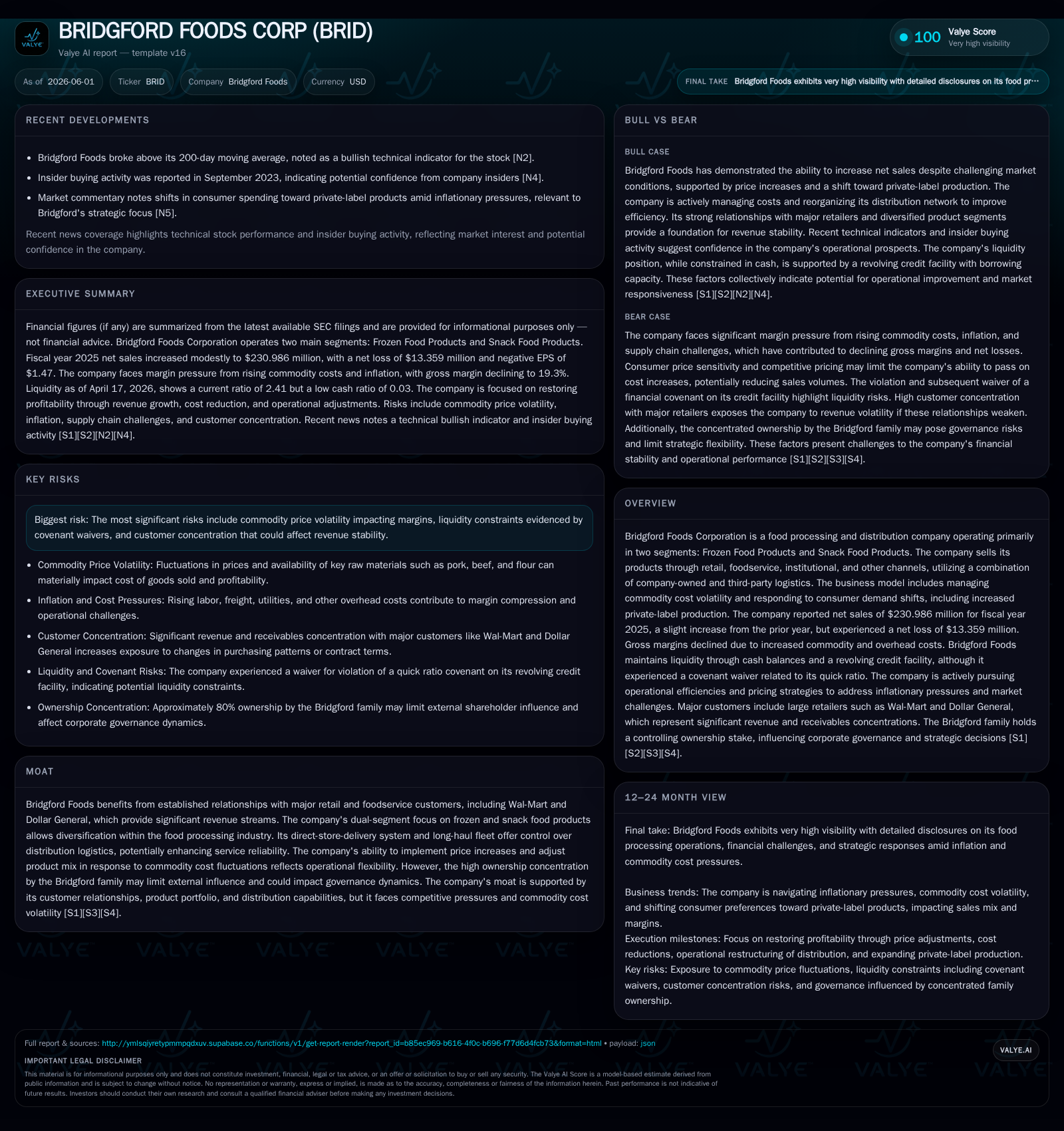
In its June 1, 2026 quarterly filing, Bridgford Foods reported continued squeeze on gross margins attributable to rising commodity prices and increased promotional activity in the frozen foods segment. While revenue growth was modest, operational disruptions including production downtime affected volumes. Bridgford’s business model—centered on frozen and snack food products sold through retail, foodservice, and institutional channels—leans on price-per-pound flexibility to manage cost inflation, but pricing lags and demand sensitivity weigh on margin recovery. Liquidity remains a concern following covenant waivers, underscoring challenges in balancing working capital amidst fluctuating commodity costs and competitive pressures from private-label growth among large retail customers like Walmart and Dollar General.
Latest Quarterly Operating Update
Bridgford Foods’ June 1, 2026 10-Q filing underscores persistent margin pressure despite maintaining relatively stable top-line results [S2]. The company experienced increased costs largely driven by commodity inflation impacting pork, beef, and flour—the fundamental raw materials for both its frozen and snack food segments. Gross margins contracted as selling price adjustments lagged input cost spikes. In the Frozen Food Products segment specifically, net sales saw a slight decline reflecting unit volume decreases partially due to a temporary production slowdown; the pause was necessary to repair a spiral freezer, a critical asset impacting throughput [S1]. Promotional spending rose during this period as Bridgford aimed to sustain retail sales against intensifying competition.
Though net sales in the Frozen segment declined marginally by 0.6%, pricing per pound improved modestly but could not fully offset volume softness [S1]. Meanwhile, the Snack Food Products segment showed resilience with a solid increase in net sales (+4.7%), propelled primarily by higher selling prices per pound alongside minimal volume gains [S1]. This divergent segment performance reflects shifting consumer behavior favoring convenient snack options over institutional frozen food demand post-pandemic. No material reportable events arose in recent filings beyond these operational updates [S3].
Business Model and Product Portfolio Dynamics
Bridgford Foods operates two complementary segments: Frozen Food Products encompassing items like sheet doughs, rolls, meat-based frozen products sold primarily to retail and institutional customers; and Snack Food Products focused on convenience meat snacks distributed through retail chains [S1]. Revenue derives from selling product volumes measured in pounds multiplied by selling price per pound—a key metric influencing sales outcomes amid volatile commodity prices.
The company’s revenue mechanics rely heavily on managing commodity cost fluctuations which directly affect profitability. Bridgford does not hedge commodities but pursues tactical price increases when market conditions permit to mitigate erosion of margins [S14]. However, these price changes are infrequent due to consumer price sensitivity and retailer pushback limiting frequency and magnitude.
Private-label production has gained importance as inflationary pressures lead consumers toward more affordable store brands offered predominantly by major retail customers such as Walmart and Dollar General. This shift requires Bridgford to optimize product mix while controlling input costs rigorously [S1]. Logistics capabilities blend company-owned direct-store-delivery routes with third-party fleets enabling greater control over inventory flow and service reliability—crucial for perishables management given short shelf lives.
Industry Structure and Competitive Positioning
The food processing sector housing Bridgford’s two segments is characterized by mixed competitive dynamics. Bridgford enjoys meaningful scale advantages from longstanding contracts with large retailers—Walmart alone accounted for approximately one-third of revenues in fiscal 2025 while Dollar General contributed another substantial share (~14%) [S1], [F1]. These relationships underpin predictable demand flows yet introduce significant customer concentration risk.
Competitive pressures arise from other food processors ranging from specialized snack manufacturers to broader frozen food suppliers competing on price variety and innovation. Branded products face increasing competition from private labels that deliver comparable value at lower prices—particularly intensified under inflationary stress.
Geopolitical developments including trade tensions related to ongoing conflicts (Ukraine-Russia, Israel-Palestine) plus tariffs impact availability and cost of key raw materials such as wheat-based flours and meat commodities [S2]. Such external variables add volatility beyond Bridgford’s operational control affecting sourcing strategies.
Growth Drivers: Pricing, Mix, and Channel Expansion
Bridgford’s near-term growth rests principally on its ability to enact price increases that offset rising input costs without eroding unit demand excessively. The company’s reported increase in average selling price per pound across both segments reflects this strategy though the lag in pricing responsiveness remains a challenge given competitive constraints [S1]
Product mix evolution favors snacks where minor volume growth offsets stagnant or declining frozen category volumes linked partially to institutional demand contraction post-pandemic [S1]. Expanding private-label production with retailers also presents an avenue for incremental volume though typically at lower margin profiles.
Channel-wise, Bridgford’s distribution spans retail stores (including grocery chains), foodservice outlets, and institutional customers allowing some balance amid shifting procurement patterns. However, direct-store-delivery logistics require continuous optimization since route density correlates with cost efficiency—hence plans to reduce certain delivery routes aim to preserve service levels while managing expenditures [S13].
Risks and Operational Constraints
Key challenges confronting Bridgford stem from sharp commodity price swings that compress gross margins when heightened costs cannot be passed through swiftly or fully [S2]. The spiral freezer repair episode highlights potential risks related to production capacity constraints; any unplanned downtime in such specialized cold-processing equipment can materially affect supply continuity.
Though the current ratio stands above two at 2.41 supported by current assets near $64 million against liabilities of roughly $26 million [F1], total debt around $6.6 million coupled with limited cash on hand (~$830K) signals tight working capital management requirements.
Customer concentration intensifies risk exposure as dependency on Walmart and Dollar General can amplify revenue volatility if contract terms deteriorate or demand declines unexpectedly [S1]. Furthermore, regulatory scrutiny especially concerning meat product safety poses reputational risks in case of contamination outbreaks which have historically impacted industry peers negatively
Next Steps and Key Milestones to Monitor
Market stakeholders should watch the upcoming quarterly disclosures for indicators of margin trend stabilization or further compression given fluctuating commodity markets. Tracking changes in private-label penetration rates will shed light on evolving channel strategies impacting both volume growth prospects and margin quality.
Operational milestones include completion verification of spiral freezer repairs translating into normalized frozen product output levels alongside efficiency gains from route network adjustments underway aimed at logistics cost containment without sacrificing customer service standards [S13]. Liquidity monitoring remains paramount given prior covenant breaches; subsequent compliance status updates will clarify financial flexibility going forward.
Summary Financial Overview
Bridgford Foods reported a net loss of approximately $13.4 million for fiscal year 2025 illustrating profit pressures alongside gross margin decline (falling from $56.3M prior year to $44.6M) despite slightly higher net sales of $231 million versus $224 million year-over-year [F1], [S1]. Cash reserves were restricted at about $830K against total indebtedness near $6.6 million as of April 2026 quarter end resulting in net debt around $5.75 million [F1].
It incorporates relevant operating detail without projecting future outcomes or providing investment research views.
Financial position in context
As of 2026-04-17, companyfacts shows $830000 in cash and equivalents and $6.586 million of total debt [F1]. The same snapshot implies net debt of roughly $5.756 million, keeping balance-sheet context relevant but secondary to the operating story [F1]. Current assets of $64.035 million and current liabilities of $26.612 million imply a current ratio near 2.41x for 2026-04-17 [F1].
Disclaimer: This is research-only, informational analysis and not investment advice. It may include AI-generated interpretation and general industry context. Always verify important details using primary sources.

Comments