
Bassett Furniture's Century-Old Craftsmanship Meets Modern Customization in a Shifting Retail Landscape
Examining Bassett's blend of heritage, custom furniture focus, and digital initiatives amid evolving operational and cybersecurity challenges.
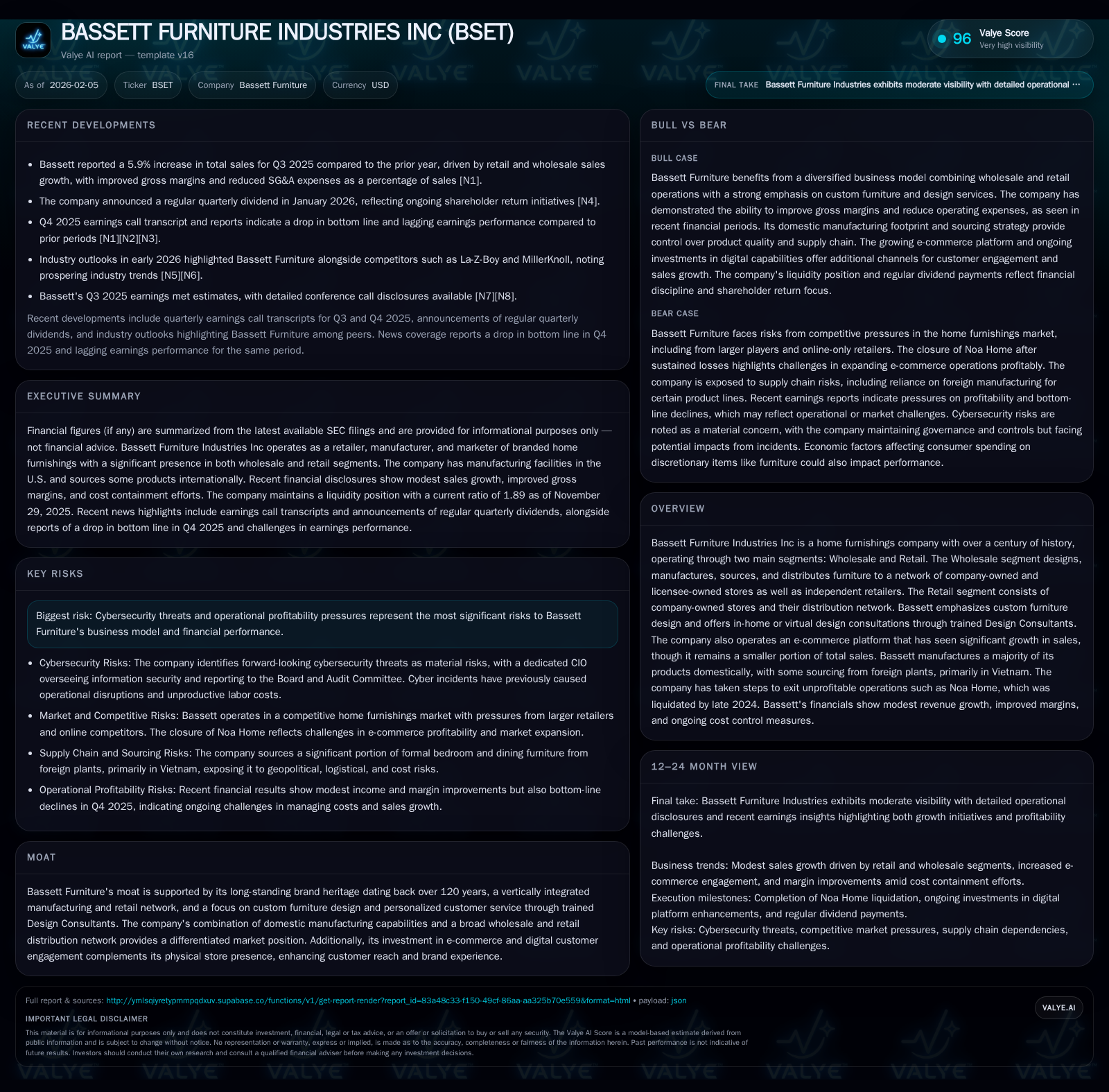
Bassett Furniture Industries traces over 120 years of brand heritage rooted in craftsmanship and quality, leveraging a vertically integrated wholesale and retail platform that emphasizes custom furniture design through trained consultants. The company continues to advance its digital transformation with an enhanced e-commerce platform supporting growth and customer engagement while operating predominantly domestic manufacturing complemented by strategic foreign sourcing. Despite recent earnings headwinds and the exit from unprofitable units, Bassett maintains a stable liquidity position and dividend policy alongside a focused approach on cybersecurity governance amid rising risks. As the home furnishings sector evolves with consumer preferences and competitive pressures, Bassett’s personalized service model and legacy strength present unique opportunities within a challenging macroeconomic environment.
Bassett Furniture: A Legacy of Craftsmanship Meets Contemporary Design
Tracing its roots back to 1902, Bassett Furniture Industries stands as a venerable name in American home furnishings. With over 120 years of history, the company has nurtured a brand identity built on principles of quality craftsmanship, value, and integrity. Its long-standing presence reflects an ability to adapt through eras of changing consumer expectations, infusing traditional values with contemporary design sensibilities [valye_report_excerpt].
This storied legacy conveys more than mere chronology—it embodies Bassett’s commitment to delivering timeless yet relevant home environments. The company's philosophy leverages deep expertise accumulated over generations while embracing innovation especially apparent in customer engagement approaches. This duality forms the backdrop for how Bassett navigates today’s fragmented retail landscape where personalization is paramount.
Segment Deep-Dive: Balancing Wholesale Roots with Retail Innovation
Bassett operates principally through two core segments: Wholesale and Retail. Wholesale encompasses the design, manufacture, sourcing, and distribution of furniture primarily to a network made up of approximately 87 company-owned or licensee-owned Bassett Home Furnishings stores alongside roughly 1,000 open market accounts that include general furniture stores and interior design firms. This extensive reach facilitates broad geographic distribution while preserving close ties to retail operations [S2].
The Retail segment comprises company-owned stores that serve as experiential hubs emphasizing the brand’s hallmark feature — customized furniture solutions delivered through personal consultation. These showrooms offer customers tailored design experiences either at home or virtually via certified Design Consultants who embody Bassett’s customer-centric ethos. Such integration ensures that product design thinking directly shapes consumer-facing services—translating customization capabilities into compelling retail offerings.
This hybrid structure enables Bassett to harness scale economics in manufacturing while maintaining agile touchpoints where client relationships are cultivated—a strategic balance which helps differentiate it from pure-play wholesalers or mass-market retailers.
Digital Transformation: E-Commerce Growth and Enhanced Customer Engagement
Late in 2023, Bassett unveiled a revamped e-commerce platform that acts not simply as an online storefront but as an immersive entry point into its broader brand experience [valye_report_excerpt]. Enhanced navigation tools combined with rich product research capabilities empower potential buyers to explore options thoroughly before engaging with physical or virtual consultants.
This digital evolution complements brick-and-mortar operations by funneling increased traffic into stores and bolstering multichannel purchasing convenience. While e-commerce remains a smaller slice of total sales for now, its rapid percentage growth underscores shifting buying behaviors—especially among younger demographics accustomed to seamless online interactions alongside traditional hands-on evaluations.
The website facilitates discovery as well as transaction facilitation without replacing the nuanced guidance provided by Design Consultants. In this way, technology amplifies rather than displaces human expertise — an essential synergy underpinning customer loyalty.
Custom Furniture as Moat: The Power of Personalization Through Design Consultants
At the heart of Bassett's differentiation lies its rigorous Design Consultant program tasked with delivering highly personalized interior solutions [valye_report_excerpt]. Prospective consultants undergo substantial training to earn certification before conducting home or virtual consultations—ensuring consistent service quality across the store network.
This people-driven approach institutionalizes expertise that translates product customization into lifestyle enhancements tailored discretely to individual client tastes and spatial requirements. It engenders trust through collaborative design processes rarely matched by standard furniture retailers.
Such bespoke service renders a meaningful moat difficult for competitors who may lack this combination of customization depth integrated within both wholesale manufacturing efficiencies and on-site retail experiences.
Domestic Manufacturing and Global Sourcing Dynamics
Bassett predominantly manufactures domestically, particularly upholstery lines—which contributes both to quality control assurance and agility in fulfilling customized orders [valye_report_excerpt]. This vertical integration fortifies operational control but exposes the firm to concentrated risk from accidents or weather events impacting domestic plants.
Complementing domestic production is important sourcing from foreign facilities concentrated mainly in Vietnam—reflecting efforts to optimize cost structures amid escalating labor expenses stateside [S2]. Navigating international supply chains injects exposure to tariffs, political tensions, and logistical disruptions common across global trade environments today.
Company risk disclosures highlight potential volatility arising from these factors alongside input cost fluctuations for raw materials and delivery expenses [S2]. Managing this balance between made-in-America craftsmanship credentials versus overseas cost efficiencies defines part of Bassett’s contemporary supply chain challenge.
Financial Pulse Check: Navigating Profitability Amid Operational Realignments
The fiscal narrative has grown more complex recently as Q4 2025 earnings revealed shortfalls versus estimates along with declines in net income attributed partly to operational realignments including the exit from unprofitable ventures such as Noa Home [N1][N2][N3]. Despite these pressures, Bassett concluded fiscal year November 2025 with net income around $6.1 million supported by revenues exceeding $116 million (noted data point from earlier periods should be carefully contextualized) [F1].
Liquidity remains robust with cash reserves totaling approximately $41 million and current assets exceeding current liabilities by nearly twofold (current ratio ~1.89), providing financial flexibility to support ongoing strategic initiatives including marketing investments post-e-commerce roll-out [F1].
Those financial metrics convey resilience but underscore margin headwinds stemming from competitive pricing pressures, supply chain cost inflation, and necessary reallocation of resources focused on higher-return segments versus shedding loss-making ones [N3][S2].
Cybersecurity at the Forefront: Risk Mitigation in a Digitally Engaged Business
As digital channels extend their footprint within sales and operations workflows, Bassett has elevated cybersecurity governance as a cornerstone enterprise risk area [S1]. The Chief Information Officer (CIO), bringing over 25 years of experience across IT domains, leads security strategy embedded directly within executive management frameworks.
The CIO maintains responsibility for developing incident response protocols delineated by severity classifications designed to promptly escalate threats while routinely reporting cybersecurity status to both senior executives and the Audit Committee at quarterly intervals [S1].
This robust governance structure reflects industry best practices acknowledging that cyber threats could materially impact information integrity or disrupt business continuity—risks amplified by growing transaction volumes through newly enhanced web platforms.
Dividend Stability and Shareholder Value Perspectives
In January 2026, Bassett announced continuation of its regular quarterly dividend—a signal often interpreted as management confidence amidst prevailing earnings variability [N4]. The decision correlates with a solid cash position enabling shareholder returns without compromising investment capacity.
Nonetheless, underlying profitability pressures necessitate a measured approach; balancing capital deployment between sustaining dividend payouts versus funding digital innovation initiatives forms part of ongoing financial stewardship considerations [F1][N4].
Investors might view dividend maintenance alternatively either as a stabilizing anchor or an indicator warranting vigilance on free cash flow sufficiency against competitive dynamics requiring reinvestment.
Looking Ahead: Industry Trends, Risks, and Strategic Opportunities
The U.S. home furnishings sector benefits broadly from macro tailwinds including stable housing markets fostering replacement demand alongside growing appetite for personalized living spaces noted among younger cohorts [N5][N6]. Yet intensifying competition from peers such as La-Z-Boy and MillerKnoll highlights challenges surrounding product differentiation coupled with promotional pricing tactics.
Additional headwinds emanate from credit availability constraints affecting consumer purchasing power for discretionary big-ticket items like furniture especially amid rising interest rates [S2]. This dynamic puts pressure on sales volumes requiring companies like Bassett to innovate customer financing solutions or deepen value propositions.
Operational risks persist related to supply chain disruptions—both foreign sourcing vulnerabilities amid geopolitical uncertainties—and concentrated domestic production infrastructure exposed to natural disasters or labor disputes [S2]. Meanwhile cybersecurity remains an evolving threat vector demanding vigilant investment maintaining customer data trust essential for sustained digital commerce growth.
Strategic opportunities thus revolve around refining omnichannel integration maximizing consultative selling platforms augmented by data analytics enhancing predictive inventory management while further expanding e-commerce penetration beyond its current scale. Success hinges largely on how effectively Bassett can leverage its century-old heritage fused with nimble adaptation toward modern consumer lifestyles without diluting brand equity.
This report is prepared solely for informational purposes based on provided data sources without offering investment advice or recommendations.
Disclaimer: This is research-only, informational analysis and not investment advice. It may include AI-generated interpretation and general industry context. Always verify important details using primary sources.

Comments