
Anheuser-Busch InBev’s Scale and Leverage Shape Global Beer Market Leadership
AB InBev’s extensive brand portfolio, geographic footprint, and strategic capital management underpin its competitive position amid moderate revenue growth and elevated leverage.
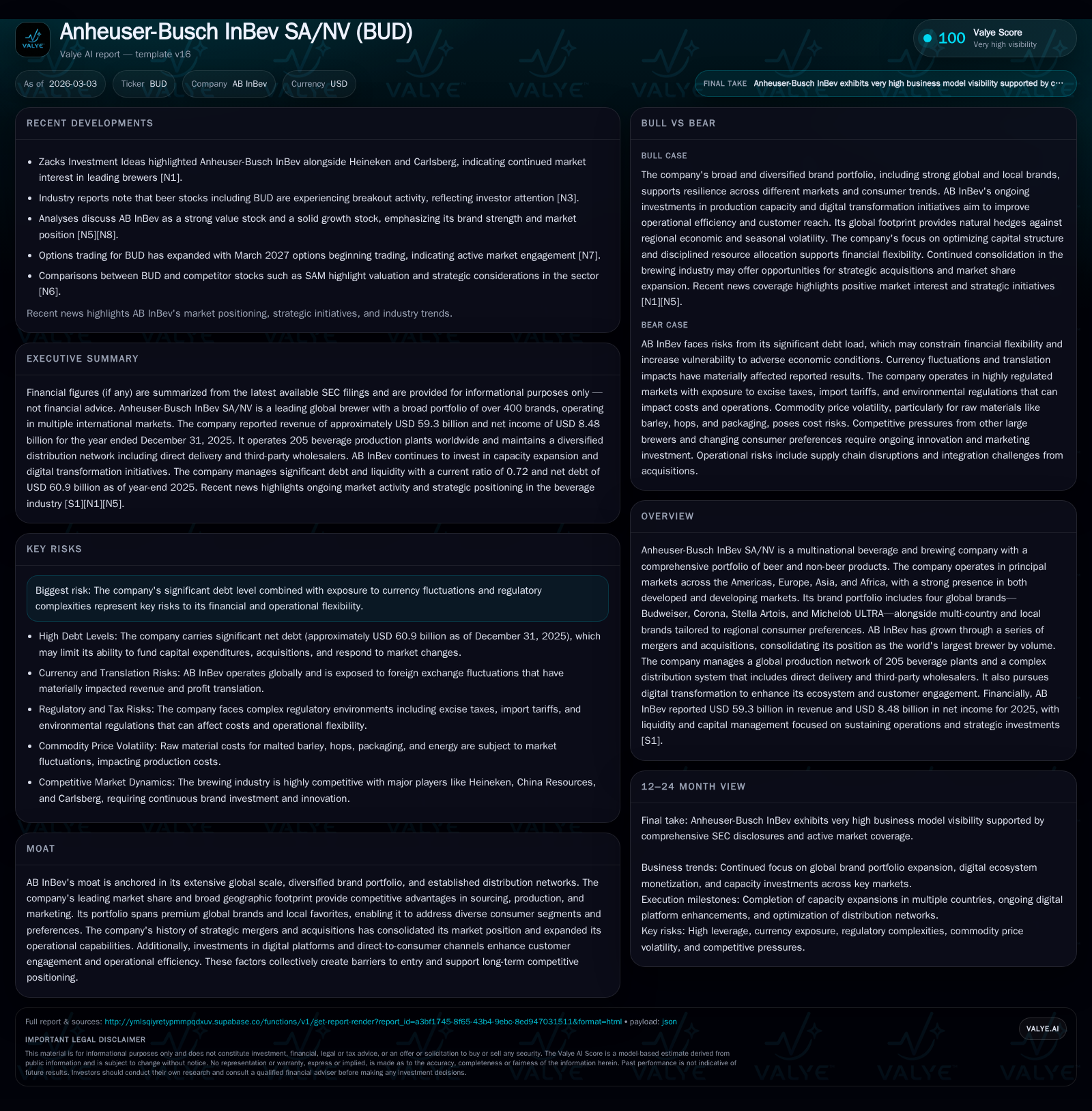
Anheuser-Busch InBev SA/NV remains the world’s largest brewer by volume, with operations spanning developed and developing markets and a diversified portfolio of global, multi-country, and local brands. Its historical growth has been driven by strategic mergers and acquisitions that expanded scale and market presence. Revenue showed slight decline in 2025, impacted by currency translation and inflation accounting adjustments, while net income improved robustly. The company targets growth through premiumization, category expansion, new business initiatives, and digital innovation. Elevated but managed debt levels pose financial risk factors, balanced against substantial liquidity and ongoing capital return programs including dividends and buybacks.
Company Overview
Anheuser-Busch InBev SA/NV stands as the largest brewer globally by volume, with a footprint spanning the Americas, Europe, Asia, and Africa. The company boasts a vast portfolio exceeding 400 beer and malt beverage brands distributed across developed and developing markets alike [S4][S23]. AB InBev's flagship global brands—Budweiser, Corona, Stella Artois, Michelob ULTRA—anchor its brand strategy alongside a collection of multi-country (e.g., Beck's, Hoegaarden) and local champions tailored to regional consumer preferences.
The company operates a substantial production network comprising approximately 205 beverage plants worldwide alongside intricate distribution systems mixing owned distribution assets with third-party wholesalers depending on country-specific regulations and market dynamics [S4]. Its recent history is marked by transformative mergers such as the combination with SABMiller in 2016 and acquisitions like Craft Brew Alliance (full acquisition in 2020).
Historical Financial Performance
AB InBev's top-line has exhibited relative stability with minor fluctuations over recent years reflecting market conditions and currency impacts. Revenue peaked in 2024 at roughly $59.8 billion before easing slightly to $59.3 billion in 2025—a decline mainly attributed to negative currency translation effects including hyperinflation accounting treatments notably impacting Argentina [F1][S1].
Net income demonstrated healthier momentum growing from about $7.4 billion in 2024 to $8.5 billion in 2025 (+14%), signaling underlying profitability gains despite revenue headwinds possibly benefiting from operational efficiencies or pricing power [F1]. This translated into an approximate return on equity of 8.7%, considering an equity base near $97.7 billion at the end of 2025 [F1].
Dividends paid followed an upward trajectory consistent with earnings growth: from roughly $3.2 billion in 2024 to $4.3 billion in 2025 [F1].
Historical performance (annual)
| FY | Rev ($bn) | Net ($bn) | Rev YoY | Net YoY |
|---|---|---|---|---|
| 2025 | 59.3 | 8.5 | -0.7% | +14.3% |
| 2024 | 59.8 | 7.4 | +0.7% | +7.6% |
| 2023 | 59.4 | 6.9 | +2.8% | -9.3% |
| 2022 | 57.8 | 7.6 |
Source: SEC companyfacts cache [F1].
Capital returns and efficiency (annual)
| FY | Div ($bn) | ROE% |
|---|---|---|
| 2025 | 4.3 | 8.7 |
| 2024 | 3.2 | 8.4 |
| 2023 | 3.0 | 7.4 |
| 2022 | 2.6 | 9.0 |
Source: SEC companyfacts cache [F1].
Note: Revenue figures are influenced materially by foreign exchange translation impacts including specific effects from accounting for hyperinflationary environments.
Future Growth Prospects
Growth going forward hinges primarily on several vectors described in company disclosures:
- Category Leadership & Premiumization: AB InBev focuses on elevating its core portfolio through premiumization strategies addressing shifting consumer demands for taste profiles aligned with health trends—including lower-carb/calorie options alongside no- or low-alcohol variants—to broaden occasion penetration [S1][S4].
- Geographic Synergies: The company's diversified geographic footprint balances developed stable markets (
35% of revenues) with high-growth emerging markets (65%), offering natural hedges against regional volatility while capturing rising discretionary spending trends especially across Latin America and parts of Asia [S21]. - Innovation Pipeline & Digital Engagement: Investments continue in product innovation supported by substantial R&D infrastructure anchored at the Global Innovation Center (Leuven), as well as development of digital capabilities for enhanced consumer engagement (e.g., direct-to-consumer logistics platforms like Zé Delivery in Brazil) [S11][S4].
- Operational Optimization: Capital expenditures target capacity expansion selectively across key countries based on forecast demand combined with logistics digitization (e.g., VPO programs) improving supply chain costs [S11].
- Mergers & Acquisitions: While large transformative deals have slowed since SABMiller acquisition completion in the mid-2010s, targeted bolt-on acquisitions or minority stake transactions remain a tangible lever for incremental growth or market entry.
Potential constraints include economic uncertainties impacting discretionary consumption patterns globally; regulatory changes affecting marketing or product formulation; elevated leverage constraining financial flexibility; and intensifying competition exemplified by companies like Heineken or China Resources Breweries [S23][S10].
Capital Structure & Liquidity
The company carries significant indebtedness reflecting its acquisition-fueled growth strategy with net debt reported near $61 billion as of end-2025 against normalized EBITDA guidance targeting a ratio near 2x for capital structure optimization [F1][S5][S6]. AB InBev maintains substantial liquidity resources totaling approximately $22 billion that combine cash/cash equivalents ($12 billion) plus committed credit facilities ($10 billion), providing a buffer against refinancing risks [F1][S7][S8].
Debt instruments are mostly fixed-rate (~98%) mitigating interest rate volatility risk though ongoing currency exposure complexities are managed through hedging policies designed to align debt currencies with functional currency cash flows [S17]. The company’s revolving credit facility incorporates sustainability-linked incentives targeting key environmental metrics—water usage efficiency, recycled content in packaging, renewable electricity sourcing, GHG emission reductions—aligning finance costs with ESG performance outcomes [S12].
Elevated leverage does impose constraints including heightened vulnerability to economic downturns or adverse market conditions limiting acquisitions or capital projects flexibility as noted explicitly by risk disclosures [S6][S10]. However, current financial resources appear sufficient to meet operational needs and planned debt service commitments.
Returns & Capital Allocation Policies
AB InBev follows a disciplined capital allocation strategy balancing organic investment with shareholder returns:
- Organic capex supports brewery modernization/water stewardship/logistics efficiency investments consistent with sustainability goals [S11].
- Dividend distributions rose steadily achieving over $4 billion total paid for FY25 up from prior years aligning payouts closer to profit growth trajectories [F1][S19].
- Share repurchase programs remain active; a multi-billion dollar authorization was commenced late-2025 with timing contingent on market conditions aiming at retirement or treasury stock holdings for stock plan fulfillment [S19][S20].
These policies seek to maintain shareholder value while managing indebtedness levels prudently.
Industry Positioning & Competitive Landscape Analysis
AB InBev dominates global brewing volumes (~493 million hectoliters vs next largest Heineken ~241 million HL), solidifying its scale moat augmented through historic consolidation spanning nearly two decades involving major combinations such as Interbrew-Ambev (2004), Anheuser-Busch (2008), Grupo Modelo (2013), SABMiller (2016) [S14]. Its product breadth covering premium global brands plus multi-country/local stalwarts enables cross-segment coverage fitting diverse demographic tastes.
Distribution sophistication incorporates both directly controlled networks especially where ownership offers competitive advantage versus regulated or historical wholesaler arrangements requiring partnerships—e.g., U.S uses numerous independent wholesalers under regulatory frameworks preventing consolidation beyond defined thresholds to ensure fair competition [S4][S22].
Key competitors include Heineken holding second-largest footprint globally focused more on premium/luxury segments; China Resources leveraging scale domestically; Carlsberg sustaining European/Asian presence alongside others like Molson Coors focusing on North American markets [N4][N5][N14]. The brewing industry continues evolving around premiumization trends coupled with growing consumer demand shifts favoring innovation around health-conscious products.
Risks Summary
Risks disclosed emphasize:
- Exposure to currency fluctuations notably affecting reported results via translation losses especially linked to hyperinflationary economies such as Argentina [S1], imposing earnings volatility.
- Debt-related risks connected to financing cost rises or refinancing unavailability could constrain investment capacity or elevate cost of capital markedly under stressed environments [S6][S10].
- Regulatory-compliance complexities across multiple jurisdictions encompassing labeling laws, advertising restrictions (particularly alcohol marketing), competition law constraints like the U.S Justice Department consent decree compliance restraining certain distributor ownership activities until mid-2026 [S22], tax proceedings especially concerning excess profit rulings in Belgium contested but largely favorable rulings lately obtained [S18], litigation exposures related to joint ventures or broader business practices.
- Environmental sustainability mandates increasing input cost pressures if resource constraints intensify.
- Dependence on wholesaler relationships can be disrupted if consolidation accelerates among retailers or wholesalers potentially diminishing negotiating positioning.
What to Watch / Forward Milestones (Analysis)
Absent explicit forward guidance beyond standard EBITDA leverage target metrics in reports:
- Monitor macroeconomic developments influencing currency landscapes particularly in emerging markets where AB InBev derives majority of revenues.
- Track progress on sustainability-linked credit facility metrics which may impact funding costs.
- Developments around share buyback execution as board discretion assesses timing post-late-2025 authorization renewal upon shareholders’ meeting expected April ’26.
- Potential shifts stemming from evolving alcohol consumption regulations or public health advocacy campaigns influencing marketing approaches or product innovation pipeline prioritization.
- Competitive dynamics given peers’ innovations or M&A moves possibly pressured by changing consumer preferences towards craft/low-alcohol alternatives.
This report synthesizes publicly available SEC filings (20-F annual report filed March ’26: S1–S29), recent news summaries (N1–N14), and validated quantitative data snapshots ([F1]). It provides context grounded strictly within provided factual evidence without speculative projections or investment recommendations.
Disclaimer: This is research-only, informational analysis and not investment advice. It may include AI-generated interpretation and general industry context. Always verify important details using primary sources.

Comments