
Bankwell Financial Group Ramps Up Profitability with Localized Lending Strategy
Localized, relationship-focused lending catalyzes Bankwell’s remarkable income surge amid geographic and regulatory challenges.
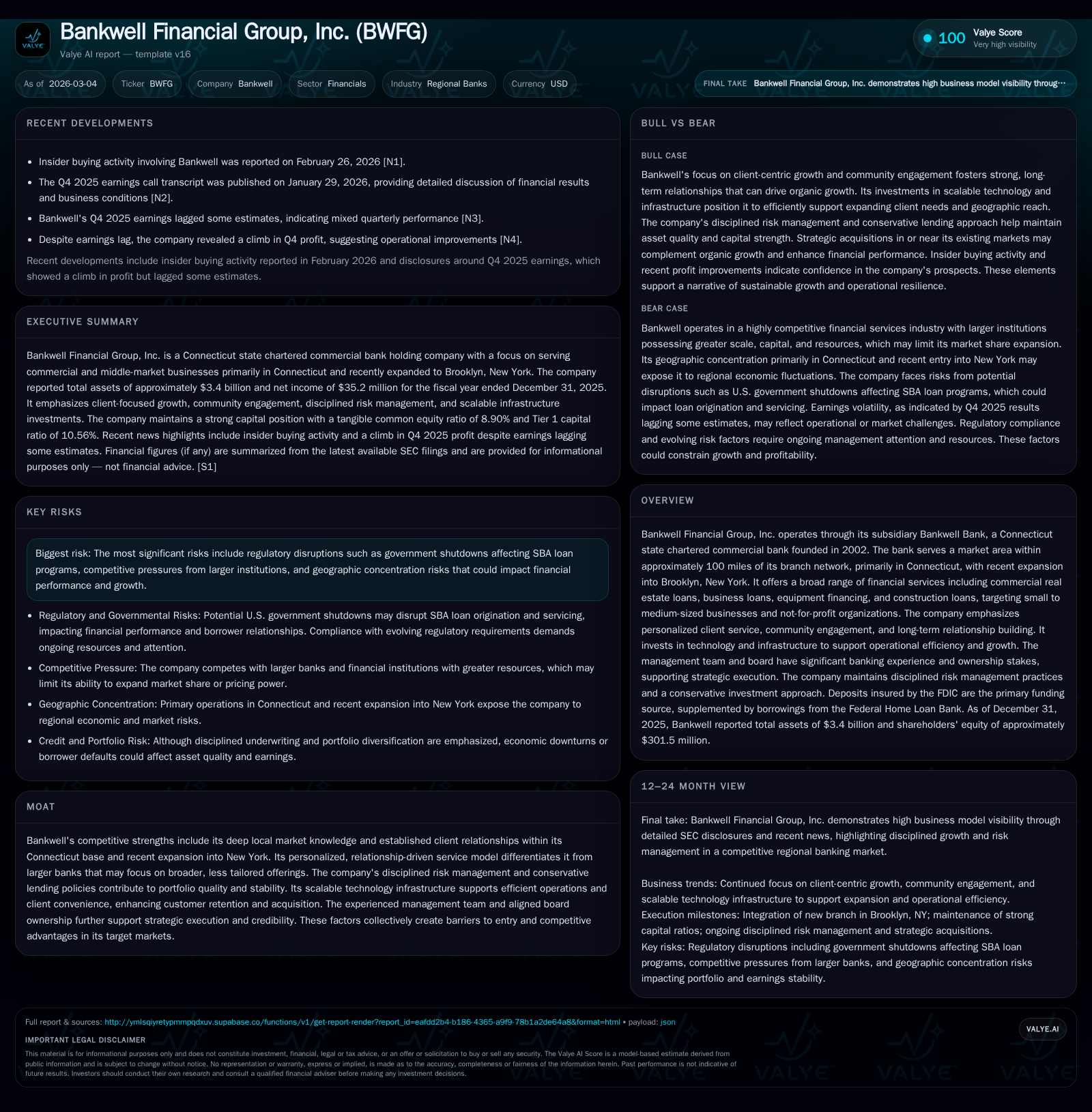
Bankwell Financial Group recorded a striking net income increase of over 260% from 2024 to 2025 driven by expansion in its commercial loan portfolio and disciplined underwriting within its core Connecticut market and recent Brooklyn expansion. Its client-centric model focused on small- to medium-sized businesses and non-profits, supported by scalable technology investments and conservative credit risk management, underpins stable growth. However, geographic concentration and SBA program dependency represent key risks to monitor alongside funding dynamics and credit quality.
Year-over-Year Performance and Profit Surge
Bankwell Financial Group demonstrated a significant increase in net income from $9.77 million in fiscal year 2024 to $35.198 million in 2025, representing a +260.3% year-over-year rise [F1]. Operating cash flow declined slightly by -5.6% to $28.273 million during the same period [F1], reflecting timing differences between accrual earnings and cash receipts. Capital expenditures nearly doubled to $1.144 million as the company invested in scaling its operations [F1]. Equity grew from approximately $270.52 million to $301.49 million, supporting balance sheet strength [F1].
Historical performance (annual)
| FY | Net ($mm) | CFO ($mm) | Capex ($mm) | Net YoY |
|---|---|---|---|---|
| 2025 | 35 | 28 | 1 | +260.3% |
| 2024 | 10 | 30 | 1 | -73.4% |
| 2023 | 37 | 32 | 2 | -2.0% |
| 2022 | 37 | 83 | 5 |
Source: SEC companyfacts cache [F1].
Capital returns and efficiency (annual)
| FY | Div ($mm) | Buybacks ($mm) | FCF ($mm) |
|---|---|---|---|
| 2025 | 6 | 1 | 27 |
| 2024 | 6 | 2 | 29 |
| 2023 | 6 | 0 | 30 |
| 2022 | 6 | 6 | 78 |
Source: SEC companyfacts cache [F1].
The divergence between net income growth and declining cash flow suggests timing or non-cash factors affecting earnings.
Growth Drivers: Focused Commercial Lending and Relationship Banking
Growth was primarily driven by Bankwell's focus on owner-occupied commercial real estate loans, commercial real estate investment loans, business term loans including equipment financing, and construction loans directed at small- to medium-sized enterprises and not-for-profit organizations concentrated within Connecticut and expanded into Brooklyn [S5]. The bank emphasizes relationship-based banking rather than price-driven transactions to serve clients needing personalized service often underserved by larger institutions.
Leveraging delegated authority within SBA programs enables expedited SBA-backed loan approvals that complement the bank’s tailored product offerings [S5]. Relationship managers source deals leveraging deep local knowledge within a roughly 100-mile radius of the branch network.
Risks: Geographic Concentration & Regulatory Dependencies
Bankwell’s geographic concentration within Connecticut plus Brooklyn expansion presents potential market risk if regional economic conditions deteriorate [S2]. The bank’s exposure to SBA loan origination processes is susceptible to disruptions during U.S federal government shutdowns that suspend SBA administrative functions including loan approvals and disbursements even for lenders with delegated authority [S2]. Such interruptions can delay revenue recognition and negatively affect borrower relationships.
Exposure to other federally funded programs impacting borrower cash flows is limited [S2]. Competitive pressures persist as larger banks expand into Bankwell’s markets.
Capital Allocation: Shareholder Returns & Investments
The company maintains stable dividends around $6.27 million annually since at least FY2022 while executing modest share repurchases totaling $1.33 million in FY2025 [F1]. This balanced approach reflects a commitment to returning capital while investing in growth.
Return on equity for FY2025 approximated at 11.7%, demonstrating solid profitability relative to equity capital [F1]. Free cash flow—calculated as operating cash flow minus capex—remained healthy near $27 million supporting discretionary spending capacity [F1].
Technology Investments Support Scalable Operations
Bankwell has increased investments in technology infrastructure supporting online account opening via Bankwell Direct, mobile banking platforms, remote deposit capture, risk management systems, and compliance automation tools [S13]. These upgrades enhance operational efficiency while preserving the bank’s high-touch service model distinct from larger competitors.
Credit Quality & Portfolio Composition
A disciplined underwriting culture limits any single borrower relationship exposure secured by commercial real estate to no more than 30% of equity capital plus allowance for credit losses; unsecured or business-dependent loans adhere to statutory limits of up to fifteen percent of equity capital plus allowances [S7][S9].
The loan portfolio is diversified across owner-occupied CRE properties, commercial investment real estate, construction lending backed by third-party inspections tied to project milestones, business term loans including equipment financing with conservative margins aligned with asset useful lives [S15]. Active monitoring includes watch lists reviewed quarterly by senior management alongside independent third-party reviews confirming risk rating accuracy; annual stress testing evaluates portfolio resilience under adverse economic conditions [S4][S7]. Consumer loans remain less than three percent of total loans minimizing retail credit risk volatility.
Brooklyn Expansion: Opportunities & Challenges Ahead
The strategic entry into Brooklyn broadens Bankwell’s market reach into a dense urban SME sector compatible with its relationship-driven approach but increases competition against larger regional banks with deeper resources as well as regulatory scrutiny typical of metropolitan markets . Success depends on balancing nimble local service delivery with demands for scale inherent in metro environments.
Monitoring Priorities: Funding Stability & Credit Metrics
Ongoing oversight should focus on funding mix stability emphasizing deposits supplemented by Federal Home Loan Bank advances managed prudently for short-term liquidity needs as overseen by the Asset Liability Committee [S6][S10]. Credit quality monitoring remains crucial through aging reports and watch list trends especially within cyclical construction and CRE portfolios.
Monitoring SBA program continuity post-government disruptions will be critical given its impact on loan origination volumes and revenue pipeline pacing [S2].
This analysis integrates publicly available SEC filings and company disclosures providing an informed overview of Bankwell Financial Group's financial health grounded in localized relationship banking strategies amidst evolving industry challenges without offering investment advice.
Disclaimer: This is research-only, informational analysis and not investment advice. It may include AI-generated interpretation and general industry context. Always verify important details using primary sources.

Comments