
Byline Bancorp Advances Commercial Banking with Steady Earnings Growth and Local Market Focus
Chicago-based Byline Bancorp delivers growth fueled by diversified lending, strategic acquisitions, and deep local ties while managing geographic and credit risks.
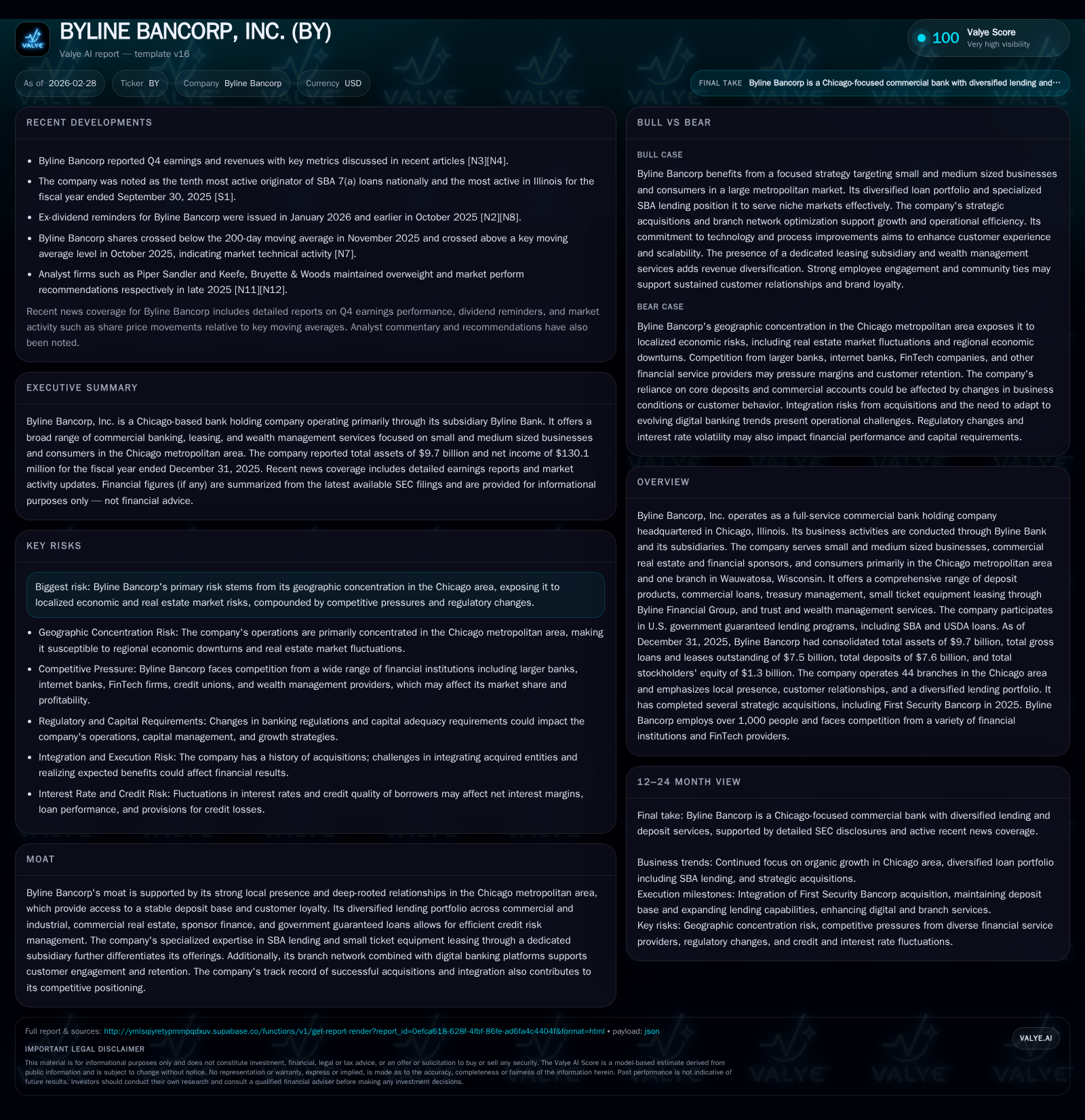
Byline Bancorp, Inc., operating through Byline Bank, is a mid-sized commercial bank primarily serving the Chicago metropolitan area with a focused suite of deposit, lending, and treasury services. The company has demonstrated steady net income growth reaching $130 million in 2025 backed by its diversified loan portfolio spanning commercial, real estate, sponsor finance, and government guaranteed loans. It maintains a solid capital position with over $1.2 billion in equity and a strong deposit base nearing $7.6 billion as of year-end 2025. Although growth prospects are bolstered by organic expansion and acquisition strategies, geographic concentration and credit risk management remain critical challenges.
Company Overview
Byline Bancorp, Inc., headquartered in Chicago, Illinois, operates as a full-service commercial bank holding company through its main subsidiary, Byline Bank. The company primarily serves small and medium-sized businesses, commercial real estate clients, private equity sponsors, and consumers mainly within the Chicago metropolitan area alongside a single branch in Wauwatosa, Wisconsin [S1][S8]. With total consolidated assets of approximately $9.7 billion as of December 31, 2025, it occupies a prominent regional position with diversified offerings including deposit products, commercial loans, treasury management services, SBA and USDA government-backed lending programs, small ticket equipment leasing via Byline Financial Group (BFG), as well as trust and wealth management services [S1][S8][S15].
Historical Performance and Revenue Drivers
Since its recapitalization in 2013, Byline Bancorp has achieved consistent growth through both organic initiatives and targeted acquisitions like First Security Bancorp in 2025 [S25]. The company's focus on expanding local market share combined with its diverse lending portfolio has driven rising loan volumes which stood at $7.5 billion at end-2025 [F1][S8][S18]. Notably, the commercial & industrial (C&I) loan group represents $3.3 billion of this total while commercial real estate (CRE) loans account for $1.4 billion and sponsor finance loans approximately $806 million [S18]. Additionally, SBA and USDA guaranteed loans total about $533 million with servicing rights held on an extended portfolio valued at around $1.6 billion [S8].
Core deposits are critical to funding strategy with Byline reporting approximately $7.6 billion in total deposits for FY2025; core deposits constitute nearly 87% of this base providing stable low-cost funding [S15][F1]. Commercial deposits form a significant portion (43%) of total deposits and dominate non-interest bearing accounts (85%) reflecting strong business client engagement [S25]. Diversification also extends into small ticket equipment leases via BFG which held roughly $752 million in leases outstanding with an average lease origination size around $84,000 during FY2025 [S15][S26].
Financially, Byline's net income increased by about 7.7% year-over-year from roughly $121 million in 2024 to $130 million in 2025 indicating sound profitability amid investment in scale and infrastructure [F1]. However, operating cash flow showed some contraction dropping by nearly 20% to around $140 million likely reflecting loan growth dynamics or working capital shifts [F1]. Capital expenditures remained relatively flat near $4 million annually underscoring controlled investment spending aligned with operational needs [F1].
Historical performance (annual)
| FY | Net ($mm) | CFO ($mm) | Capex ($mm) | Net YoY |
|---|---|---|---|---|
| 2025 | 130 | 140 | 4 | +7.7% |
| 2024 | 121 | 175 | 4 | +11.9% |
| 2023 | 108 | 166 | 4 | +22.7% |
| 2022 | 88 | 220 | 4 |
Source: SEC companyfacts cache [F1].
Capital returns and efficiency (annual)
| FY | Div ($mm) | Buybacks ($mm) | FCF ($mm) |
|---|---|---|---|
| 2025 | 18 | 24 | 136 |
| 2024 | 16 | 0 | 171 |
| 2023 | 15 | 0 | 162 |
| 2022 | 13 | 17 | 217 |
Source: SEC companyfacts cache [F1].
Note: Equity figures approximate shareholder equity for each fiscal year; buyback activity restarted notably in 2025.
Future Growth Prospects
Byline aims to consolidate its leadership position within its core Chicago market while exploring adjacent markets through selective organic growth and acquisitions [S1][S25]. Its track record includes multiple acquisitions since 2013 adding scale as well as expanded product capabilities including the recent purchase of First Security Bancorp in early 2025 [S25][S23]. Growth is expected to be supported by:
- Continued penetration into underserved small business segments leveraging local decision-making authority.
- Expansion of government guaranteed lending programs such as SBA loans where Byline ranks among top originators nationally.
- Enhancement of Treasury Management solutions catering to complex merchant payment needs.
- Scaling equipment leasing nationwide via BFG targeting niche verticals like manufacturing.
However, future growth is moderated by risks stemming from credit losses linked to the geographic concentration in Chicago’s economy and real estate exposure [S1][S22]. Regulatory changes associated with surpassing the $10 billion asset threshold—which Byline is expected to breach—will introduce heightened compliance costs and supervisory scrutiny potentially restricting operational flexibility [S20]. Competitive pressures from larger banks offering more expansive services could further constrain margin expansion.
Forecasts and Milestones
Management guidance explicitly quantifying near-term financial milestones has not been disclosed publicly [N2][N3]; hence investors should monitor:
- Asset size trajectory towards surpassing regulatory thresholds tied to enhanced capital requirements.
- Credit loss provisions amidst prevailing macroeconomic conditions impacting local borrowers.
- Deposit growth rates reflecting ability to attract stable low-cost funding.
- Integration outcomes from recent acquisitions influencing branch footprint efficiency.
- Technological investments improving digital banking experiences which could drive retention.
Earnings estimates have trended upward modestly according to recent analyst commentary though devoid of specific target figures [N1][N2], suggesting cautious optimism within the industry peer context.
Returns and Capital Allocation
Byline maintains a healthy capital position with stockholders’ equity increasing from around $765 million in 2022 to nearly $1.27 billion by end-2025 positioning it well against regulatory capital buffers [F1][S17][S21]. Return on equity approximates a solid double-digit level near 10.3%, indicating efficient capital utilization given the company's risk profile [F1]. Dividend distributions have grown steadily from roughly $13 million paying out regular quarterly dividends valued at about $18 million for FY2025 demonstrating commitment to returning capital to shareholders [F1][N6]. Notably, share repurchases resumed in FY2025 after a hiatus representing about $24 million utilized for buybacks signifying confidence in valuation metrics or excess capital availability [F1].
Capital expenditures have been modest relative to cash flows reflecting disciplined reinvestment primarily aimed at technology upgrades supporting digital service enhancements alongside branch network maintenance rather than aggressive expansion capex projects [F1][S25]. Operating cash flow declines may warrant monitoring but currently remain strong enough to sustain dividends plus buybacks without raising external equity or debt substantially.
Risk Considerations
A clear vulnerability arises from Byline’s geographic concentration; dependence on Chicago-area economic health exposes it to regional downturns or localized real estate market stress which could materially impact credit quality [S22][S12]. The significant proportion of real estate-secured loans necessitates vigilant underwriting standards especially amid fluctuating property valuations or interest rate environments affecting repayment capacity [S28][S19].
Credit risk management remains paramount given the subjective evaluation required for allowances against credit losses under GAAP CECL methodology which could underestimate actual loss exposures if forecasts prove overly optimistic or economic conditions deteriorate unexpectedly [S1]. Compliance risks related to consumer protection laws like ECOA and TILA impose potential litigation or regulatory penalties if violations occur affecting reputation or operational latitude [S11][S13]. Moreover, entering above the $10 billion asset mark will trigger enhanced regulatory requirements potentially increasing costs without commensurate revenue gains initially [S20].[N2]
Industry Context (Analysis)
Regional banks like Byline operate amidst pressure from fintech entrants compelling innovation while customer expectations shift toward hybrid digital-human service models plus relentless margin compression squeezed by rising funding costs following Fed rate hikes across recent years. Successful institutions balance hyperlocal knowledge against scalable technology platforms enabling tailored solutions across lending verticals – an approach that resonates well within small-to-mid-market customer niches underserved by national mega-banks or solely digital disruptors.
Conclusion
Byline Bancorp navigates its growth strategy focused on strengthening its competitive moat anchored around deep relationships within Chicago’s small-medium business landscape combined with diversified loan products including SBA guaranteed financing and equipment leasing specialization. Steady net income expansion coupled with prudent capital deployment via dividends and resumed buybacks underpin financial discipline amidst intensifying regulatory regimes forecasting asset thresholds above $10 billion.
Monitoring credit quality metrics particularly concerning real estate concentrations along with deposit franchise health will be crucial going forward as will technological investments enabling seamless cross-channel customer engagement crucial for retention.
This report is prepared solely for informational purposes based on public sources without providing investment advice or recommendations regarding securities or financial instruments related to Byline Bancorp.
Disclaimer: This is research-only, informational analysis and not investment advice. It may include AI-generated interpretation and general industry context. Always verify important details using primary sources.

Comments