
Blaize Holdings Advances Automotive AI Chips with New Contracts and Strategic Partnerships
Blaize's latest quarterly filings reveal revenue gains and strategic automotive collaborations that underpin its growth trajectory amid ongoing operational challenges.
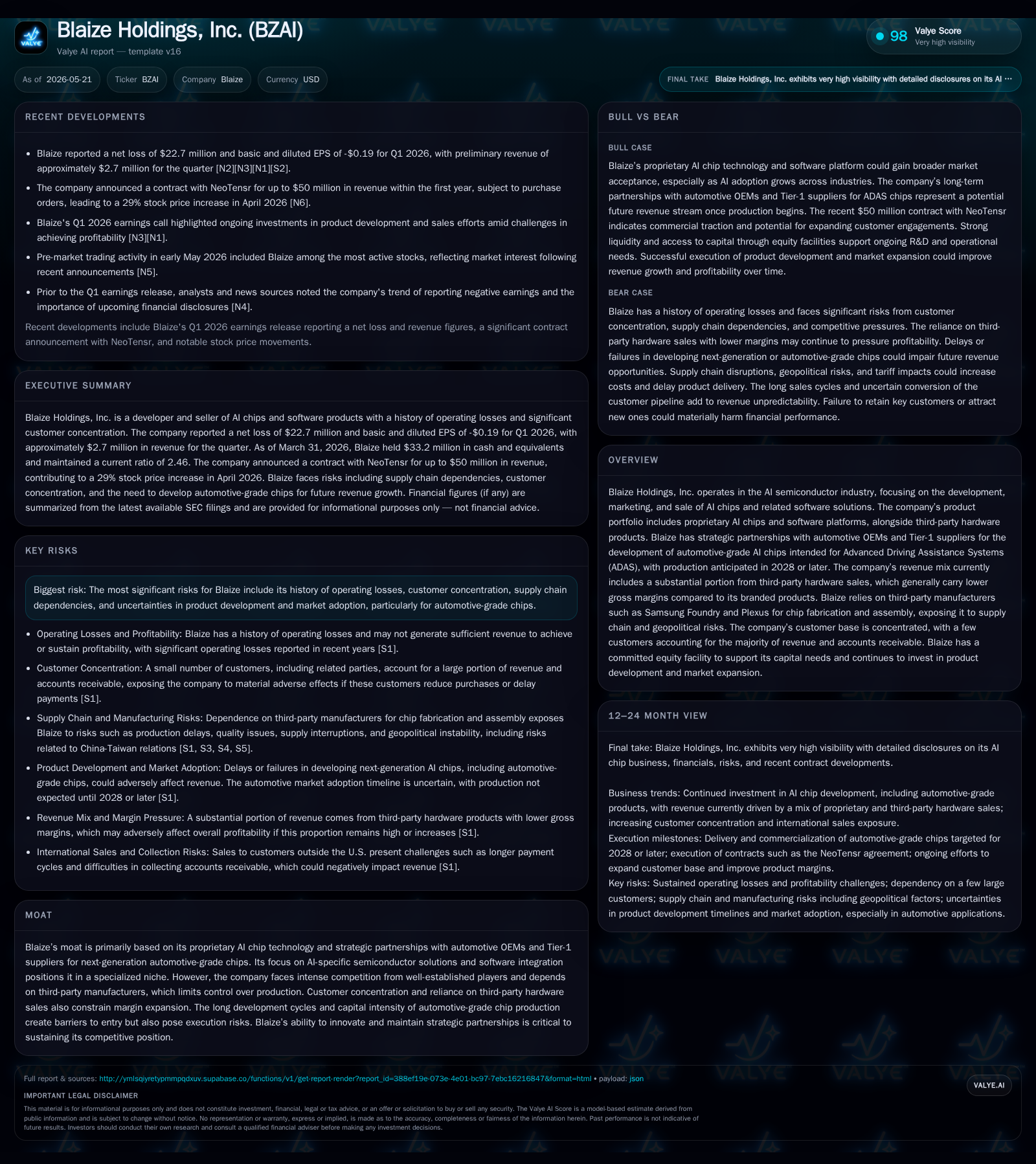
In its Q1 2026 results, Blaize Holdings reported revenue exceeding estimates driven by new contracts including a sizable $50 million agreement with NeoTensr, underscoring progress toward commercializing automotive-grade AI chips. The company’s business model balances proprietary AI chip sales and software platforms with lower-margin third-party hardware, reflecting a transition phase. Operating in a highly competitive AI semiconductor landscape, Blaize maintains strategic OEM and Tier-1 partnerships critical for entering the Advanced Driving Assistance Systems market with production slated for 2028 or later. Customer concentration, supply chain dependencies on foundries like Samsung, and long development cycles remain key constraints. Monitoring backlog developments and delivery milestones will be essential to gauge execution momentum.
Latest Quarterly Operating Update: Revenue Beats Amid Ongoing Losses
Blaize Holdings reported Q1 2026 financials on May 14, 2026 [S2], [S3], showing revenue of approximately $2.7 million which exceeded consensus expectations [N2]. This uptick was primarily driven by planned shipments valued at $10–12 million under a recently announced $50 million contract with NeoTensr announced in April 2026 [S4], [N6]. Despite this top-line improvement, the company continues to report net operating losses reflective of ongoing investment in R&D and commercialization efforts typical in specialized semiconductor startups targeting emergent AI markets [N1]. The quarter's operational update highlights a delicate balance between scaling content deliveries while advancing product development milestones fundamental to longer-term growth.
Business Model and Product Portfolio: Proprietary AI Chips Supported by Software Platforms
Blaize operates within the niche yet rapidly evolving AI semiconductor sector focusing on designing proprietary energy-efficient AI chips integrated with complementary software platforms [S1]. This integrated approach aims to deliver differentiated silicon optimized for workload-specific applications such as Advanced Driving Assistance Systems (ADAS) in automotive contexts. Importantly, Blaize’s current revenue mix also includes significant sales of third-party hardware products which carry substantially lower gross margins than its branded solutions [S1]. This mix depresses overall profitability but provides near-term revenue while internal chip designs mature. The company's outsourced manufacturing strategy leverages firms like Samsung Foundry for fabrication and Plexus for assembly/packaging, reflecting typical fabless semiconductor model attributes but exposing Blaize to external supply chain volatility [S1].
Industry Context: Competition, Customer Concentration, and Supply Chain Dependencies
Within the fiercely competitive AI semiconductor industry, Blaize contends with well-funded incumbents offering broader platforms. The company’s moat is anchored mainly through its focus on tailored automotive-grade AI chips combined with embedded software ecosystems—a more specialized niche compared to general-purpose GPU or CPU providers [S1]. However, Blaize faces intense pressure from established suppliers in both technology sophistication and scale.
Customer concentration is pronounced; a handful of related parties generate over 90% of revenues and receivables balances [S6], [S9], raising bargaining leverage concerns that could constrain pricing flexibility. Additionally, reliance on external foundry partners such as Samsung Foundry brings inherent geopolitical risks amid shifting trade tensions affecting global semiconductor supply chains [S9]. These factors underscore both the structural complexity of delivering next-generation AI chip solutions and the operational constraints facing Blaize.
Strategic Partnerships and Collaborations Targeting Automotive AI Chip Production
The firm has forged strategic agreements with leading automotive OEMs and Tier-1 suppliers to develop ADAS-focused automotive-grade AI chips targeted for production in 2028 or later [S1], deploying these partnerships as validation points for technology roadmaps. Notably, the NeoTensr contract valued up to $50 million signifies an important step toward commercial traction albeit subject to purchase order finalization contingent on product delivery [S4]. Such multi-year arrangements reflect necessary long development cycles imperative to meet stringent automotive certification standards. While no firm purchase orders are received until chip delivery completes certification phases [S1], these collaborations offer valuable co-development synergies enhancing Blaize's competitive positioning.
Growth Drivers: NeoTensr Contract, Automotive-Grade Chip Pipeline, Software Integration
Key growth vectors reside first in execution against large-scale contracts like NeoTensr enabling initial inventory shipments expected imminently in mid-2026 [S4]. Following this contractual milestone, revenue scaling will depend on transitioning into broader production volumes once automotive-grade chip certifications materialize post-2028. Concurrently, expanding uptake of Blaize's software platforms which enable seamless integration of its chips into complex enterprise deployment environments offers potential recurring revenue streams enhancing customer stickiness and margin quality over time [N1]. However, these avenues are inherently protracted due to long validation cycles characteristic in the automotive vertical.
Risks and Constraints: Customer Concentration, Supply Chain Risks, Long Development Cycle
Significant risk factors documented revolve around heavy customer concentration where a few related parties constitute the vast majority of revenues and accounts receivable positions—a scenario heightening exposure should any key partner reduce purchases or renegotiate terms unfavorably [S1], [S6]. Supply chain continuity risks escalate given dependency on third-party manufacturers such as Samsung Foundry amid geopolitical uncertainties affecting cross-border logistics and fabrication capacity allocation [S1], [S9]. Moreover, the capital-intensive nature of developing next-gen auto-grade semiconductors coupled with inherently slow sales cycles typical for large enterprise customers translates into execution timing uncertainty that can impact cash flow profiles.
What to Monitor Next: Order Backlog, Delivery Milestones, Customer Expansion
Industry watchers should focus attention on several near-to-medium term indicators including confirmation of subsequent purchase orders linked to the NeoTensr contract beyond initial inventory shipments—as these will signal meaningful commercial ramp-up trajectories [S2]. Progressing towards production qualifications for automotive-grade chips slated post-2028 remains a critical technological milestone; updates here could recalibrate market expectations regarding commercialization timelines. Additionally, tracking expansion within the existing customer base or onboarding new clients would indicate successful scaling of Blaize's software licensing model which carries higher margin potential relative to third-party hardware sales.
Concise Financial Overview: Cash Position, Liquidity, Operating Losses
As of March 31, 2026, Blaize held cash and cash equivalents totaling approximately $33.2 million against current liabilities near $26.5 million resulting in a healthy current ratio of roughly 2.46 [F1], indicative of sufficient short-term liquidity to sustain operations. Total debt remains minimal at around $1.5 million as per prior disclosures [F1]. Despite this liquidity buffer enabling continued investments into R&D pipelines essential for product innovation and certification efforts, operating losses remain sizeable consistent with growth-stage patterns prevalent among specialized fabless semiconductor players pursuing capital-intensive automotive markets [F1].
This analysis synthesizes publicly filed quarterly SEC disclosures alongside recent market commentary. All operational metrics align strictly with documented filings without speculative forecasts or assumptions beyond stated industry conditions.
Disclaimer: This is research-only, informational analysis and not investment advice. It may include AI-generated interpretation and general industry context. Always verify important details using primary sources.

Comments