
Chubb Ltd Outpaces Peers with Diversified Premium Growth and Capital Strategy
Chubb's robust revenue and net income growth in 2025 reflect disciplined underwriting and strategic acquisitions across multiple global insurance segments.
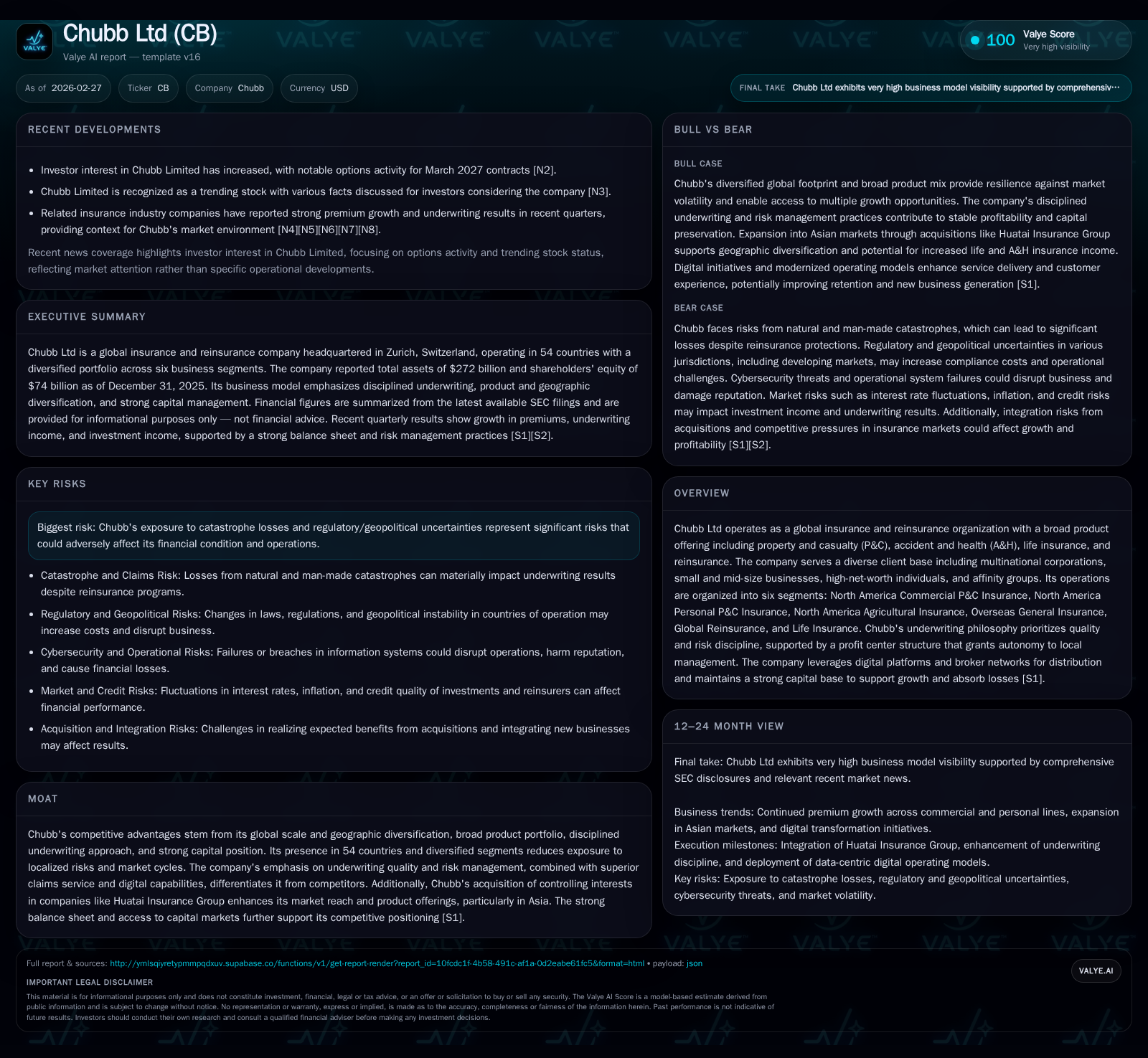
Chubb Ltd demonstrated a strong financial performance in fiscal 2025, marked by a 6.5% increase in revenues to $59.4 billion and an 11.2% rise in net income to $10.3 billion, underscoring the impact of disciplined underwriting and strategic geographic expansion. Its diversified operating structure across six key segments and presence in 54 countries help mitigate volatility from localized risks, supporting stability amid evolving regulatory and catastrophe exposures. Capital allocation remains focused on sustaining dividend growth and share repurchases, backed by a solid balance sheet and operational cash flow generation. Looking ahead, monitoring renewal pricing trends, integration of recent acquisitions such as Huatai Insurance Group, and regulatory developments will be critical to sustaining its growth trajectory.
From Expansion to Execution: Chubb’s Growth Trajectory Through 2025
Chubb Ltd delivered notable financial momentum in fiscal year 2025, driven by its comprehensive global insurance platform and disciplined underwriting practices [F1][S1]. Revenues grew by 6.5% to $59.4 billion from $55.7 billion in the prior year, while net income rose by a more pronounced 11.2% to reach $10.3 billion [F1]. The company attributes this strong top-line and bottom-line expansion partly to targeted acquisitions that expanded their geographic reach — notably the acquisition of Cigna’s Asian accident & health and life insurance businesses in 2022 and achieving a controlling stake (approximately 87%) in Huatai Insurance Group by mid-2023 [S1]. These moves enhanced Chubb’s access to fast-growing markets in Asia Pacific, balanced against its established North American base.
Underwriting discipline remained paramount as Chubb balanced premium growth with profitability objectives rather than market share maximization. This approach helped maintain a profitable book despite heightened volatility from catastrophe events and inflationary pressures affecting claims costs [S1]. The company continues structuring its operations into profit centers spanning diverse jurisdictions, each accountable for local underwriting decisions within clearly defined authorities — a governance model fostering agility and accountability.
Historical financial details illustrate this trajectory:
Historical performance (annual)
| FY | Rev ($bn) | Net ($bn) | CFO ($bn) | Rev YoY | Net YoY |
|---|---|---|---|---|---|
| 2025 | 59.4 | 10.3 | 12.8 | +6.5% | +11.2% |
| 2024 | 55.8 | 9.3 | 16.2 | +12.1% | +2.7% |
| 2023 | 49.7 | 9.0 | 12.6 | +15.2% | +69.9% |
| 2022 | 43.2 | 5.3 | 11.2 |
Source: SEC companyfacts cache [F1].
Capital returns and efficiency (annual)
| FY | Div ($mm) | Buybacks ($bn) | ROE% |
|---|---|---|---|
| 2025 | 1505 | 3.7 | 14.0 |
| 2024 | 1436 | 1.8 | 14.5 |
| 2023 | 1394 | 2.4 | 15.2 |
| 2022 | 1375 | 2.9 | 10.5 |
Source: SEC companyfacts cache [F1].
Source: [F1]
Multi-Segment Strength: The Role of Geographic and Product Diversification
Chubb divides its business into six key segments: North America Commercial P&C Insurance, North America Personal P&C Insurance, North America Agricultural Insurance, Overseas General Insurance, Global Reinsurance, and Life Insurance [S8]. Operating across approximately fifty-four countries grants Chubb significant geographic diversification that dilutes exposure to region-specific risks or downturns.
Segmentally, the North America Commercial P&C accounts for close to two-fifths of consolidated net premiums earned (38%), complemented by Personal P&C lines focusing on high-net-worth individuals’ needs [S8][S26]. Overseas General Insurance further diversifies product exposure outside North America with locally admitted policies tailored for regional market dynamics.
The Global Reinsurance segment underpins risk dispersion through reinsurance protection predominantly sold via brokers on an excess-of-loss basis targeting large accumulation risk scenarios [S20]. Agricultural insurance offerings include federally subsidized crop insurance programs providing protection primarily in North America.
This multi-line mix is enabled by Chubb’s modular profit center structure granting local teams autonomy within robust underwriting standards while leveraging cross-border digital platforms for efficient distribution [S1][S10]. From an industry standpoint, such structural fragmentation mitigates cyclicality typical of pure-play insurers limited to narrow product or geography exposure.
Underwriting Quality as a Pillar of Stability and Profitability
Central to Chubb’s strategy is rigorous underwriting emphasizing disciplined pricing aligned with risk evaluation rather than aggressive volume gain [S1]. The company enforces clear underwriting authorities at each profit center supported by annual audits and global product boards ensuring consistent standards worldwide.
This governance generates stable loss ratios—balancing price adequacy with selective exposure—focusing on risk-adjusted returns superior to peers who may sacrifice margins chasing premium growth [S1][S8]. The approach incorporates adjustments for inflationary trends and evolving climate patterns impacting catastrophe frequencies.
The profit center model fosters accountability among local leadership tasked with tailoring product mixes while adhering to corporate risk appetite frameworks — an industry best practice increasing responsiveness without compromising overall portfolio discipline.
Challenging the Headwinds: Navigating Catastrophe and Regulatory Risks
Among the most pronounced risks disclosed are exposures related to catastrophe losses inherent in property casualty insurance [S4][S15]. While reinsurance programs mitigate peak loss severity via layered excess-of-loss treaties, weather-related volatility introduces earnings uncertainty.
Regulatory burdens have increased notably around cybersecurity mandates—such as those imposed by New York Department of Financial Services’ Cybersecurity Regulation—and data security laws like the NAIC Insurance Data Security Model Law adopted variably across states [S6][S17]. Compliance necessitates ongoing investments in IT risk management infrastructure raising operational costs but essential for safeguarding customer data.
Artificial intelligence regulation also looms as emerging legislation globally enforces transparency around algorithmic decision-making processes applied within underwriting or claims handling functions [S16][S17]. Such compliance complexities require proactive governance adaptations.
Geopolitical uncertainties surrounding Chubb’s extensive international operations pose additional operational risks including abrupt regulatory changes or nationalization scenarios particularly within developing markets that can disrupt business continuity [S16].
Capital Allocation Excellence: Balancing Dividends, Buybacks, and Liquidity
Chubb’s capital strategy balances rewarding shareholders through dividends with opportunistic share repurchases while maintaining liquidity buffers sufficient for underwriting commitments [F1][S23][S25]. In fiscal year 2025 dividends were raised modestly to approximately $1.5 billion reflecting confidence in sustained earnings power.
Simultaneously, buybacks accelerated sharply—to nearly $3.7 billion compared with $1.8 billion in the prior year—indicating management’s intent to optimize capital structure amid surplus liquidity [F1]. Operating cash flows diminished somewhat by roughly one-fifth year-over-year but at $12.8 billion remain robust relative to dividend distributions [F1].
Equity increased substantially over recent years reaching approximately $73.8 billion at end-2025 supporting an estimated return on equity around a healthy ~14%, reflecting efficient capital deployment relative to profitability [F1]. Short-term liquidity arrangements include revolving credit facilities totaling $3 billion expiring in late-2027 supplemented by letters of credit enhancing flexibility during periods of timing mismatches between cash inflows/outflows [S7][S11].
Future Proofing Growth: Key Milestones and Market Dynamics to Monitor
While explicit financial guidance has not been disclosed recently by Chubb beyond general commentary [N11], several factors merit close attention going forward:
- The progress integrating Huatai Insurance Group operations post-2023 acquisition will shape expansion outcomes particularly within China’s substantial but competitive insurance marketplace [S1][N13].
- Renewal pricing trends especially for commercial property lines remain critical as inflationary claims pressures persist industry-wide; publicly reported peer earnings releases suggest mixed rate environments indicating careful monitoring needed ([N1]-[N6]).
- Regulatory evolution around AI usage, data privacy frameworks, cybersecurity mandates require continuous adaptations impacting compliance costs but also potentially enabling operational efficiencies if managed well [S16][N11].
- Climate change-driven catastrophe frequency raises the importance of effective risk modeling refinements influencing underwriting guidelines.
- Ongoing investments in digital platforms underpin distribution capabilities targeting both retail broker networks and direct-to-consumer channels characteristic of personal lines growth vectors.
In sum, sustaining Chubb’s double-digit growth trajectory hinges on balancing disciplined risk selection with thoughtful expansion strategies amid complex external headwinds.
Disclaimer: This report is based solely on publicly available information from SEC filings and verified news sources as indicated; it is intended for informational purposes without expressing investment advice or recommendations.
Disclaimer: This is research-only, informational analysis and not investment advice. It may include AI-generated interpretation and general industry context. Always verify important details using primary sources.

Comments