
Crown Holdings’ Scale and Innovation Support Growth Despite Raw Material and Debt Challenges
A global packaging leader’s financials and strategic initiatives underscore growth driven by innovation and sustainability amid cost pressures.
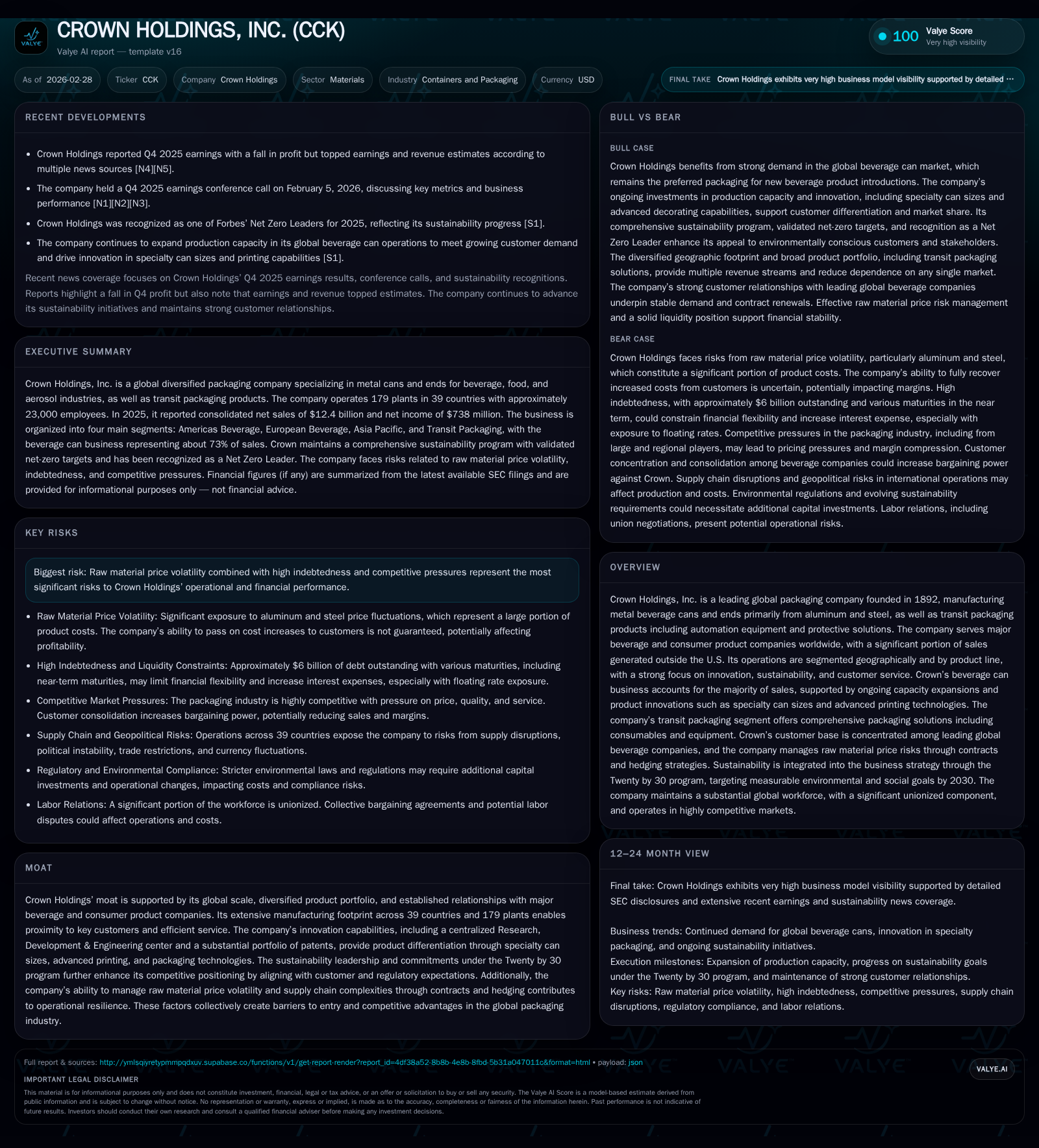
Crown Holdings, Inc. has demonstrated steady revenue and earnings growth over recent years, leveraging its expansive global footprint and focus on beverage can innovation. While capex remains moderate relative to cash flow generation, the company faces risks from raw material price volatility and elevated debt levels. Its broad customer base concentrated among leading beverage companies supports ongoing demand, supplemented by sustainability efforts under the Twenty by 30 program. Watch for developments in cost management, trade tariffs, and legal proceedings affecting profitability.
Historical Performance
Crown Holdings has steadily expanded its top-line alongside improving profitability over recent years. According to SEC filings, the company reported consolidated net sales of $12.4 billion for fiscal year 2025, marking roughly a 2.1% increase compared to the previous year [F1]. This growth is largely attributed to expanded capacity investments in the beverage can segment as well as new product innovations like slim/sleek specialty cans which help differentiate customers’ products.
Operating income surged nearly 9.4% year-over-year to $1.55 billion in FY2025 despite inflationary pressures on raw materials and energy costs [F1]. Notably, net income recorded a significant jump of about 74%, reaching $738 million for the year, reflecting both operational improvements and effective expense control measures during a complex macroeconomic environment [F1].
The company’s operating cash flow was strong at $1.53 billion against capital expenditures of $413 million in FY2025, yielding approximately $1.12 billion in free cash flow—indicating solid cash conversion that supports both reinvestment and shareholder returns [F1]. Capital spending has moderated relative to peak years but remains focused on capacity expansion primarily for beverage can production lines globally.
Historical performance (annual)
| FY | Net ($mm) | CFO ($mm) | OpInc ($mm) | Capex ($mm) | Net YoY |
|---|---|---|---|---|---|
| 2025 | 738 | 1530 | 1553 | 413 | +74.1% |
| 2024 | 424 | 1192 | 1419 | 403 | -5.8% |
| 2023 | 450 | 1453 | 1269 | 793 | -38.1% |
| 2022 | 727 | 803 | 1336 | 839 |
Source: SEC companyfacts cache [F1].
Capital returns and efficiency (annual)
| FY | Div ($mm) | Buybacks ($mm) | FCF ($mm) |
|---|---|---|---|
| 2025 | 120 | 505 | 1117 |
| 2024 | 119 | 217 | 789 |
| 2023 | 115 | 12 | 660 |
| 2022 | 106 | 722 | -36 |
Source: SEC companyfacts cache [F1].
Revenue reflects consolidated net sales; buybacks notably increased in FY25 versus FY24 contributing to capital return strategy.
Business Segments and Competitive Positioning
Crown’s dominant business unit is Global Beverage Cans which accounted for about 73% of total sales in 2025 [S1]. This segment benefits from stable long-term demand trends towards metal packaging, favored for its recyclability—the aluminum can leads globally as the most recycled beverage container—and appeal among alcoholic and non-alcoholic beverage producers alike.
The Transit Packaging segment contributes roughly $2 billion annually through provision of automation equipment, protective solutions (such as airbags and edge protectors), consumables integration across metals/plastics/paper substrates serving multiple industries including food & beverage, construction, agriculture, and general industrial sectors [S21]. Transit Packaging faces more regional competitive dynamics but leverages Crown's scale and broad portfolio for differentiation.
Competition is intense with peers like Ball Corporation (BALL), Ardagh Metal Packaging, Silgan Holdings Inc., Sonoco, among others all vying for market share primarily on price, service quality, innovation capability, and reliability [S25]. Crown’s established presence spanning over 39 countries with ~179 plants enhances proximity to customers reducing supply risk while enabling customization.
Growth Catalysts
Expansion in global beverage can capacity remains central; Crown has consistently invested capital to meet rising demands from leading customers including Anheuser-Busch InBev, Coca-Cola, Heineken, Keurig Dr Pepper, Molson Coors and Pepsi-Cola who collectively represent nearly half of consolidated sales volume [S25]. Increasing consumer preference shifts towards sustainable packaging options continue bolstering metal container usage versus plastics or alternative materials given regulatory scrutiny around environmental impact.
Further growth hinges on product innovation led by Crown's centralized Research Development & Engineering center located in Wantage UK that advances technologies such as Accents™ variable printing enabling up to twenty-four different designs per run enhancing brand visibility; Quantum™ debossing adding unique textures that reduce material usage up to thirteen percent while combating counterfeiting; alongside specialty can sizes deployed globally enabling customer differentiation at retail shelves [S19][S23].
The Twenty by 30™ sustainability program targets twenty measurable goals aiming at reducing carbon emissions intensity and boosting recycled content utilization across metals supply inputs aligned with circular economy principles—a growing priority among customers driven both by consumer demand and tightening regulations worldwide [S1][N10].
Growth may also come from selective acquisitions or joint ventures though constrained near term by existing leverage levels restricting further indebtedness under credit agreements per reported covenants; hence organic expansion dominates strategy currently [S15].
Key Risks Limiting Growth Prospects
Raw material price volatility poses one of the largest uncertainties: Aluminum alone accounts for approximately forty-seven percent of consolidated cost of goods sold excluding depreciation/amortization while steel comprises roughly eight percent [S1]. Price fluctuations tied to global market conditions, geopolitical tariffs—for example US-imposed tariffs on Chinese imports introduced or paused recently—and supplier consolidation intensify supply risk impacting margins given limited pass-through ability without volume loss or market share erosion.
Additionally Crown carries substantial debt totaling nearly six billion dollars inclusive of diverse senior notes maturing between next few years through mid-2030s with restrictive covenants limiting dividend payments/share repurchases/capital spending flexibility despite substantial free cash flow generation observed recently [F1][S13][S15]. Rising interest rates could increase interest expense notably given ~$1.8 billion exposure to floating rate borrowings increasing earnings sensitivity.
Legal liabilities remain material with asbestos-related claims accrued at $177 million creating potential future cash outflows alongside ongoing European Commission antitrust investigations resulting in multi-million dollar fines with uncertainties regarding appeals outcomes potentially affecting results unpredictably .
Operational risks include potential supply chain disruptions or capacity mismatches due to volatile customer demand patterns especially in emerging markets where infrastructure buildout continues amid geopolitical instability; furthermore technology failure or cyber-attacks could disrupt manufacturing or logistics networks given heavy IT reliance underscored by internal controls disclosures [S11][S14].
Forecasts / What To Watch
Crown did not provide explicit forward guidance publicly within current disclosures but upcoming quarterly earnings calls (e.g., Q4 FY25 release Feb ‘26) will elucidate management’s outlook particularly on raw material inflation mitigation strategies, margin trajectory amidst competitive pricing pressures, execution progress on capacity expansions primarily for cans segments across Asia-Pacific & Americas regions [N8][S3].
Monitoring developments around sustainability goal milestones under Twenty by 30 remains critical since they influence customer contracts and government relations directly.
Lockstep monitoring of legal case status regarding European Commission fines appeal expected later this year could have discrete financial impacts uncertain currently but material ultimately if penalties upheld without relief measures implemented.
Currency fluctuations especially involving Mexican peso/Euro/Thai baht relative to USD also warrant attention given translation exposure affecting reported earnings negatively during USD strength episodes noted historically impacting net income up to ~$20 million with moderate moves otherwise [S22].
Returns & Capital Allocation Strategy
Return on equity approximated 24.6% based on latest reported net income relative to equity base signaling efficient capital deployment; however leverage dampens net returns to shareholders somewhat due to interest burdens even though the company sustains robust operating cash flows exceeding $1.5 billion annually supporting consistent dividend payments ($120 million annually recently) complemented by opportunistic share repurchase programs which accelerated sharply in FY25 ($505 million buybacks) after more muted levels prior years reflecting balance sheet comfort improvements + confidence in free cash generation capacity [F1].
Capital expenditure discipline evident as capex remained flat around $400 million marking a significant decrease from prior peak investment cycles exceeding $790 million accommodating new line builds plus maintenance expansions across footprint likely optimized following completion phases enabling more efficient asset utilization moving forward [F1][S19][S23].
Overall free cash flow profile remains strong with ample coverage for interest obligations (~$398 million annual interest) allowing incremental deleveraging prospects albeit gradual given principal maturities approaching within short term horizon necessitating refinancing or liquidity management measures stated within filings documenting credit facility terms & covenant compliance risks heavily emphasized postures around financial prudence required [F1].
Conclusion
Crown Holdings exhibits a solid historical record marked by resilient revenue growth combined with improving earnings supported chiefly by expanding beverage can capacity worldwide coupled with distinctive packaging innovations strengthening competitive moat derived from scale advantages plus customer concentration among global leaders.
Nonetheless raw material price volatility inherent in aluminum/steel markets alongside elevated indebtedness pose notable strategic challenges constraining flexibility amid ongoing tariff uncertainties requiring active hedging plus contract management ingenuity.
Its sustainability framework under Twenty by 30 positions it favorably against regulatory trends pushing circular economy principles while litigation risks mainly asbestos legacy claims plus EU investigations add layers of complexity.
Investors should closely track management’s quarterly communication focusing on cost pass-through strategies versus volume retention dynamics alongside updates on legal contingencies plus debt refinancing plans which collectively hold sway over future performance trajectories.
This analysis is compiled solely for informational purposes drawing exclusively upon publicly available regulatory filings ([F1], [S#]) and verified news sources ([N#]) without any investment advice or recommendations.
Disclaimer: This is research-only, informational analysis and not investment advice. It may include AI-generated interpretation and general industry context. Always verify important details using primary sources.

Comments