
CareDx's Shift to Integrated Transplant Solutions: Growth and Profitability Challenges
CareDx advances transplant patient care via molecular diagnostics and digital health, facing persistent profitability hurdles despite revenue gains in 2025.
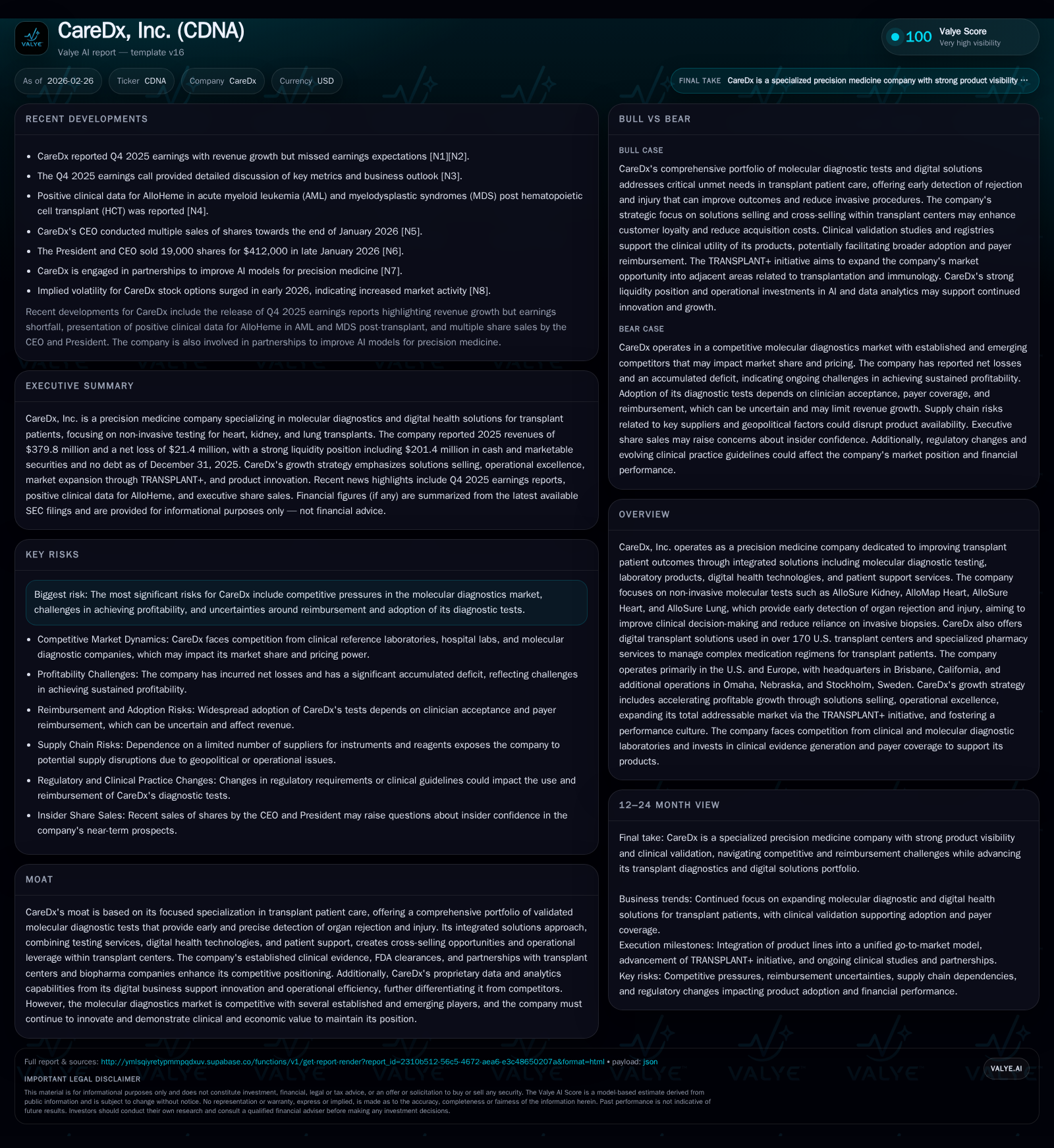
CareDx, Inc. stands out in the transplant diagnostics landscape with a focused portfolio of non-invasive molecular tests complemented by digital health and patient support solutions. Its integrated approach drove a 15% revenue growth in 2025, fueled by expanding test volumes and digital offerings, yet the company reported operating losses reflecting high R&D and competitive pressures. Aggressive share repurchases characterize capital allocation over dividends, while ongoing regulatory investigations and pricing dynamics underscore risk factors. Watch for clinical trial readouts and reimbursement developments as key drivers influencing CareDx’s path toward sustained profitability.
CareDx’s Business Model: Specialization in Transplant Patient Care
CareDx is a precision medicine company singularly focused on improving outcomes for organ transplant patients through an integrated suite of molecular diagnostic tests, digital health technologies, and patient support services [S1][S24]. Its product ecosystem anchors on proprietary non-invasive tests such as AlloSure Kidney (dd-cfDNA for kidney transplants), AlloMap Heart (gene expression profiling for heart transplants), AlloSure Heart, HeartCare (a combination of AlloMap Heart and AlloSure Heart), and AlloSure Lung [S1]. Beyond testing services, CareDx’s patient and digital offerings encompass pharmacy solutions (e.g., Ottr software) and operational support tools adopted by over 170 U.S. transplant centers [S1]. This comprehensive approach creates embedded relationships within transplant centers, enabling cross-selling that lowers customer acquisition costs — critical in the highly selective laboratory developed test (LDT) market characterized by low switching costs for clinicians [S24]. Moreover, the company leverages proprietary transplant center data analytics to inform product innovation and operational efficiency enhancements.
Historical Revenue Surge Driven by Genomics-Based Testing Services and Digital Solutions
CareDx’s full-year 2025 revenue grew to approximately $380 million—a 15% increase over 2024—supported notably by a testing services revenue advance of 10%, reaching $275 million [F1][S1]. Testing service volumes expanded by 14%, reflecting adoption gains across core assays [S1]. Concurrently, patient and digital solutions revenues surged by an impressive 31% to $57 million, highlighting successful deployment of software platforms and specialized pharmacy services within transplant centers [S1][N4]. Product sales also increased 19% year-over-year to $48 million, likely buoyed by pre-transplant and lab product expansions.
The trend evidences diversification beyond purely genomics-based testing into technology-enabled patient management solutions—a strategic effort to deepen integration at clinical sites. The following summarizes key financial metrics for FY2022 through FY2025:
Historical performance (annual)
| FY | Net ($mm) | CFO ($mm) | OpInc ($mm) | Net YoY |
|---|---|---|---|---|
| 2025 | -21 | 42 | -31 | -140.6% |
| 2024 | 53 | 38 | 41 | +127.6% |
| 2023 | -190 | -18 | -203 | -148.4% |
| 2022 | -77 | -25 | -77 |
Source: SEC companyfacts cache [F1].
Capital returns and efficiency (annual)
| FY | Buybacks ($mm) | ROE% |
|---|---|---|
| 2025 | 88 | -7.0 |
| 2024 | 1 | 13.9 |
| 2023 | 28 | -72.8 |
| 2022 | 1 | -17.8 |
Source: SEC companyfacts cache [F1].
Revenue YoY is calculated where data is available; operating income shows large fluctuations including prior impairments affecting comparability.
Q4 2025 Earnings Snapshot: Growth Amid Operating Losses
In Q4 2025 alone, CareDx reported revenues of approximately $108 million—a robust 25% increase compared to the prior-year quarter—driven by testing services ($78 million; up 23%) and marked expansion in patient/digital solutions (+47%) [S1][N1][N2]. Test volume was roughly 53,000 samples representing a healthy throughput rise of 17%. Despite top-line momentum, the company recorded a net loss of $4 million contrasting with an $88 million net income four quarters prior—reflecting cost pressures such as higher R&D spend linked to clinical validations as well as impacts from prior period adjustments embedded within revenue figures [S1][N3]. Operating cash flow remained positive at approximately $21 million for the quarter supporting liquidity amid ongoing investments.
This quarterly volatility illustrates the challenge facing CareDx: balancing rapid clinical adoption with managing escalating costs inherent in complex molecular diagnostics development.
Innovation Pipeline and Market Expansion Prospects in Integrated Transplant Solutions
Looking ahead, CareDx’s research efforts encompass new indications including AML/MDS post hematopoietic cell transplantation diagnostics via its AlloHeme product candidate that recently showed positive clinical data [N9][S1]. The strategy extends beyond post-transplant surveillance into pre-transplant matching technologies aiming to improve donor-recipient compatibility—a segment aligned with existing HLA laboratory workflows supported by acquired businesses like HLA Data Systems [S1].
Complementing molecular test innovation are digital platform enhancements designed to streamline transplant center operations while leveraging machine learning insights gleaned from accumulated multi-terabyte datasets generated by its integrated solutions [S1]. These initiatives potentially enlarge addressable markets and establish barriers through deeper integration into transplant center ecosystems.
Capital Allocation Strategy: Aggressive Buybacks Without Dividends
From a shareholder return standpoint, CareDx exhibits a clear preference for capital recycling through share repurchases rather than dividends. In fiscal year 2025 alone, it repurchased approximately $87.8 million worth of its common stock—about 5.8 million shares—under two board-authorized programs initiated earlier in the year [F1][S4][S6]. This contrasts sharply with negligible dividend distributions; indeed, the company has never declared or paid cash dividends historically [S4]. As of year-end 2025, an additional $12.2 million remained authorized for buybacks under active programs.
However, this aggressive repurchase activity must be viewed against potential constraints imposed by the Inflation Reduction Act excise tax on net stock redemptions enacted January 2023 which could dampen future share repurchase economics [S4]. Further considerations include the opportunity cost of capital given ongoing R&D demands and market expansion priorities.
Profitability Constraints: R&D Expenses, Competitive Pressures, and Pricing Dynamics
Despite commendable revenue growth trajectories, sustained profitability continues to elude CareDx principally due to elevated expenses associated with research & development activities essential for clinical validation of complex molecular assays [S1]. The LDT market’s low clinician switching costs exacerbate revenue acquisition costs making scale lucrative only through deep penetration at concentrated transplant centers where cross-selling can amortize sales efforts effectively [S24][S12].
Moreover, CareDx faces significant competition from established molecular diagnostics players offering alternative genomic tools or lower-cost assays potentially commoditizing aspects of post-transplant monitoring [S12]. Maintenance of competitive edge will require continuous innovation cycles and regulatory clearances.
Risks Highlighted from Regulatory and Reimbursement Environments
Regulatory scrutiny poses non-trivial risks as reflected by multiple governmental investigations initiated around alleged False Claims Act violations concerning kidney testing practices; while the Department of Justice declined intervention in late-2024 signaling closure without findings of wrongdoing, related qui tam litigation remains active with motions pending dismissal decisions [S5][S9][S10].
Additionally, reimbursement frameworks—both domestic Medicare/Medicaid policies and international payor systems—create uncertainty impacting adoption rates of new tests given their high cost sensitivity particularly outside the U.S.[S20]. Foreign regulatory regimes impose further complexities including compliance with EU IVDD regulations governing in vitro diagnostics placement on market [S13].
What To Watch: Clinical Trials, Reimbursement Updates, and R&D Outcomes
Looking forward into mid-to-late 2026, market participants will closely monitor readouts from ongoing clinical studies such as those evaluating AlloHeme’s utility in AML/MDS post-transplant scenarios which could expand CareDx’s addressable space substantially if validated clinically [N9]. New FDA clearances or CE markings for novel test kits will also serve as checkpoints validating product innovation cadence.
Reimbursement environment developments remain pivotal—any material shift augmenting coverage or enhancing payment rates for existing or forthcoming assays can catalyze accelerated adoption across transplant centers reliant on favorable payer dynamics.
Finally, partnership announcements especially those accelerating AI-driven diagnostic capabilities aligned with precision medicine advancements may provide incremental differentiation versus competitors [N7], underscoring the strategic value embedded within their digital transplant solutions platform.
Disclaimer: This analysis is based exclusively on disclosed SEC filings and public information sources as specified; it does not constitute investment advice or recommendations regarding any securities mentioned.
Disclaimer: This is research-only, informational analysis and not investment advice. It may include AI-generated interpretation and general industry context. Always verify important details using primary sources.

Comments