
Kontoor Brands’ Financial Arc: From Brand Strength to Future Growth Challenges
Examining how Kontoor Brands leverages its established apparel brands amid margin pressures and evolving market dynamics.
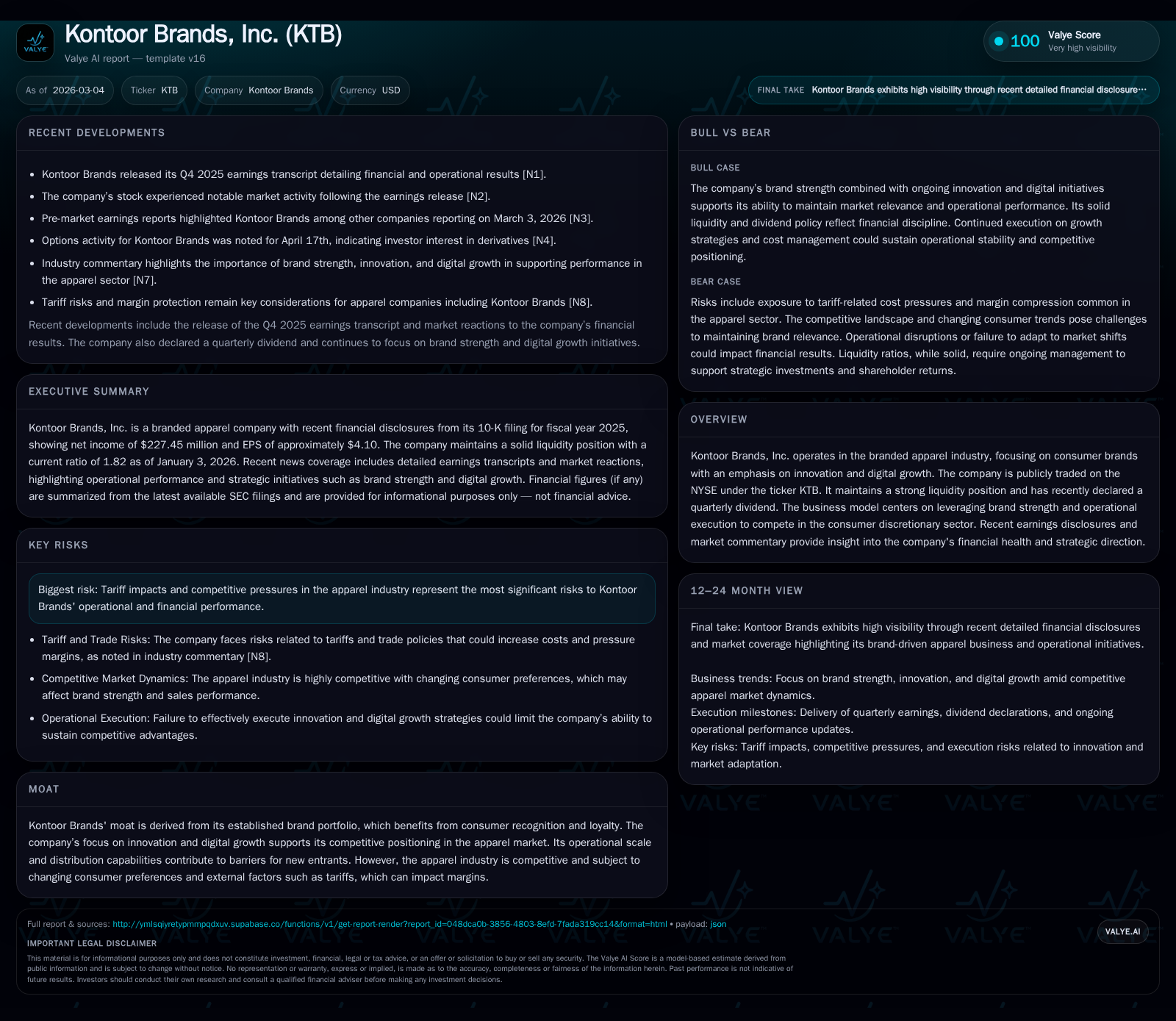
Kontoor Brands, Inc. has demonstrated resilience through a historically strong brand portfolio that has fueled substantial revenue growth. However, operating income and net income faced recent headwinds due to margin compression linked to tariffs and competitive pricing pressures. The company’s strategic investments in digital innovation aim to support omnichannel growth but face execution risks within a highly competitive apparel landscape. Solid capital allocation practices, including consistent dividend payments and measured share repurchases, reflect disciplined cash flow management supported by a robust balance sheet and liquidity profile. Key future milestones revolve around margin recovery efforts, tariff impact mitigation, and enhanced digital commerce penetration.
Brand Portfolio Backbone and Historical Financial Momentum
Kontoor Brands' foundation rests upon an established portfolio of renowned consumer apparel brands that provide significant competitive advantages through brand recognition and customer loyalty. Over the period from FY2019 to FY2025, the company registered remarkable revenue growth, scaling from approximately $653 million in FY2019 to over $2.1 billion by FY2025 [F1]. This represents an exceptional compound trajectory; notably, a YoY revenue increase of 221.5% comparing FY2020 with FY2019.
Operating income has experienced relative stability but did see a slight decline in FY2025 to $336.8 million from $342.3 million in FY2024 (-1.6% YoY), indicating emerging margin pressures despite top-line gains [F1]. Meanwhile, net income also contracted by 7.5% YoY to $227.5 million in FY2025 [F1], reflecting some cost headwinds offsetting operational scale benefits.
These trends suggest that while Kontoor’s brand equity fuels strong sales momentum, achieving commensurate profitability is challenged by sector-specific factors including pricing dynamics and external cost variables.
Historical performance (annual)
| FY | Net ($mm) | CFO ($mm) | OpInc ($mm) | Capex ($mm) | Net YoY |
|---|---|---|---|---|---|
| 2025 | 227 | 456 | 337 | 21 | -7.5% |
| 2024 | 246 | 368 | 342 | 19 | +6.4% |
| 2023 | 231 | 357 | 319 | 27 | -5.9% |
| 2022 | 245 | 84 | 357 | 18 |
Source: SEC companyfacts cache [F1].
Capital returns and efficiency (annual)
| FY | Buybacks ($mm) | FCF ($mm) | ROE% |
|---|---|---|---|
| 2025 | 25 | 435 | 40.3 |
| 2024 | 86 | 349 | 61.4 |
| 2023 | 30 | 329 | 62.1 |
| 2022 | 62 | 65 | 97.9 |
Source: SEC companyfacts cache [F1].
Table shows key annual financial metrics from FY2019 through the latest available FY2025 data [F1].
Quarterly Earnings Insights: Q4 FY2025 Review
The company's Q4 fiscal 2025 earnings call transcript reveals management’s acknowledgement of operational challenges that weighed on margins despite resilient top-line results [N1][S3]. Commentary emphasized ongoing supply chain disruptions contributing to elevated freight costs and raw material expenses—partly driven by prevailing import tariffs.
Management highlighted progress on digital initiatives designed to strengthen omnichannel distribution capabilities and direct-to-consumer engagements—identified as pivotal for capturing evolving shopping behaviors underpinned by online growth trends [N1]. There was measured optimism about leveraging data analytics for consumer insights enhancing SKU rationalization decisions while balancing assortment complexity.
Potential risks flagged include persistent tariff headwinds along with intensity from both legacy branded peers and emerging fast-fashion competitors exerting pricing pressure [N1][S4][S5]. Forward-looking statements stressed cautious execution on margin recovery plans contingent upon normalization of logistics costs and tariff mitigation outcomes.
Drivers Behind Recent Revenue Stability Amid Operating Income Pressures
The revenue stability observed juxtaposes increasing pressures on operating income margins shaped by multiple cost factors peculiar to the branded apparel space [F1][S4][S5]. Import tariffs imposed on certain categories have translated into gross margin erosion requiring strategic price adjustments or absorption of costs impacting profitability metrics.
Freight cost inflation remains a recurring theme given global supply chain bottlenecks affecting inventory flow timing [S4]. In response, Kontoor has embarked on SKU rationalization—streamlining product lines to optimize working capital yet maintaining breadth essential for market competitiveness.
Competitive pricing dynamics within the sector have constrained pass-through ability on heightened input costs implying operational leverage gains are nuanced against margin dilution risks [S5]. Thus, controlling indirect expenses while adapting product assortments continues to be a balancing act integral to sustaining earnings quality.
Digital Innovation as a Catalyst for Growth Prospects
Kontoor's strategic focus on enhancing digital infrastructure underpins an ambition to augment omnichannel presence beyond traditional wholesale partnerships [N1][S6]. Recent filings indicate incremental increases in R&D and technology-related capital expenditures supporting e-commerce platform enhancements and backend supply chain digitization.
Improved e-commerce penetration provides not only a volume lever but also richer first-party consumer data enabling targeted marketing activations and personalized engagement—critical differentiators in an increasingly crowded retail environment.
This push towards leveraging data analytics aligns with broader industry patterns wherein direct-to-consumer channels offer higher gross margins albeit requiring upfront investment commitments [S7]. Monitoring ongoing capex versus resultant cash flow impacts will offer insight into the efficacy of innovation spending over coming quarters.
Market Challenges: Tariffs, Competitive Intensity, and Consumer Trends
Externally sourced risks prominently include tariff uncertainties affecting cost base predictability as outlined extensively in the risk factors sections [S4][S5]. These duties complicate manufacturing sourcing strategies compelling possible reallocation of production footprint or price recalibration efforts.
Competitive intensity remains pronounced with numerous brands vying within similar price tiers fostering category commoditization pressures that weigh on pricing power [N3]. Shifting consumer preferences further necessitate agile SKU management—balancing trend responsiveness against supply chain complexity limitations.
Supply chain bottlenecks exacerbate inventory risk management issues resulting in occasional stockouts or excesses impacting service levels and markdown expenses [S4]. Collectively these elements form a challenging operating matrix demanding proactive mitigation tactics anchored in operational excellence.
Evaluating Capital Allocation: Dividends, Buybacks, and Cash Flow Generation
Capital deployment reflects discipline towards rewarding shareholders alongside maintaining financial flexibility [F1][S8][S9][S11]. The company consistently declared quarterly dividends at $0.53 per share throughout late 2025 into early 2026 [S8][S9], reinforcing its commitment to steady cash returns.
Share repurchases have been more modest recently with $25 million expended during FY2025 compared with notably higher levels in prior years—indicating caution aligned with preserving liquidity amid market uncertainties [F1].
Operating cash flow reported robust growth rising by approximately 23.8% YoY in FY2025 reaching $455.8 million while capital expenditures were increased moderately (+11.7%) consistent with technology investments supporting strategic objectives [F1]. This translated into an estimated free cash flow near $435 million underscoring efficient cash conversion capability.
The approximate return on equity of around 40% measured against latest equity figures exhibits solid capital stewardship characteristic of mature branded apparel firms deploying excess capital prudently [F1].
Liquidity and Balance Sheet Robustness in Context
Kontoor’s balance sheet portrays a healthy liquidity position measured through its current ratio near 1.82 based on current assets totaling approximately $1.08 billion versus current liabilities around $594 million as of fiscal year-end Jan-2026 [F1][S14].
Cash and equivalents exceeding $108 million provide additional short-term buffer facilitating working capital management flexibility critical during periods of supply chain flux or market volatility.
Such financial conservatism affords the company room to maneuver strategically either via incremental investments or opportunistic share repurchases without existential impact on balance sheet integrity.
Strategic Milestones to Monitor in FY2026 and Beyond
Looking forward, several key developments merit close observation for indications of operational trajectory shifts or enhanced value creation potential [N1][S2][N3]:
- Margin Recovery Efforts: Progress towards offsetting tariff-related cost inflation through pricing strategy adjustments or sourcing reorganizations will be central.
- Digital Commerce Penetration: Measuring the acceleration of e-commerce sales contribution will reveal effectiveness of digital investments driving direct-to-consumer engagement.
- SKU Innovation Pipeline: Introduction cadence of new products aligned with consumer trends may influence growth sustainability amid competitive pressure.
- Geographic Expansion Initiatives: Potential moves into emerging markets could diversify revenue streams but come with execution complexities noted in filings.
Absent explicit quantitative guidance for FY2026 in the sources cited suggests monitoring these qualitative milestones offers meaningful insight into evolving strategic execution risks/opportunities going forward.
Disclaimer: This analysis is based solely on disclosed public filings and recent news transcripts as cited; no speculative or non-public information has been used or implied herein.
Disclaimer: This is research-only, informational analysis and not investment advice. It may include AI-generated interpretation and general industry context. Always verify important details using primary sources.

Comments