
Constellation Energy's Growth Momentum and Earnings Pressure Following Calpine Acquisition
Constellation's January 2026 acquisition of Calpine dramatically expands scale while tightening near-term profitability and capital deployment.
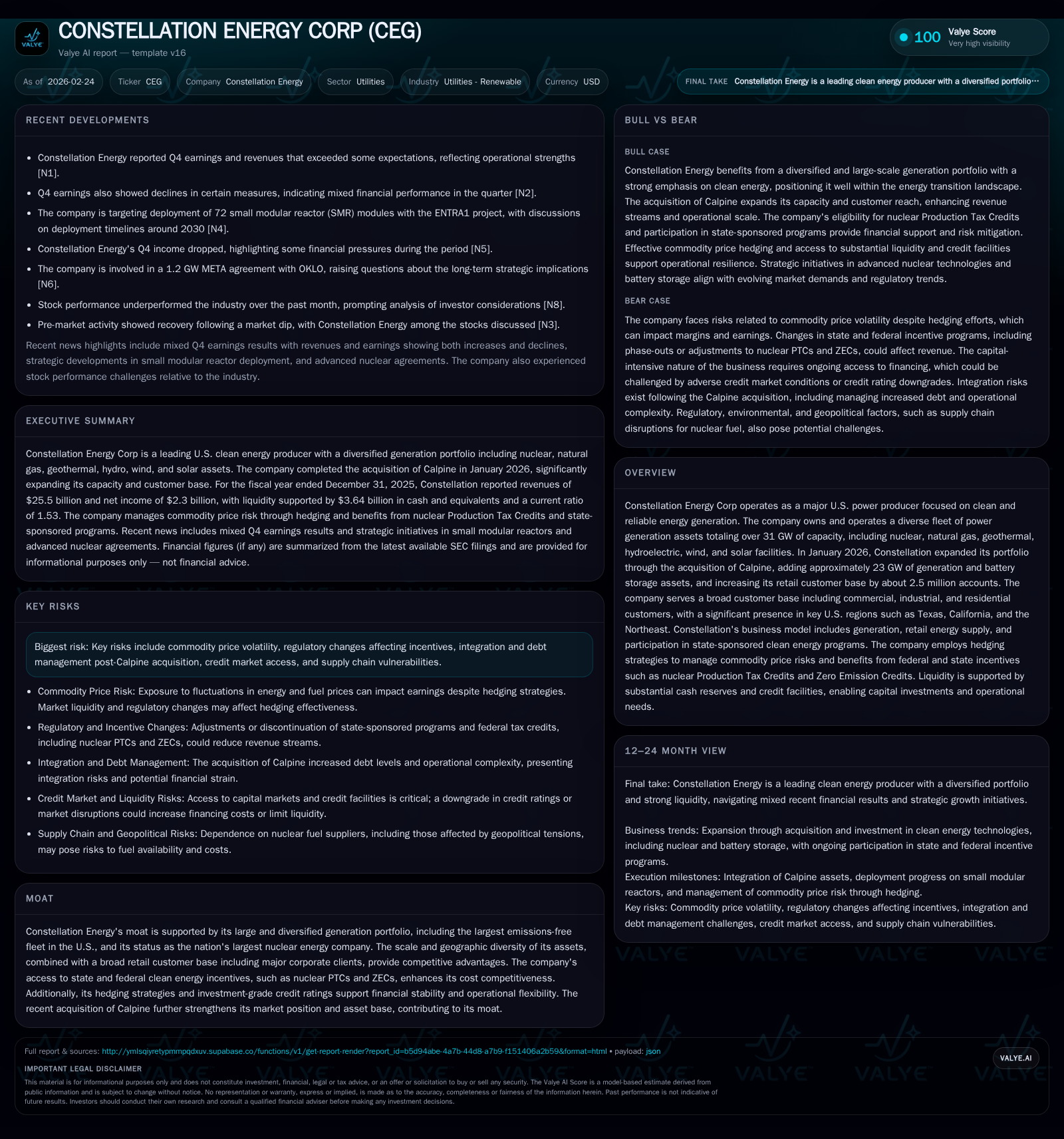
In early 2026, Constellation Energy completed a transformative acquisition of Calpine, adding roughly 23 GW of generation capacity and around 2.5 million retail customers, cementing its position as the largest clean energy producer in the U.S. This scale expansion fueled an 8.3% revenue increase in 2025 but coincided with significant earnings pressure, as operating income declined nearly 30% and net income dropped over 38%, driven by decreased nuclear production tax credit (PTC) revenues and elevated state program refunds. Despite these margin headwinds, operating cash flow rebounded substantially, supporting steady capital expenditures and dividend growth, but share repurchases moderated amidst post-merger integration and increased debt levels. Looking forward, key growth drivers include sustained access to nuclear PTCs through 2032 and synergy realization from Calpine integration, balanced by risks related to commodity price volatility, regulatory uncertainties, and credit market dynamics.
Transformative Growth: The Calpine Acquisition Impact
In January 2026, Constellation Energy executed a landmark transaction acquiring all outstanding equity interests in Calpine, instantly scaling its portfolio by approximately 23 gigawatts across 72 generation and battery storage assets [N1][S1]. This deal lifted Constellation’s total owned generating capacity beyond 55 GW — a commanding presence that powers an estimated 27 million U.S. homes and accounts for about 10% of national clean energy supply.
Calpine's fleet complements Constellation’s existing asset mix with a strong emphasis on natural gas-fired generation—the nation's largest—and geothermal power, particularly concentrated in Texas, California, and the Northeast regions [S13][S14]. These geographies coincide with some of the fastest-growing demand corridors for electricity in the U.S., underpinning the strategic value of this footprint expansion.
Beyond generation scale, the acquisition added roughly 2.5 million retail customers spanning commercial, industrial, and residential segments [N1]. This enhances Constellation's competitive retail presence nationwide and diversifies revenue streams beyond asset-based earnings.
Integration complexity is non-trivial given overlapping operations, differing corporate cultures, and materially increased financial obligations due to approximately $12.6 billion of assumed debt consisting of senior unsecured notes, secured notes, term loans, and project financing arrangements [S4][S7]. Successfully navigating this phase will be crucial to realizing expected operational synergies and financial benefits.
Reviewing Historical Performance: Revenue Expansion vs Profit Compression
The broader company — excluding full consolidation of Calpine until post-close — reported solid top-line momentum in FY2025 with revenues rising approximately 8.3% year-over-year to $25.53 billion for the twelve months ending December 31st [F1]. This was primarily fueled by higher contracted energy prices across core regional markets plus incremental contributions from acquisitions other than Calpine during the year [N1].
Yet beneath this revenue strength lurked significant pressure on profitability measures: operating income declined sharply by nearly 29%, falling from approximately $4.35 billion in FY24 to just over $3.08 billion in FY25 [F1]. Net income showed an even steeper drop of about 38%, settling at $2.32 billion compared to $3.75 billion previously.
Cash flows from operations demonstrated a remarkable turnaround from losses recorded in prior years (-$2.46B in FY24) posting a sizeable positive swing to +$4.24B in FY25—a recovery more than doubling prior positive inflows from earlier years [F1]. This divergence between accounting earnings erosion and cash flow resilience reflects certain non-cash items affecting reported profits as well as improved working capital management.
Historical performance (annual)
| FY | Rev ($bn) | Net ($bn) | CFO ($bn) | OpInc ($bn) | Rev YoY | Net YoY |
|---|---|---|---|---|---|---|
| 2025 | 25.5 | 2.3 | 4.2 | 3.1 | +8.3% | -38.1% |
| 2024 | 23.6 | 3.7 | -2.5 | 4.4 | -5.4% | +131.0% |
| 2023 | 24.9 | 1.6 | -5.3 | 1.6 | +2.0% | +1114.4% |
| 2022 | 24.4 | -0.2 | -2.4 | 0.5 |
Note: Omitted columns lack sufficient annual XBRL coverage in the provided tags (need ≥2 annual points): Capex. Source: SEC companyfacts cache [F1].
Capital returns and efficiency (annual)
| FY | Div ($mm) | Buybacks ($mm) | FCF ($bn) |
|---|---|---|---|
| 2025 | 486 | 400 | 1.3 |
| 2024 | 444 | 999 | -5.0 |
| 2023 | 366 | 992 | -7.7 |
| 2022 | 185 | -4.0 |
Source: SEC companyfacts cache [F1].
Note: Data excludes standalone inclusion of Calpine contribution due after acquisition closing Jan '26
Drivers Behind Earnings Decline
A pivotal driver behind earnings compression was the pronounced falloff in nuclear production tax credit (PTC) revenues which plunged roughly $1.76 billion or 85%, from around $2.08 billion in FY24 to just $320 million recognized in FY25 [S15][F1]. This decline corresponds with phase-out clauses adjusting for inflation-driven gross receipts thresholds under federal nuclear tax credit provisions active through at least 2032 but tapering annually.
Compounding this headwind were net revenues from state-sponsored programs—such as Zero Emission Credits (ZECs) and Capacity Market Contracts (CMCs)—which swung negative by about $125 million due to contractual provisions requiring pass-through or refund of credits equivalent to amount of PTC benefits received [S15]. The recent termination of New Jersey’s ZEC program further curtailed upside potential beginning mid-2025.
Commodity price volatility also played a critical role: elevated natural gas prices pressured purchased power costs across key jurisdictions including ERCOT (+52%) and Midwest (+31%), diluting margins despite hedging strategies designed to mitigate exposure [S16][S13]. While hedges generated realized gains supporting operational earnings stability in some regions — notably Mid-Atlantic — their realized economic gains fell relative to prior periods.
Merger-related costs linked to Calpine integration contributed incremental expenses absent from prior-year comparables notwithstanding stable core generation volumes generally maintaining performance consistency.
Future Growth Enablers and Regulatory Headwinds
Looking ahead, Constellation retains access to valuable federal incentives underpinning its nuclear fleet economics — chiefly the extended PTC through calendar year 2032 with inflation adjustments maintaining roughly up to $15 per MWh credits subject to phase-out triggers based on annual gross receipts thresholds [S15]. This creates a durable earnings buffer for what remains the company’s largest emissions-free production component.
State-level clean energy programs remain material: Illinois’ CMC pricing mechanism provides monthly compensation indexed dynamically against market prices with payouts varying accordingly — averaging about $33 per MWh recently but exhibiting swings influencing revenue recognition patterns [S15]. However, expiration or revision of programs such as New Jersey’s ZECs adds uncertainty requiring ongoing monitoring.
Additionally, Calpine’s natural gas-fired capacity offers indispensable dispatchable resources critical for reliability amid increasing intermittent renewables penetration nationally — preserving earnings diversity though exposed cyclically to fuel price fluctuations and environmental regulation shifts.
The growing battery storage footprint complements this portfolio diversification enhancing grid flexibility solutions alongside emissions-reduction mandates.
Financial Health, Capital Structure, and Liquidity Position
Constellation entered calendar year-end with a robust balance sheet carrying approximately $14.5 billion in stockholders' equity supporting an estimated return on equity near 16%, based on latest net income figures scaled by equity base [F1]. Liquidity remains ample with cash & equivalents of about $3.64 billion complemented by unused revolving credit lines totaling upwards of $7.3 billion providing short-term funding buffers as needed [S4][S17].
The acquisition required assumption of roughly $12.6 billion in new debt facilities—long-term bonds, secured notes tied to assets acquired from Calpine as well as committed revolvers—with scheduled maturities staggered predominantly beyond mid-decade preserving manageable refinancing windows [S4][S11]. Management has taken steps including private exchange offers replacing some Calpine notes while retiring selected loans promptly after closing improving debt maturity profiles.
Investment-grade credit ratings remain affirmed (S&P BBB+, Moody’s Baa1), underscoring stable capital market access crucial for cost-effective commercial paper issuance and long-dated borrowings financing capital-intensive operations.
Capital Expenditure Trends, Dividends, and Share Repurchases
Capital expenditures increased roughly 15% year-over-year reaching approximately $2.95 billion during FY25 led by investments targeting renewable generation expansions including solar arrays plus upgrades/refurbishments critical for sustainable operations post-Calpine acquisition which bolstered asset scale materially [F1][S16].
Dividend payments tracked steady upward trajectories growing close to 10% year over year amounting to about $486 million cash payout signaling management commitment towards returning yield while balancing growth capex needs [F1][S6]. Conversely share repurchases were notably scaled back dropping from near $999 million spent a year ago down to roughly $400 million reflecting prudent capital allocation amidst elevated leverage entering post-merger phase necessitating retention of cash for integration support and debt servicing obligations.
Critical Risks: Commodities, Regulation, and Post-Merger Integration
Key exposure remains commodity price volatility on fuel inputs—natural gas prices dominate costs posing margin risk without effective economic hedging coverage while wholesale electricity prices fluctuate regionally influenced by weather events or demand cycles impacting profitability variably.
Regulatory landscapes evolve rapidly; changes such as cessation or modification of Zero Emission Credit programs—in particular suspension such as New Jersey’s ZEC program ending May 2025—may reduce subsidy flows tied directly or indirectly via refund provisions linked with federal credits necessitating close attention given substantial revenue impact potential [S12][S15].
Post-merger operational integration presents execution risk relating both to combining workforce (~2,500 new employees added via Calpine), consolidating IT systems/platforms used for plant operations/retail customer management, harmonizing safety/compliance standards plus achieving promised cost synergies within projected timelines.
Supply chain continuity uncertainties endure especially given reliance on specialized equipment/materials for nuclear/upgrades along with expanding battery storage deployments requiring rare minerals/components globally constrained.
Credit market appetite remains contingent on rating stability; any downgrade below investment grade could trigger costly collateral requirements estimated near approximately $2.4 billion adversely impacting liquidity cushions potentially forcing increased financing costs or asset monetization urgency.
Key Metrics And Monitoring Points Ahead
Investors should watch:
- Progress against integration milestones announced with the Calpine deal including synergy realization timelines;
- Updates regarding nuclear PTC valuation changes or regulatory modifications impacting ZEC/CMC states like Illinois;
- Debt refinancing activities leveraging investment grade status ensuring maturities remain manageable;
- Trends in operating margin recovery indicated by EBITDA per megawatt generated;
- Stability and consistency of free cash flow which underpins dividends/capital allocation decisions post-acquisition phase.
This analysis is prepared solely for informational purposes without offering investment advice or recommendations regarding securities mentioned herein.
Disclaimer: This is research-only, informational analysis and not investment advice. It may include AI-generated interpretation and general industry context. Always verify important details using primary sources.

Comments