
Rush Enterprises Faces Growth Constraints from Cyclicality and Manufacturer Dependence Despite Aftermarket Strength
Strong aftermarket services support profitability, but economic cycles and manufacturer reliance pose growth limitations.
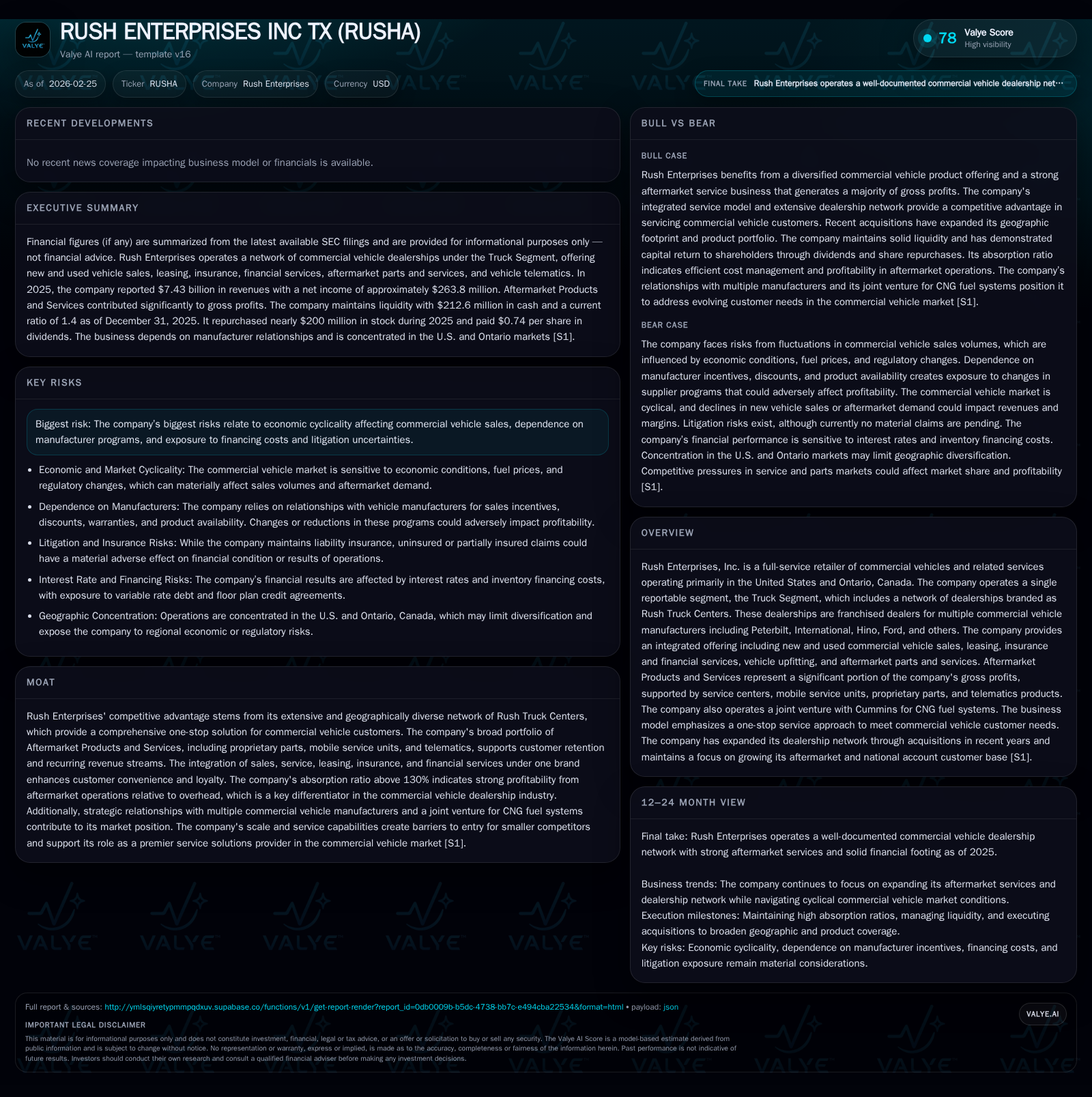
Rush Enterprises, a leading commercial vehicle retailer operating primarily in the U.S. and Ontario, Canada, saw a revenue decline in 2025 driven by weaker new and used vehicle sales amid cyclical headwinds. The company’s integrated business model, featuring a diverse dealership network and strong aftermarket parts and services, supports stable recurring gross profits. Historically, aftermarket operations deliver robust absorption ratios over 130%, compensating for margin pressure on vehicle sales. Rush’s near-term prospects hinge on economic recovery impacting truck demand and maintaining key manufacturer partnerships, notably with Peterbilt (PACCAR) and International Motors. Liquidity remains solid with extensive credit facilities supporting fleet investments. A disciplined capital strategy balances dividends and sizable share repurchases while navigating potential financing costs and litigation risks.
Company Overview
Rush Enterprises, Inc. (RUSHA) operates as an integrated commercial vehicle retailer with a dominant presence primarily across the United States and Ontario, Canada. Its core Truck Segment centers on a wide network of Rush Truck Centers that function as dealerships for multiple commercial vehicle manufacturers including Peterbilt (a PACCAR division), International Motors, Hino, Ford, among others [S1][S22]. The company’s offerings span retail sales of new and used commercial vehicles, leasing through Idealease and PacLease franchises, parts sales, vehicle servicing—including mobile units—collision repair centers, telematics products, insurance services, and financial products.
This comprehensive approach provides one-stop solutions supporting both upfront commercial vehicle needs as well as ongoing maintenance through high-margin aftermarket operations.
Historical Financial Performance
Rush’s financial trajectory over the past four years exhibits a pattern reflecting commercial vehicle industry cyclicality coupled with strategic growth in higher-margin services:
Historical performance (annual)
| FY | Rev ($bn) | Net ($mm) | CFO ($mm) | OpInc ($mm) | Rev YoY | Net YoY |
|---|---|---|---|---|---|---|
| 2025 | 7.4 | 264 | 862 | 394 | -4.7% | -13.3% |
| 2024 | 7.8 | 304 | 620 | 468 | -1.5% | -12.4% |
| 2023 | 7.9 | 347 | 296 | 512 | +11.6% | -11.3% |
| 2022 | 7.1 | 391 | 294 | 506 |
Note: Omitted columns lack sufficient annual XBRL coverage in the provided tags (need ≥2 annual points): Capex. Source: SEC companyfacts cache [F1].
Capital returns and efficiency (annual)
| FY | Div ($mm) | Buybacks ($mm) | FCF ($mm) |
|---|---|---|---|
| 2025 | 58 | 195 | 462 |
| 2024 | 56 | 16 | 187 |
| 2023 | 51 | 212 | -73 |
| 2022 | 45 | 94 | 51 |
Source: SEC companyfacts cache [F1].
Financials sourced from company filings [F1].
Revenue peaked in FY23 but slipped notably during FY24-25 amid weakening demand for new heavy-duty trucks influenced by fuel price pressures, freight recession impacts, and economic headwinds [S17]. Operating income fell proportionally more due to margin compression especially visible in new truck sales where gross margins declined to approximately 8.6% in FY25 from near double digits previously [S17].
Net income also followed this downward trend but operating cash flow significantly expanded (+39%) last year driven by tighter working capital management despite reduced capex.
Aftermarket Operations: Profit Engine Amid Challenges
A defining facet of Rush's moat lies within its Aftermarket Products and Services segment which accounted for roughly two-thirds of total gross profits in FY25 (~$930 million) despite only representing a portion of overall revenues [S11]. This segment includes parts distribution—supported by proprietary lines—service centers including mobile service units that provide onsite repairs to fleets in operation, collision repair facilities, vehicle upfitting solutions including specialized bodies assembly, telematics diagnostics, along with insurance offerings.
Key profitability drivers include an absorption ratio over 130%, indicating that after covering dealership overhead costs most profit accrues from aftermarket activities rather than unit sales—a critical advantage given the cyclical variability of truck sales volumes.
Gross margins on parts hover between high twenties to low thirties percentage range while service operations enjoy far superior margins (~66-68%), resulting in blended margins around ~37%. Margins improved slightly year-over-year fueled by part pricing adjustments and manufacturer rebates [S11].
Manufacturer Dependence: A Double-Edged Sword
The largest single revenue contributor remains Peterbilt trucks (PACCAR), representing approximately half of all new vehicle sales revenue for FY25 though down slightly from prior years [S23]. Similar significance is attached to International Motors vehicles (including International trucks and IC buses).
Rush's dealership agreements are tightly bound to these manufacturers who retain control over supply terms and brand goodwill—critical to the businesses given limited direct control on product availability or pricing post-manufacture [S1]. These agreements also restrict changes such as ownership controlling stakes impacting dealership continuity.
The company's ability to maintain its dominant franchise rights hinges on:
- Continued delivery of competitively priced technologically current emission-compliant trucks;
- Enduring brand reputation maintained by manufacturers;
- Preservation of funding programs including specialized inventory financing arrangements.
Disruption or loss of these relationships could materially impair revenues and profitability given their outsized contribution.
Leasing Operations and Capital Expenditure Outlook
Rush maintains significant leased fleet assets under Idealease (corporate-owned lease fleet) and PacLease franchises (customer-leased). Leasing revenues increased modestly (+4%) in FY25 due to portfolio growth offset partially by lower rental utilization rates [S11].
The firm plans capital expenditures between approximately $335-$392 million for ongoing fleet replenishment and facility improvements throughout FY26: specifically $300-$350 million directed at commercial vehicle lease/rental fleet acquisitions reflecting customer demand trends plus around $37-$42 million for recurring investments in tools, computers, shop equipment etc. [S5].
Liquidity and Capital Structure
At December 31, 2025 Rush reported robust liquidity metrics:
- Cash & cash equivalents: $213 million;
- Current assets: $2.09 billion versus current liabilities of $1.49 billion yielding a comfortable current ratio of about 1.4x;
- Stockholders’ equity grew modestly to just over $2.2 billion indicating solid capitalization levels balanced against debt obligations [F1].
Credit facilities include:
- PLC Agreement: revolving credit up to $500 million primarily financing lease fleet acquisitions;
- BMO Floor Plan Credit Agreement with a commitment of around $675 million supporting inventory purchases;
- WF Credit Agreement extending revolving loans up to $175 million targeting Idealease fleet investments;
- Additional revolving credit lines financing Canadian inventory under RTC Canada agreements totaling over CAD$290 million across multiple credit instruments [S4][S9][S10][S21].
Interest expense decreased significantly (-35%) in FY25 aided by falling variable interest rates combined with lower inventory holdings mitigating financing costs [S24].
Capital Allocation Discipline Including Returns & Buybacks
Shareholder returns remain an explicit priority with dividends paid totaling approximately $58 million during FY25 corresponding roughly to quarterly distributions amounting to $0.74 per share annually [F1][S6]. The Board declared continued quarterly dividends though future payouts remain subject to business performance considerations.
Notably the company executed aggressive share repurchase programs repurchasing approximately $195 million worth of common stock during FY25 alone—an order-of-magnitude increase relative to FY24 reflecting confidence amidst cyclical softness but also leveraging liquidity strength [F1][S6]. The current repurchase authorization permits up to an additional $150 million through December year-end [S12].
Return on equity approximates about 12% based on FY25 net income relative to shareholders' equity indicating moderate profitability levels relative to equity base [F1]. Free cash flow (operating cash flow minus capex) was robust at approximately $462 million in FY25 demonstrating strong cash generation capacity after reinvestment needs [F1].
Risks Summary
Primary risks outlined include:
- Cyclical dependency on economic factors influencing Class 8 truck sales volumes including freight market dynamics, fuel costs volatility and interest rate shifts;
- Heavy reliance on key manufacturers like PACCAR (Peterbilt) and International Motors for truck supply financing programs driven through floor plan credit agreements limiting control over supply chain disruptions or strategic decisions affecting dealership arrangements;
- Exposure to fluctuating interest rates on revolving debt facilities impacting net interest expenses;
- Potential material adverse effects arising from litigation inherent across operations despite insurance coverage policies maintained including captive insurer structures;
- Contractual covenant requirements within credit instruments enforcing leverage ratios creating refinancing dependencies or operational constraints under stress scenarios [S1][S14].[N1]
Future Growth Prospects & What To Watch
While no explicit forward guidance was provided regarding revenue or earnings projections the following are pivotal growth determinants:
- Economic recovery fueling Class 8 new truck orders benefiting unit volume growth;
- Continued expansion of high-margin aftermarket services increasing gross profit mix further enhancing operating leverage;
- Sustaining robust fleet leasing/rental demand aiding recurring yield streams coupled with disciplined fleet modernization strategies balancing capex commitments;
- Potential expansions via acquisition activity demonstrated historically yet requiring strategic fit evaluation given capital intensity [S13];
- Maintenance or enhancement of manufacturer relations especially ensuring uninterrupted supply chains for Peterbilt-heavy inventory mix.
Monitoring key metrics like gross margin trends across new vs aftermarket segments as well as interest cost trajectories will illuminate how operational efficiencies are preserved amid cyclicality pressures. Further attention should be placed on any announcements relating to dealership agreement renewals or terminations affecting composure length stability alongside changes in financed fleet portfolio scale.[N1]
Conclusion
Rush Enterprises exemplifies an integrated commercial vehicle retailer leveraging diversification across new/used trucks sales allied with highly profitable aftermarket operations that underpin steady cash generation even when unit volumes falter amid economic cycles. However, its structural dependence upon major manufacturers chiefly PACCAR’s Peterbilt division introduces potential vulnerabilities particularly if supply constraints emerge or dealership agreements face renegotiation under shifting ownership or market conditions. Liquidity remains solid supported by substantial revolving credit capacity facilitating required working capital needs for inventory acquisition plus fleet modernization spending. Capital allocation balances shareholder returns via dividend continuity alongside meaningful share repurchases signaling board confidence tempered by cyclical caution. Overall future growth is primarily tethered to macroeconomic factors governing transportation demand complemented by management’s success executing on expanding proprietary service offerings fostering customer retention beyond mere transactional sales.
Disclaimer: This analysis is provided solely for informational purposes based on publicly available data as of February 2026 without any investment advice or recommendations.
Disclaimer: This is research-only, informational analysis and not investment advice. It may include AI-generated interpretation and general industry context. Always verify important details using primary sources.

Comments