
UFP Industries' Declining Profitability Undermines Growth Despite Diversified Segment Structure
A comprehensive review of UFP Industries Inc.'s 2025 performance highlights deteriorating earnings amid solid revenue and outlines growth drivers, milestones, and risks.
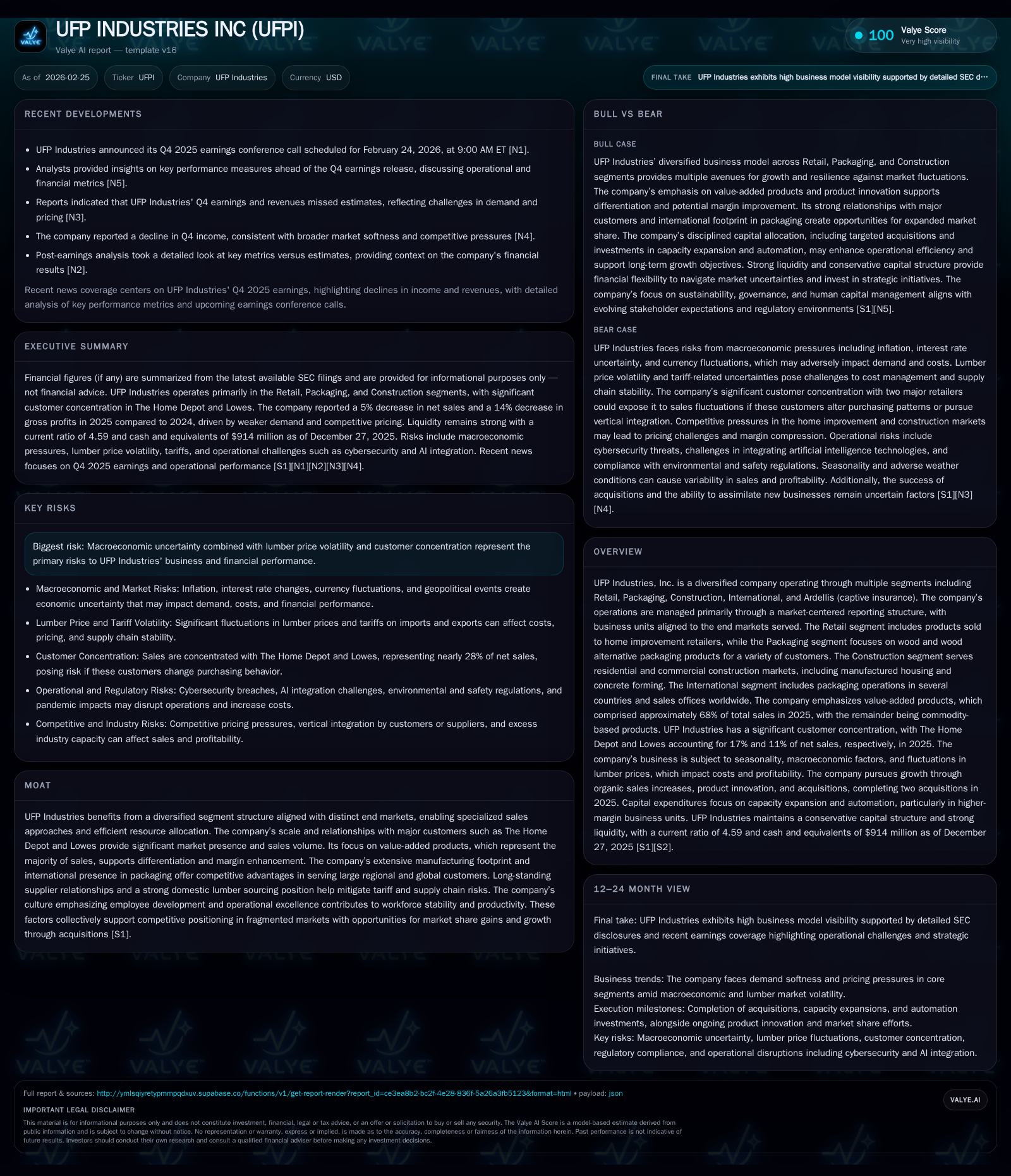
UFP Industries posted a 5% decline in net sales and a steeper 26% drop in operating income during fiscal 2025, driven by weaker demand and pricing pressures across its Retail, Packaging, and Construction segments. While the company's diversified market-oriented segment structure supports resilience through scale and customer relationships with key accounts like The Home Depot and Lowes, margin compression caused by input cost volatility and competitive pricing remains a challenge. Looking ahead, UFP aims to grow via expanded capacity for value-added products, strategic acquisitions, geographic expansion particularly in packaging, and operational excellence initiatives. Capital allocation focuses on disciplined investments with robust cash flow generation supporting dividends and share repurchases despite declining return on equity.
Company Overview
UFP Industries Inc. is a multi-segment manufacturer specializing in wood and wood-alternative products primarily serving home improvement retail, packaging, residential/commercial construction sectors, with international operations mainly in packaging. The firm’s market-centered segment approach tailors resources efficiently across Retail Solutions, Packaging, Construction, International operations, plus a captive insurance business (Ardellis), facilitating rapid product introductions targeted at distinct end markets [S4][S10]. Partnerships with leading retailers such as The Home Depot (17% net sales) and Lowes (11%) underpin substantial volume leverage [S4].
The company differentiates itself by focusing on value-added offerings—accounting for roughly 68% of sales in 2025—which provide resiliency against commoditization pressures while enabling margin preservation [S15].
Historical Performance & Growth Drivers
Financial Results Summary
Historical performance (annual)
| FY | Net ($mm) | CFO ($mm) | OpInc ($mm) | Capex ($mm) | Net YoY |
|---|---|---|---|---|---|
| 2025 | 40 | 546 | 364 | 269 | -41.3% |
| 2024 | 68 | 643 | 492 | 232 | -34.2% |
| 2023 | 103 | 960 | 647 | 180 | -22.0% |
| 2022 | 133 | 832 | 950 | 174 |
Note: Omitted columns lack sufficient annual XBRL coverage in the provided tags (need ≥2 annual points): Rev. Source: SEC companyfacts cache [F1].
Capital returns and efficiency (annual)
| FY | Div ($mm) | Buybacks ($mm) | FCF ($mm) |
|---|---|---|---|
| 2025 | 433 | 276 | |
| 2024 | 141 | 410 | |
| 2023 | 68 | 82 | 780 |
| 2022 | 59 | 96 | 657 |
Source: SEC companyfacts cache [F1].
Note: Revenue data post-2018 is not available from provided tags; revenue trends are inferred from narrative disclosures.
The company’s net sales declined approximately 5% in fiscal year 2025 due to lower unit volumes—particularly within the Retail segment—and competitive pricing pressures [S9][S10]. Operating income contracted more sharply (-26%) as a result of gross margin compression stemming from increased lumber costs and softer demand [S9][S10]. Despite these challenges, operating cash flow remained robust at $546 million reflecting effective working capital management [S12][F1]. Capital expenditures increased by about +16%, directed primarily towards expanding manufacturing capacity for Deckorators’ proprietary Surestone™ mineral-based composite decking products—a key growth initiative targeting product differentiation [S15][S25]. Share repurchase activity accelerated significantly to $433 million in FY2025 as part of disciplined capital return strategy [S7][F1].
Segment-Level Insights & Milestones
- Retail: Unit sales declined approximately -7%, driven by weaker consumer spending on housing repair/remodel projects amid higher interest rates and softening sentiment [S15]. The Deckorators business achieved a +20% increase in composite decking sales (wood-plastic composite up +5%, Surestone™ mineral-based composite up +36%), partially offsetting declines including a -23% reduction in railing sales due to market share losses with one big box customer [S15]. A notable milestone includes the ongoing closure of Bonner, Montana plants with production transitioning to other facilities.
- Packaging: Growth benefited from tuck-in acquisitions such as RWP West LLC and National Supply LLC that expand UFP’s footprint internationally across Mexico, Canada, Spain, India, Australia [S14][S25]. The segment leverages its broad geographic presence to serve large regional customers aiming to reduce supplier complexity.
- Construction: Sales remained flat despite challenging market conditions; industry forecasts predict low single-digit growth or slight declines in housing starts through mid-2020s [S14]. Commercial and concrete forming units show modest growth potential.
Industry Context
Wood products manufacturers remain sensitive to cyclical housing activity with single-family starts having significant influence on demand patterns for repair/remodel segments served by UFP’s Retail business. Lumber price volatility continues due to trade duties on Canadian imports combined with capacity reductions domestically impacting input costs.
Future Outlook & Strategic Milestones
UFP Industries has articulated several strategic milestones that frame its outlook:
- Completion of Bonner plant closures with production shifted internally aims to improve operational efficiency.
- Realization of market share gains for Deckorators’ mineral-based composite decking products is expected mostly during calendar year 2026.
- Continued pursuit of targeted acquisitions aligned with strategic objectives within Packaging and Retail sectors bolsters geographic expansion plans.
- Operational excellence programs emphasizing workforce development support margin preservation amidst inflationary wage pressures [S1].
- Management anticipates soft demand continuation into early-mid calendar year but remains focused on long-term growth via innovation and market consolidation.
Risks include macroeconomic uncertainty impacting housing markets, lumber cost fluctuations influencing pricing power, concentration risk from major customers (Home Depot & Lowes combined ~28%), and weather-related seasonality affecting production cycles [S22][S1].
Capital Allocation & Financial Health
The company demonstrates disciplined capital allocation evidenced by:
- Capital expenditures totaling $269 million (+16% YoY), focused on automation upgrades and capacity expansions particularly for high-growth Deckorators lines [F1][S12][S7].
- Operating cash flow of $546 million (-15%), yielding free cash flow exceeding $276 million after capex investment supporting both growth investments and capital returns [F1][S12].
- Shareholder returns include dividends totaling $82 million (+6%) alongside aggressive share repurchases deploying $433 million during the fiscal year [F1][S7].
Despite sound liquidity—with a current ratio above ~4.5x—and conservative leverage management [F1][S6], profitability metrics have eroded with ROE declining sharply to approximately ~1.3%, reflecting compressed net income relative to equity base [F1].
Key Metrics To Monitor
Investors should track:
- Unit volume recovery particularly within Repair/Remodel correlated Retail segments.
- Market penetration progress for Deckorators composite decking products including Surestone™ technology.
- Lumber cost trends versus selling price adjustments impacting gross margins.
- Execution effectiveness of acquisition integration maintaining accretive EBITDA margins.
- Operational cost discipline amid inflationary pressures supporting operating leverage.
Summary
UFP Industries navigated a challenging fiscal year marked by contraction in revenues driven by softer end-market conditions across housing-related repair/remodel activities alongside steady packaging demand. Profitability saw sharper declines due to input cost increases outpacing pricing power placing pressure on margins. Nonetheless, prudent capital deployment enabled capacity expansions targeting differentiated product lines such as Deckorators composites while solid free cash flow generation supported shareholder returns including dividends and substantial stock buybacks.
The near-term outlook hinges on stabilization in the housing sector coupled with success growing innovative product penetration while managing inherent commodity price risks within the lumber-based manufacturing model.
This report reflects data available as of February 2026 based on SEC filings [F1][S#] and Nasdaq news coverage [N#], intended solely for informational purposes.
Disclaimer: This is research-only, informational analysis and not investment advice. It may include AI-generated interpretation and general industry context. Always verify important details using primary sources.

Comments