
Gulfport Energy's Return to Profitability Supported by Production Growth and Debt Refinancing
The company’s turnaround in 2025 reflects improved commodity markets and strategic capital management.
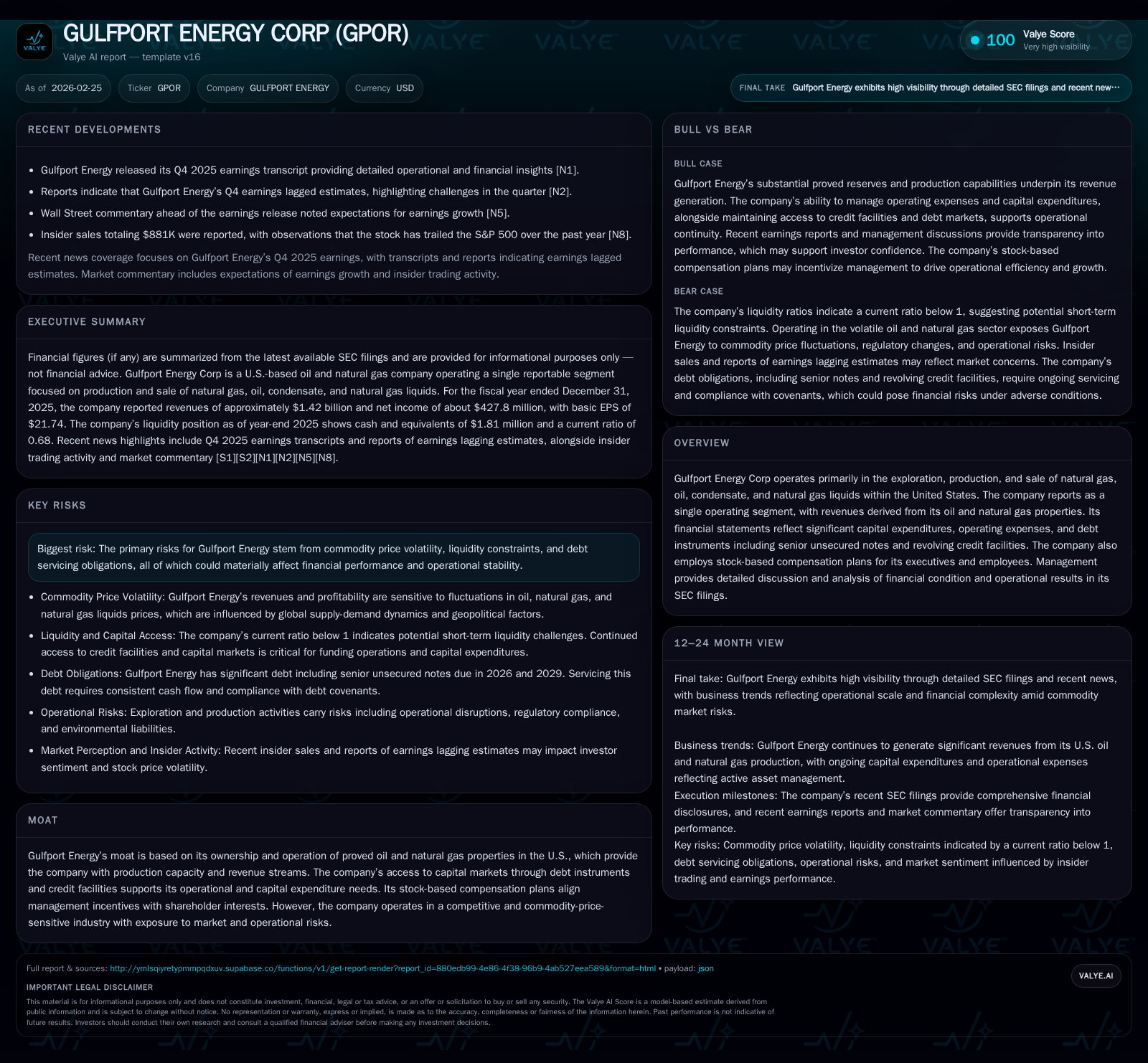
Gulfport Energy Corp reported strong financial performance in 2025, reversing significant losses in 2024 through a nearly 50% revenue increase to $1.42 billion and positive operating income of $600 million. Key drivers included higher oil and gas production and prudent cost management amid volatile commodity prices. The firm reduced debt burdens by redeeming its 2026 notes early and refinancing with longer-term 2029 senior notes, enhancing liquidity while maintaining a $1.0 billion revolving credit facility. Share repurchases continue as part of capital allocation strategy, signaling confidence despite sector headwinds.
Historical Financial Performance
Gulfport Energy Corp demonstrated marked volatility in its recent annual results, reflective of the broader energy sector swings affecting producers exposed to natural gas and oil prices. After an abrupt downturn in FY2024 with revenues falling to approximately $958 million from $1.79 billion in FY2023 — a drop of nearly 46% — the company rebounded sharply in FY2025, posting top-line sales of about $1.42 billion [F1]. This represented a recovery period coinciding with tighter global energy markets.
Operating income shifted dramatically from -$237 million loss in FY2024 to a robust $600 million profit by FY2025, an improvement of over 350% year-over-year [F1]. This swing was driven primarily by higher realized commodity prices coupled with improved operational efficiencies.
Net income followed suit: from a sizeable net loss of approximately $261 million in FY2024 to a net profit near $428 million in FY2025 [F1]. This translated into an approximate return on equity metric of 23%, given equity balances rising moderately to about $1.83 billion at year-end [F1].
Operating cash flows experienced solid growth as well — increasing by nearly one quarter year-over-year to over $803 million [F1]. Consistent cash flow generation facilitated ongoing capital expenditures averaging around $106 million annually, supporting production maintenance and incremental development [S26].
Historical performance (annual)
| FY | Rev ($mm) | Net ($mm) | CFO ($mm) | OpInc ($mm) | Rev YoY | Net YoY |
|---|---|---|---|---|---|---|
| 2025 | 1423 | 428 | 803 | 600 | +48.5% | +263.7% |
| 2024 | 958 | -261 | 650 | -237 | -46.5% | -117.8% |
| 2023 | 1792 | 1471 | 723 | 975 | +34.6% | +197.3% |
| 2022 | 1331 | 495 | 739 | 543 |
Source: SEC companyfacts cache [F1].
Note: Some line items are omitted where multi-year comparability is limited in the structured SEC XBRL dataset; trend columns are shown only when comparable history exists.
Capital returns and efficiency (annual)
| FY | ROE% |
|---|---|
| 2025 | 23.3 |
| 2024 | -15.3 |
| 2023 | 68.0 |
| 2022 | 59.7 |
Source: SEC companyfacts cache [F1].
Note: Financial figures are drawn from Gulfport's annual SEC filings; YoY percentages calculated where prior comparable data available [F1].
Drivers Behind Past Growth
The factor boosting Gulfport's throughput has been its underlying oil and natural gas production capacity mainly focused on domestic resources such as the SCOOP/STACK plays, traditional shale basins, and Utica/Marcellus formations [S26]. Commodity price improvements during the calendar year supported significant revenue uplift.
Operational spending disciplined around lease operating expenses, tax burdens, transportation/gathering costs, and depreciation along with lower impairments helped translate stronger revenues into meaningful earnings gains [S26]. Meanwhile, Gulfport’s infrastructure investments sustained steady output levels while awaiting more constructive market conditions.
Additionally, Gulfport refined its balance sheet by proactively repurchasing high-cost debt instruments — notably retiring outstanding May-2026 senior notes significantly before maturity using proceeds from issuing longer-dated notes at lower coupons [S10][S14][S16]. This swap relieved near-term refinancing pressures and interest costs.
Capital Structure and Liquidity
As of late FY2025, the consolidated long-term debt consists mainly of:
- $650 million of senior unsecured notes due September 2029 bearing a coupon rate of approximately 6.75%
- Revolving credit facility borrowings around $51 million with ~$48 million letters of credit outstanding, with total net debt hovering near $692 million after unamortized issuance costs [S4][S7][S16].
The revolving credit facility exhibits favorable terms post amendments extending maturity through September 2028 and includes covenants requiring net funded leverage below about 3.50x [S4][S8]. As per most recent filings for Q3-2025, Gulfport complied comfortably within borrowing limits and current ratio above minimum thresholds despite volatile market conditions.
Early redemption actions on the higher coupon (8%) May-2026 Senior Notes were pivotal for deleveraging; nearly all principal was retired or tendered for roughly $550 million from new note proceeds plus excess cash [S10][S14].
Liquidity metrics reflect constrained cash balances (~$1.8 million reported) against current liabilities near $365 million; hence working capital appears tight but manageable within revolving credit access [F1].
Future Growth Prospects
Looking forward into calendar year FY2026 and beyond, Gulfport projects modest growth predicated on sustaining or incrementally ramping oil/gas production volumes primarily via selective drilling and efficiency enhancements [N1][S1]. Commodity price fluctuations remain critical risk factors influencing topline performance.
Capital expenditure programs mirror cautious optimism: balancing investment to support production while preserving liquidity amid cyclical price uncertainty [N5][S26]. Additionally, Gulfport’s active repurchase program signals confidence yet recognizes external constraints limiting aggressive expansion strategies [S15][N8].
Potential upside could arise if oil prices hold firm or improve relative to hedged positions or if operational efficiencies lower unit costs further.
Conversely, downside risks include continued price volatility, geopolitical disruption impacting fuel demand, or credit market tightening potentially hampering refinancing options given sizeable maturing obligations beyond existing facilities.
Expected Milestones & Monitoring Points (Analysis)
While explicit guidance detailing precise milestones is limited publicly post-FY2025 earnings release, investors should monitor:
- Quarterly production volumes across key basins for signs of sustainable growth or decline.
- Commodity price realizations versus hedge book effectiveness impacting realized revenues.
- Progress on debt reduction initiatives beyond current repurchase outlines.
- Changes in capital expenditure intensity reflecting strategic shifts.
- Covenant compliance status under revolving credit arrangements as economic cycles evolve.
These indicators will offer insights into resilience amidst sector cyclicality.
Capital Allocation & Returns Profile
Gulfport has actively returned capital to shareholders via share repurchases totaling over $785 million since program inception through Q3-2025 at weighted average prices exceeding $117 per share [S15][F1]. Recent buyback activity accelerated during H1-H2 CY25 alongside stock price recovery.
Dividend payments remain minimal or non-existent given prevailing leverage and reinvestment priorities; preferred stock dividends are paid as applicable but steadily reduced via conversions/redemptions during recent periods [S18][S24].
Return on equity stands strong at approximately 23% based on latest net income relative to equity base for FY25 [F1], reflecting improved profitability after multi-year challenges.
Operating cash flows consistently exceed capital outlays thus supporting flexibility for opportunistic debt repayments or shareholder returns without compromising financial stability [F1].
Stock-based compensation incurs moderate expenses aligning management incentives with operational goals but remains partially capitalized against development activity costs mitigating direct P&L impact [S15][S25].
Competitive Moat & Industry Risks
Gulfport’s competitive advantage arises chiefly from ownership of proven reserves domestically accessible coupled with solid production infrastructure and established access to borrowing capacity facilitating funding needs . Its single-segment focus simplifies operational oversight but concentrates exposure on commodity-price-sensitive oil/gas markets where competition is fierce.
Key vulnerabilities include susceptibility to energy price swings directly affecting profitability margins and potential liquidity squeeze exacerbated by leverage loads especially if commodity environments deteriorate sharply or unexpectedly.
Recent insider selling activities highlight caution among executives regarding valuation comfort zones although this does not definitively signal strategic slowing but warrants close monitoring for governance implications [N8].
Summary & Closing Perspectives
In conclusion, Gulfport Energy Corp has emerged from stark financial distress witnessed in FY24 toward restored profitability driven by improved pricing environments combined with rigorous cost control and proactive refinancing maneuvers completed by early FY25-end. The company's strong operating cash flow generation supports measured growth investments alongside sustained share repurchase programs aimed at enhancing shareholder value amid industry cyclicality.
Despite these positives, fundamental risks intrinsic to commodity markets plus ongoing debt maturities require vigilant liquidity stewardship going forward. Investors should track quarterly operational metrics closely alongside external macroeconomic drivers shaping global energy demand/supply dynamics.
Disclaimer: This analysis is for informational purposes only and does not constitute investment advice or recommendations.
Disclaimer: This is research-only, informational analysis and not investment advice. It may include AI-generated interpretation and general industry context. Always verify important details using primary sources.

Comments